James Hardie Siding in Penn Valley
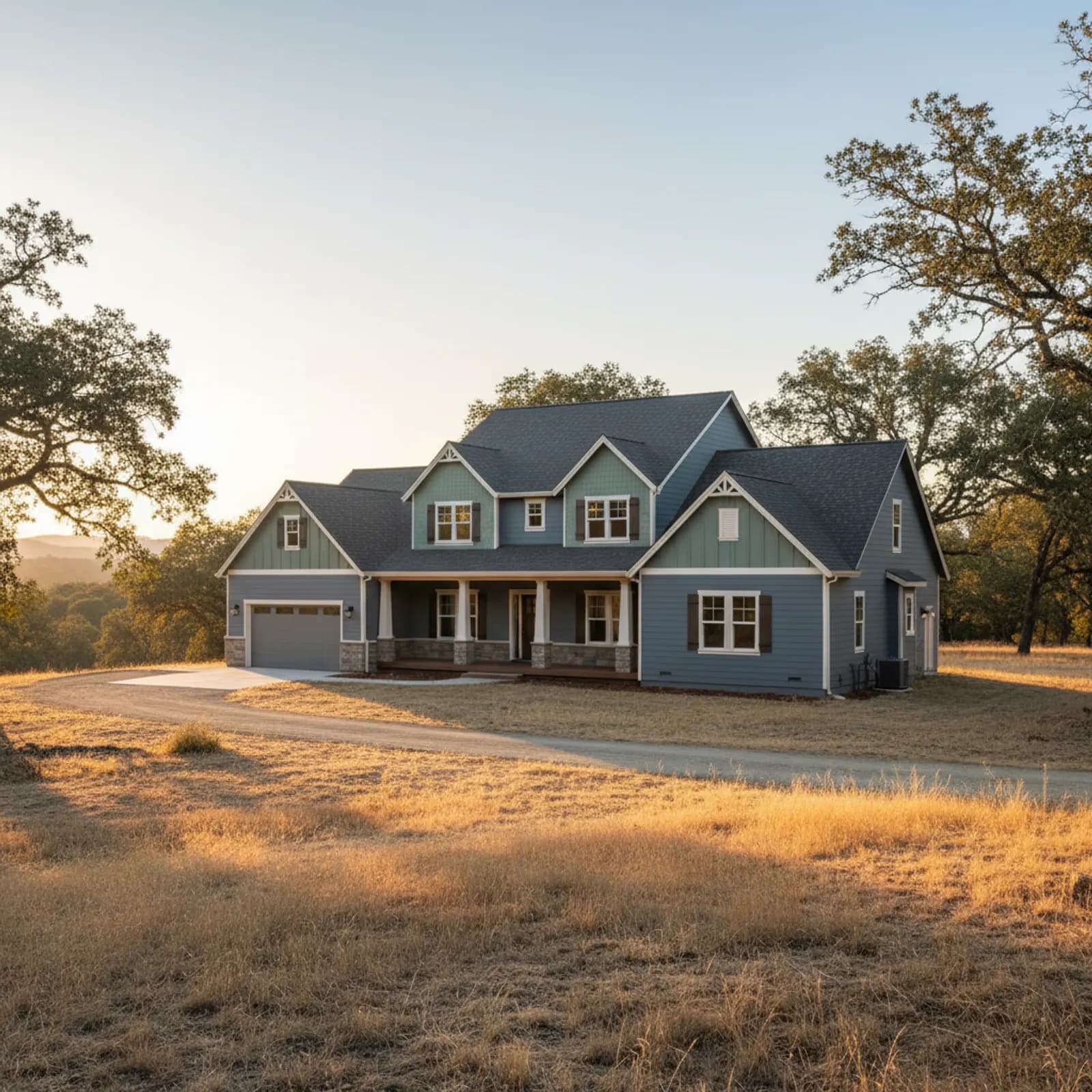
Penn Valley is two communities sharing a zip code: the gated Lake Wildwood community with its HOA and lake-oriented homes, and open ranch and equestrian acreage spread across oak grassland. Both sit in high-fire terrain, but they're genuinely different James Hardie jobs — one is design-review-governed, the other is a whole-property scope.
Inside Lake Wildwood: hardened within the rules
Lake Wildwood homes answer to an HOA and a lake-community aesthetic, so the hardening has to clear design review. We choose Class A profiles and ColorPlus tones that satisfy that architectural context and prepare the submittal — the fire protection and the HOA approval are handled as one process, not sequential surprises.
Out on the ranches: think the whole parcel
Penn Valley's open ranch and equestrian properties carry barns, stables, and outbuildings across oak grassland that carries fire fast. Hardening the house while a combustible barn sits within ignition range is half a solution. We scope the Class A cladding and ground-to-wall and eave detailing across the parcel's relevant structures, not just the residence.
Why fiber cement clears 7A inspection in Penn Valley's WUI
Almost every parcel in Penn Valley sits inside a state-mapped Wildland-Urban Interface, which means new exterior work falls under WUI-code ignition-resistant requirements rather than a standard residential spec. That distinction matters because James Hardie fiber cement is non-combustible and already carries the listings a 7A wall assembly needs, so it answers the code without bolt-on workarounds. We treat the inspection criteria as the starting point: lap or panel rated for the assembly, ignition-resistant trim at every penetration, and detailing at eaves and rake edges where embers actually collect. On an oak-and-pine ranchette west of Grass Valley, the failure mode is rarely a wall of flame; it is a wind-driven ember finding a combustible soffit return or an unprotected gable vent. Specifying Hardie across the field while closing those edge conditions is what turns a code box-check into an exterior that genuinely buys a homeowner time during a foothill fire event.
Radiant heat and the south-facing acreage exposure
Penn Valley summers run hot and the terrain offers little shade once you are off the creek bottoms, so an acreage home's south and west elevations take sustained radiant load on top of the wildfire concern. That heat profile shapes how James Hardie should be ordered and hung here. ColorPlus finish holds its tone against the foothill UV far better than a job-site paint coat that chalks and fades on an unshaded ranch wall within a few seasons. Just as important is the proper ventilated rainscreen and fastening pattern: fiber cement expands and contracts with the daily temperature swing common between an oak-grassland morning and a triple-digit afternoon, and boards installed tight will telegraph that movement at the joints. We set the recommended gaps, back-prime cut ends, and flash the horizontal transitions so the cladding rides the thermal cycle without cupping or fastener pull. The difference shows years out, when a Lake Wildwood neighbor's chalked paint is failing while the ColorPlus next door still reads true. On these exposed Nevada County parcels, getting the heat detailing right is what keeps a hardened wall looking and performing like new.
Why this matters in Penn Valley
- Specified for Sierra Foothills conditions
- Class A non-combustible fiber cement as the recommended system
- Correctly detailed weather-resistive barrier and flashing
- Installed by a crew with 20 years combined experience
Recommended systems for Penn Valley
- Class A non-combustible fiber cement
- fire-aware detailing
- robust flashing
James Hardie Siding for Penn Valley homes
The full james hardie siding approach — materials, weather-resistive detailing, and the manufacturer standards we install to — is covered on the main service page, then specified for Penn Valley's conditions on this one.
Our Penn Valley process
- Step 1
Consultation
We listen to your goals and assess your home on site — exposure, substrate, and architecture.
- Step 2
Design & Proposal
A clear written proposal with the right system specified for your climate and a transparent scope.
- Step 3
Expert Installation
Trained crews install to manufacturer best practices with careful weather-management detailing.
- Step 4
Walkthrough & Support
A final walkthrough, full cleanup, and a clear written record of the scope completed — work we stand behind.
FAQ
James Hardie Siding in Penn Valley — FAQ
No — and that's the key distinction. Lake Wildwood is HOA-design-review-governed; the open ranch acreage is a whole-property, multi-structure scope across oak grassland. We approach the two differently rather than apply one Penn Valley template.
Yes — we select Class A profiles and ColorPlus tones that satisfy the community's architectural context and prepare the design-review submittal, so approval doesn't stall a fire project.
On a Penn Valley acreage parcel they should. Oak grassland carries fire fast and structure-to-structure, so the honest scope considers outbuildings within ignition range of the house, not just the residence.
Keep Exploring
More for Penn Valley homeowners
More in Penn Valley
Other exterior services in Penn Valley
Nearby Service Areas
James Hardie Siding near Penn Valley
Helpful Exterior Guides