Exterior renovation at Lake of the Pines
Lake of the Pines is a private, gated lake-and-golf community in southwestern Nevada County, just off Combie Road near the Placer County line. Its homes ring a man-made recreational lake and a wooded golf course, tucked under a dense canopy of ponderosa pine and oak at roughly 1,500 feet. That mix of mature trees, water-adjacent lots, and a tightly packed gated layout is exactly what makes wildfire the controlling exterior consideration here. For most owners a re-side is a home-hardening project first and an aesthetic upgrade second, and we scope it that way from the gate in.
Why a gated lake community is different
Unlike open foothill acreage, Lake of the Pines packs custom homes close together on wooded lots behind a controlled entrance, which changes both the fire math and the logistics. Homes share a continuous fuel canopy, so an ember that finds one weak eave threatens neighbors as well. Access runs through a gated entry with its own check-in and there are community guidelines to honor. We plan staging, deliveries, and lift placement around that reality, and we detail the exterior as one connected hardened envelope rather than a wall with a vulnerable edge.
Considering an exterior project in Lake of the Pines?
Lake of the Pines housing and architecture
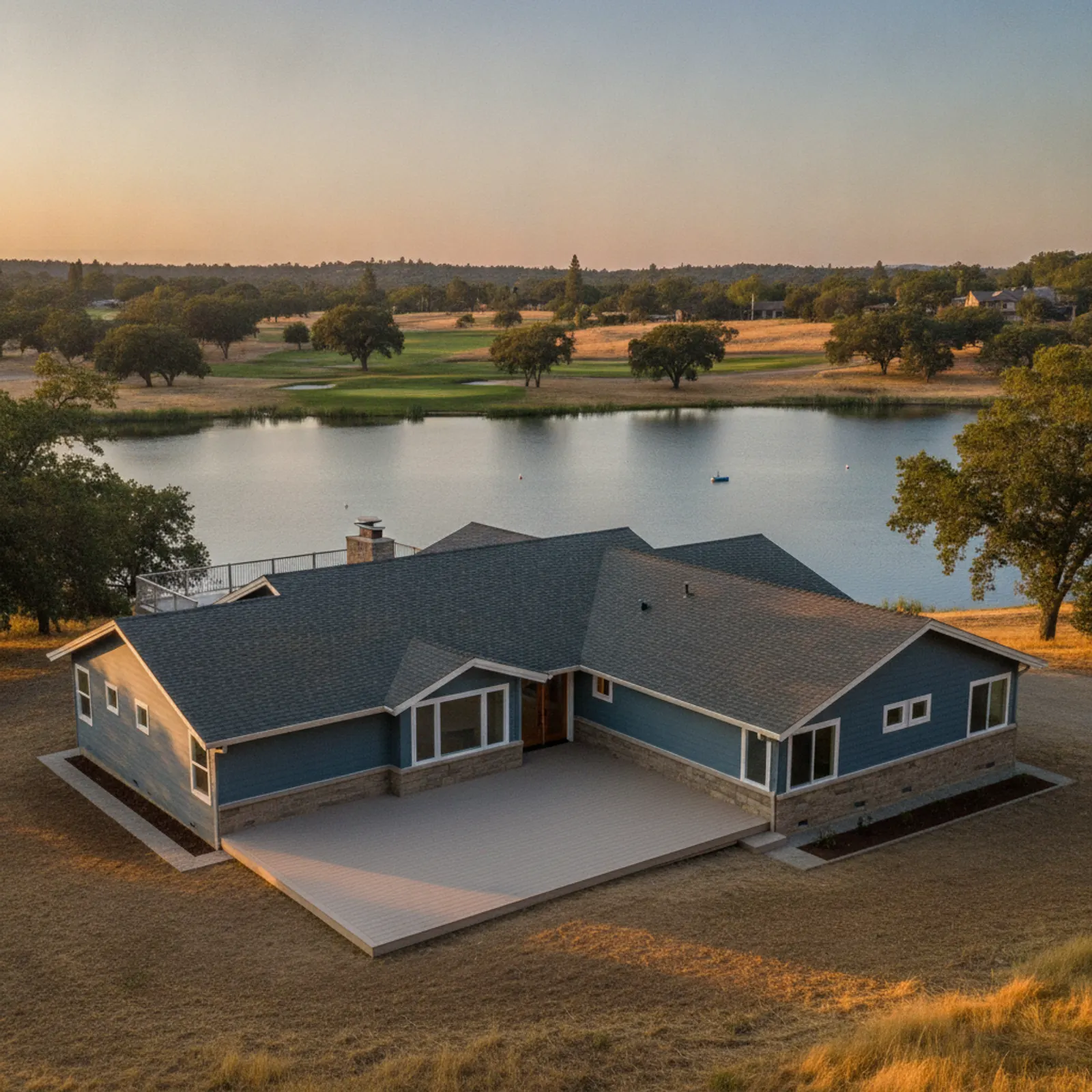
The community was developed largely from the 1970s onward, so its core stock is 1970s-80s lakefront and golf-course homes — many with cedar, board-and-batten, or T1-11 elevations and the deep, open eaves typical of that era. Around and among them sit custom foothill estates, later infill custom homes, and traditional ranch-style houses on the gentler lots. The older combustible elevations and open eaves are the highest-value hardening targets here, and the variety of decks, walk-out lower levels, and lake-facing glass means each home wants its own walk-through rather than a single template applied across the development.
Lake of the Pines' foothill climate
The controlling stressor at Lake of the Pines is the long, pine-fueled dry season. Summers are hot, high-UV, and rain-free for months, curing the surrounding ponderosa and oak into available fuel right up to the foundations and decks. Winters are cool and genuinely wet, with the lake adding humidity and the wooded lots holding moisture against north-facing walls. So while fire sets the agenda, the same project has to shed real water reliably — a sound drainage plane, flashing, and ground clearance matter alongside the cladding choice, especially on shaded lakeside elevations.
Hardening a Lake of the Pines home
These wooded, closely-spaced parcels carry high wildfire exposure, so we specify Class A non-combustible fiber cement and harden the ignition-prone points — open eaves, soffits, vents, and the ground-to-wall and deck-to-wall transitions where embers collect. Because homes share a continuous tree canopy here, hardening one elevation matters to the whole street, and we coordinate cladding with soffit, fascia, and vent detailing so the assembly behaves as one envelope. We document the materials and assemblies installed so the work supports your defensible-space planning and insurability conversations; insurers set their own criteria.
Recommended materials for Lake of the Pines
Non-combustible fiber cement — including James Hardie systems — is the recommendation here given the forested fire exposure and the close lot spacing. We advise against replacing combustible cladding with more wood; there's no durability trade to make, because fiber cement also rides out the foothill heat, the high UV, and the lake-driven winter wet-and-freeze cycles that age cedar and T1-11 quickly. Factory finishes hold color through the long dry summers, and the profiles can echo the community's wooded, lake-cabin character while the assembly underneath is fully hardened.
What an exterior project costs at Lake of the Pines
Projects here carry the standard drivers plus fire-hardening scope, gated-community access and check-in coordination, and the substrate and dry-rot discovery common on 1970s-80s homes once the old cladding comes off. Lake-facing elevations with decks, multi-level walls, and extensive glass add detail labor at flashings and transitions, and shaded lakeside walls sometimes hide moisture damage. We assess all of it on site and provide a written, itemized estimate; in this gated forest setting the hardening scope is core to the value rather than an add-on line, and your written estimate governs.
Lakefront and golf-course lots
Homes directly on the lake or backing the golf course face their own conditions: more glass, more deck, and shaded, humid north and east elevations that hold winter moisture. On these we pay particular attention to deck-to-wall flashing, ground clearance, and drainage behind the cladding, since the same wall has to resist embers in August and stay dry under the canopy in February. The lake-facing finish also matters for resale in this community, so we balance the hardened spec with a profile that keeps the home's recreational character intact.
Gated access and community coordination
Working inside a gated community changes the day-to-day of a job. Entry check-in, on-site parking and staging limits, and any architectural or work-hour guidelines all have to be planned into the schedule before the first delivery. We carry the same hardened non-combustible specification we'd use on open acreage into Lake of the Pines and coordinate access and material handling so the project runs smoothly within the community's setup rather than stalling at the gate.
Resale and insurability context
Lake of the Pines is one of southwestern Nevada County's stronger homeowner markets, and buyers here increasingly weigh wildfire exposure and insurability alongside the lake-and-golf lifestyle. A faithful, non-combustible re-side protects both the look that sells these homes and the hardening story that increasingly shapes foothill transactions. We treat the cladding choice as a market decision as much as a maintenance one, and document the work so it supports the insurance conversation that often follows a sale.
Lake of the Pines is unincorporated: LOPMA, Peardale-Chicago Park Fire, HZ10
Lake of the Pines is not a city. It is a gated residential community — an unincorporated CDP — in Nevada County. Building permits go through Nevada County's Community Development Agency. The Lake of the Pines Mutual Association (LOPMA) is the property owners' association that governs gated access, common areas, and architectural review; approved palettes and material submittals go through LOPMA before permits issue. Electric and gas are PG&E, with high-PSPS exposure. Water is supplied by the Nevada Irrigation District (NID). Fire response is Peardale-Chicago Park Fire alongside CAL FIRE. Lake of the Pines is in James Hardie's HZ10 zone; installing HZ5 is a documented warranty misapplication. Essentially all of LOP sits in Moderate to Very High FHSZ under California's 2025 LRA Fire Hazard Severity Zone map, and the 2025 California Wildland-Urban Interface Code governs the exterior wall on nearly every re-side. Chapter 7A moved into the standalone WUI Code on January 1, 2026.
Our process in Lake of the Pines
- Step 1
Consultation
We listen to your goals and assess your home on site — exposure, substrate, and architecture.
- Step 2
Design & Proposal
A clear written proposal with the right system specified for your climate and a transparent scope.
- Step 3
Expert Installation
Trained crews install to manufacturer best practices with careful weather-management detailing.
- Step 4
Walkthrough & Support
A final walkthrough, full cleanup, and a clear written record of the scope completed — work we stand behind.
At Lake of the Pines the goal is an exterior that's genuinely hardened against a pine-canopy fire season and still true to a relaxed gated lake-and-golf community. We design for both, coordinate the gated access cleanly, and scope every Lake of the Pines project on site so the plan fits your specific lot, stock, and exposure.
FAQ
Lake of the Pines — Common Questions
High. The community sits under a continuous ponderosa-and-oak canopy with homes spaced closely on wooded lots, which is why non-combustible cladding with hardened detailing is the baseline for our work here.
Yes — we coordinate entry check-in, staging, and any community guidelines into the schedule, and carry the same hardened non-combustible specification we'd use on open acreage.
Re-cladding combustible cedar or T1-11 in non-combustible fiber cement is one of the highest-value hardening steps available for a home under this tree canopy.
Those shaded, deck-heavy walls hold winter moisture, so we pay extra attention to deck-to-wall flashing and drainage behind the cladding alongside the fire hardening.
Snow is uncommon and usually light at this elevation, but winters are genuinely wet, so we include sound drainage-plane and flashing detailing alongside the fire strategy.
We advise against it given the forested fire exposure and close lot spacing; fiber cement carries no durability penalty and adds real protection for you and your neighbors.
It can support insurability in this terrain. We document the materials and assemblies installed so the work complements defensible-space planning; insurers set their own criteria.
A correctly installed, well-drained fiber cement system commonly performs 30+ years here while materially reducing ignition risk under the canopy.
Explore
Exterior Services
Helpful Exterior Guides