Fiber Cement Siding in Lake of the Pines
Fiber cement is the default cladding recommendation inside Lake of the Pines, and the reason is the canopy rather than the individual house. Homes here sit close together on wooded lots under one continuous ponderosa-and-oak cover behind the gate off Combie Road, which means the exterior decision each owner makes is partly a decision about the street. A combustible wall in the middle of a tight, shared-canopy community is a risk that does not stay on its own lot.
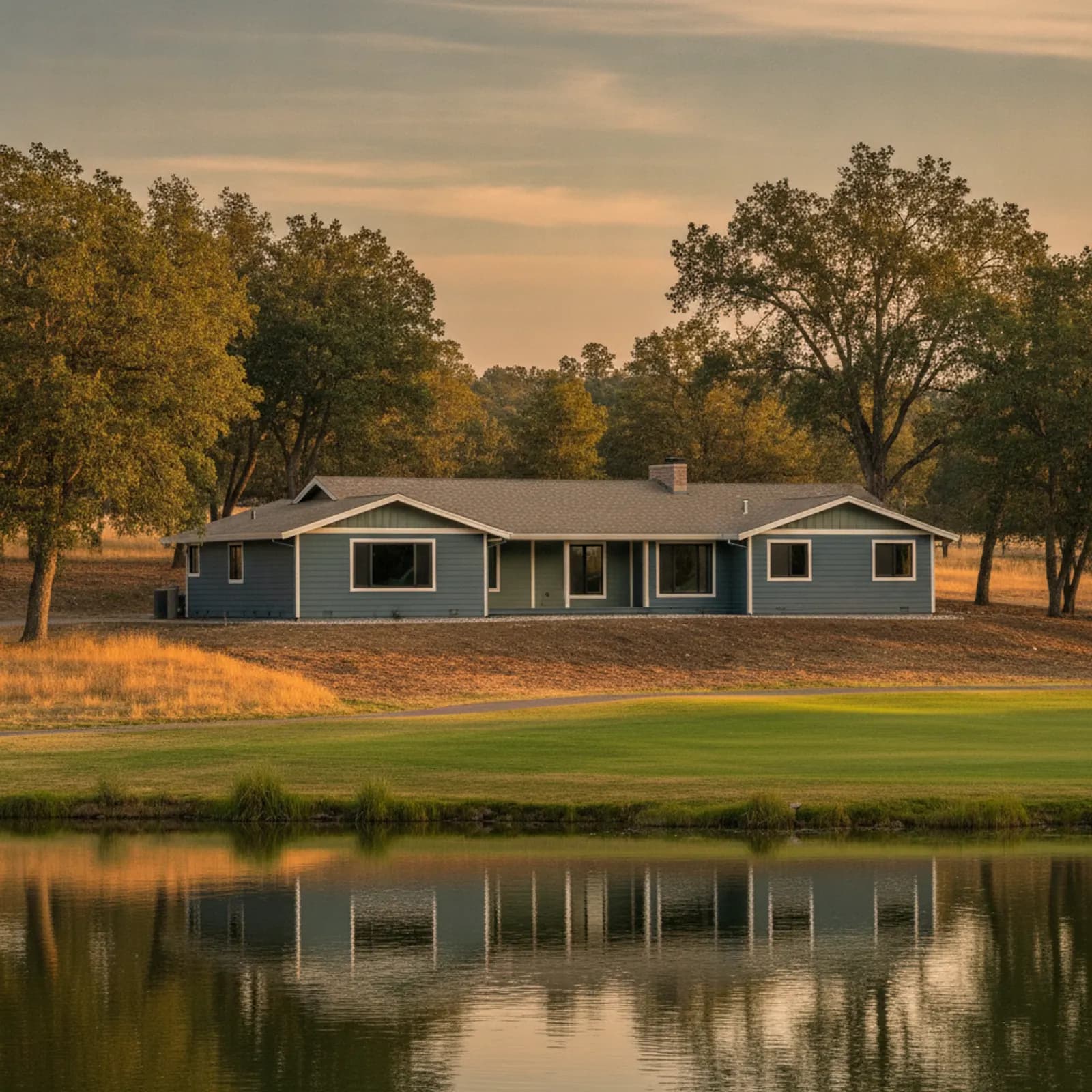
The community's 1970s and 80s lakefront and golf-course homes were built in the era of cedar, board-and-batten, and T1-11, so most re-side projects here are a straight swap from a combustible elevation to a non-combustible one — with the added benefit that the maintenance cycle those wood walls demand goes away at the same time.
Why the material category, not just the brand, matters here
Fiber cement as a category is non-combustible and carries a Class A flame-spread rating under ASTM E84, which is the property that matters most on a lot surrounded by mature pine. Within that category the practical differences between manufacturers come down to finish systems, trim ecosystems, warranty terms, and profile selection rather than to fire behaviour — a well-detailed generic fiber cement board and a premium branded one both stop being fuel. That is worth knowing before you shop, because it means the fire case for re-siding is settled once you choose fiber cement, and the remaining decisions are about finish life, appearance, and budget rather than about safety.
Lakefront elevations and the water side of the job
The lots that back to the water carry a second problem the golf-course and interior lots do not. Deck ledgers, multi-level walkouts, and the walkway transitions common on lakefront homes are all places where cladding meets another assembly, and every one of those junctions is a potential water entry point. On these elevations we hold the manufacturer's clearance to grade and to deck and walkway surfaces so the bottom course stays out of standing moisture, flash the ledger and walkout transitions deliberately, and detail penetrations so the wall sheds rather than collects. Fiber cement tolerates the damp lake-adjacent winters well, but only if the details below and around it are built to keep water moving.
Working through architectural review
The Lake of the Pines Association runs architectural review, and a fiber cement submittal goes more smoothly when the package reflects what will actually be installed. That means a specific profile, a specific finish and color with a physical sample, and product data the committee can put in a file — not a general description of the material. We assemble that package before the job starts and hold the approved profile and color through installation rather than substituting after approval. Where a homeowner wants to change something mid-project, the honest answer is that it goes back through review, and planning for that up front is cheaper than discovering it later.
One community, one replacement window
Because Lake of the Pines was largely built out across a compressed span of years with wood-forward elevations, a great deal of its original cladding is reaching end of life at roughly the same time. Practically, that means an owner here is rarely the only one on the street thinking about it, and there is real value in the hardening being contiguous — the fire benefit of a non-combustible wall is meaningfully larger when the neighbours have made the same choice, because structure-to-structure ignition is a genuine mechanism in a community this densely built. We will say plainly what siding does and does not do: it removes the wall as a fuel source and improves the home's odds, as one layer of a whole-property defensible-space strategy. It does not make a house fireproof, and no cladding does.
Why this matters in Lake of the Pines
- Specified for Sierra Foothills conditions
- Class A non-combustible fiber cement as the recommended system
- Correctly detailed weather-resistive barrier and flashing
- Installed by a crew with 20 years combined experience
Recommended systems for Lake of the Pines
- Class A non-combustible fiber cement
- James Hardie
- fire-aware detailing
Fiber Cement Siding for Lake of the Pines homes
The full fiber cement siding approach — materials, weather-resistive detailing, and the manufacturer standards we install to — is covered on the main service page, then specified for Lake of the Pines's conditions on this one.
Our Lake of the Pines process
- Step 1
Consultation
We listen to your goals and assess your home on site — exposure, substrate, and architecture.
- Step 2
Design & Proposal
A clear written proposal with the right system specified for your climate and a transparent scope.
- Step 3
Expert Installation
Trained crews install to manufacturer best practices with careful weather-management detailing.
- Step 4
Walkthrough & Support
A final walkthrough, full cleanup, and a clear written record of the scope completed — work we stand behind.
FAQ
Fiber Cement Siding in Lake of the Pines — FAQ
Not materially. Fiber cement as a category is non-combustible with a Class A flame-spread rating, so the fire case is settled once you choose the material. The differences between manufacturers show up in finish systems, warranty terms, trim ecosystems, and color selection — real considerations, but not safety ones.
Water management. Lakefront homes carry deck ledgers, multi-level walkouts, and walkway transitions where cladding meets another assembly, and those junctions are where water gets in. We hold clearances to grade and deck surfaces and flash those transitions deliberately. Interior and golf-course lots are a more straightforward wall.
It is a real step to plan around rather than an obstacle. Submitting a specific profile, finish, and color with a physical sample and product data gives the committee something documented to approve, and we hold that specification through the job. Changing the color or profile after approval means going back through review, so it is worth settling early.
It still removes your wall as a fuel source and ends your repaint cycle, so yes. But we will be straightforward: in a community built this densely under one canopy, structure-to-structure ignition is a real mechanism, and the fire benefit compounds when the hardening is contiguous. Siding is one layer of a whole-property strategy, never a guarantee on its own.
Keep Exploring
More for Lake of the Pines homeowners
More in Lake of the Pines
Other exterior services in Lake of the Pines
Nearby Service Areas
Fiber Cement Siding near Lake of the Pines
Back to
Nevada County & Lake of the Pines
Helpful Exterior Guides