Exterior renovation and rebuilds in Berry Creek
Berry Creek is a remote, heavily forested community in the Butte County foothills northeast of Oroville, scattered across timbered ridges and canyons above Lake Oroville. In September 2020 the North Complex fire — the Bear Fire run — moved through this area with devastating force, taking many homes and lives. The community has been rebuilding in the years since, on rural acreage among regrowing pine and oak. For the people rebuilding here, and for those hardening homes that survived, the exterior isn't a finish choice — it's part of whether a home stands through the next fire. We treat every Berry Creek project with that weight.
Rebuilding a forest community honestly
Berry Creek's situation deserves plain, respectful talk rather than sales language. This is a small, dispersed mountain community that lost a great deal, and the people rebuilding here already understand the stakes better than anyone. Our role is not to make the case for fire hardening — that case was made the hard way — but to deliver non-combustible, correctly detailed assemblies to current standards, and to be honest about what cladding does and doesn't do. Siding is one layer of a whole-property strategy, and we won't overstate it on a ridge that has already seen the worst.
Considering an exterior project in Berry Creek?
Berry Creek housing and architecture
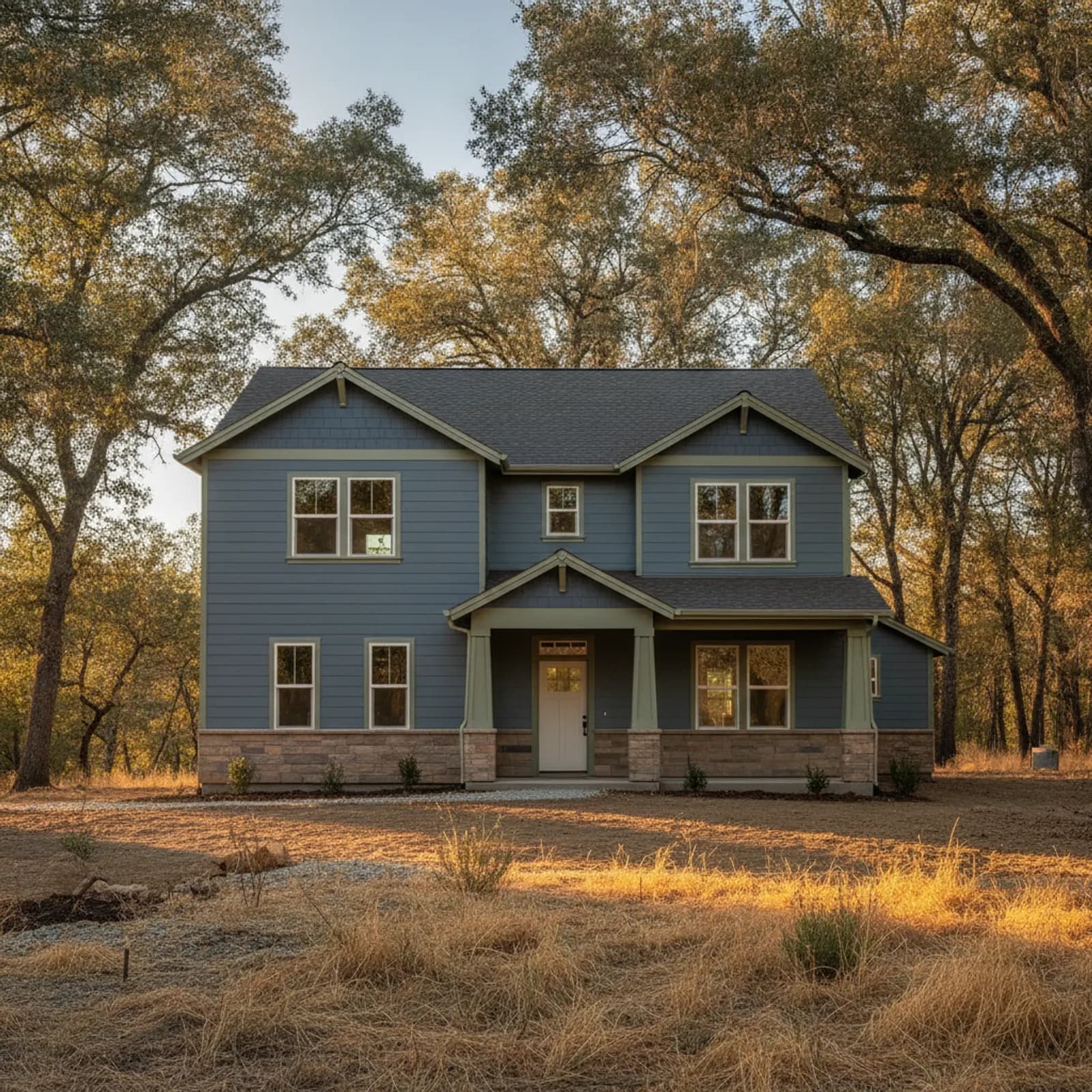
Berry Creek's housing today is a mix of post-2020 rebuilds going up to current wildfire standards, the older forest homes and cabins that survived the North Complex fire, and rural acreage properties on private drives among the trees. Many rebuilds are non-combustible from the framing out by design. The surviving older homes — often clad in wood, board-and-batten, or T1-11 from an earlier era — are exactly where re-cladding delivers the largest hardening gain available to an existing structure. Off-grid and well-water properties are common out here, which shapes how a project is scheduled and staged as much as how it's clad.
Berry Creek's forest-ridge climate
The controlling stressor in Berry Creek is wildfire in its most severe foothill form. Summers are hot and dry with heavy timber and brush fuel across steep, remote terrain, and the canyon-and-ridge geography channels wind in the way that drove the 2020 fire's catastrophic run. Winters bring cool, wet weather and occasional light snow at the higher elevations, so drainage and flashing detailing stay on the list. But everything defers to the fire agenda here: the exterior is specified first and foremost for ember-and-wind behavior on a forested ridge.
Aggressive wildfire hardening in Berry Creek
Berry Creek warrants the most rigorous hardening practice we have. We specify Class A non-combustible fiber cement and detail uncompromisingly at eaves, soffits, vents, decks, and ground-to-wall transitions, recognizing the ridge's extreme ember-and-wind exposure in heavy timber. We build to current California WUI rebuilding standards and document every assembly so the work supports defensible-space, code, and insurability requirements. We are also honest about limits: cladding is one layer of a whole-home and whole-property fire strategy that also depends on vents, decks, defensible space, and the surrounding forest. We won't claim siding alone makes a home fireproof.
Recommended materials for Berry Creek
Non-combustible fiber cement, hardened and detailed to current WUI standards, is the only cladding we recommend in Berry Creek. We won't install combustible cladding on this terrain — the exposure is too severe and too recently proven. Fiber cement also handles the UV, heat, and wet-winter cycling that a forest ridge throws at an exterior, so the safest material is also the most durable here. High-UV finishes, corrosion-aware fasteners, and sound drainage detailing round out a system built to last through long dry seasons and wet winters alike on remote acreage.
What an exterior project costs in Berry Creek
Cost in Berry Creek is driven by comprehensive fire-hardening scope, current-code detailing, and the remote terrain — long, rough, or unpaved drives for material delivery and debris removal, and regrowing vegetation that crowds the work zone. On a rebuild, the hardening is simply how the home is built; on a surviving older home it's a deliberate retrofit with its own substrate and dry-rot discovery. The dispersed, off-grid nature of many parcels adds logistics that a town project doesn't carry. We assess on site and provide a written, itemized estimate; the hardening scope is the point here, not an upsell.
Rebuilds versus surviving homes
These are two different jobs in Berry Creek. A new rebuild is typically non-combustible from the framing out, with cladding coordinated into a current-code shell from the start. A surviving older forest home is a retrofit: re-cladding combustible wood, board-and-batten, or T1-11 in hardened fiber cement is the single highest-value survival upgrade available to it, though it comes with substrate and dry-rot discovery the rebuild doesn't have. On a ridge that lost so much in 2020, hardening a home that came through is some of the most meaningful work we do, and we scope each path for exactly what it is.
Remote access and staging
Berry Creek's geography defines every project. Parcels are dispersed across timbered ridges and canyons on long, often unpaved private drives, and many are off-grid or on well water, which affects everything from delivery to daily logistics. Regrowing vegetation and steep terrain crowd the work zone and complicate scaffold and lift placement. We plan staging, access, and clearances carefully during the site visit so the schedule reflects the real approach to a remote forest parcel rather than an optimistic guess made from a map.
Documentation, code, and insurability
Insurability is a hard, practical reality for Berry Creek homeowners after 2020, and a documented, current-WUI non-combustible assembly is the strongest position a homeowner can bring to that conversation. We document the materials and assemblies we install so the exterior supports defensible-space, code, and insurability discussions on the ridge. Insurers set their own criteria and we won't speak for them or promise an outcome we don't control — but the underlying hardening is concrete, verifiable, and recorded, which is what we can honestly deliver.
Butte County, private wells, and CAL FIRE Butte Unit
Working exteriors in Berry Creek coordinates with a few local authorities. Berry Creek is unincorporated Butte County — there is no city government, so building permits come through the Butte County Development Services Department rather than a municipal department. Electric and gas are PG&E, and the entire eastern Butte County ridge is at the epicenter of PG&E's PSPS-shutoff footprint given the 2018 Camp Fire and 2020 Bear Fire histories. Water is drawn from private wells on the vast majority of parcels — the community has no unified public water system — and small mutual and community systems serve pockets. Fire response is CAL FIRE Butte Unit alongside Butte County Fire and adjoining volunteer companies on structure calls, with the Butte County Sheriff coordinating evacuation (the 2020 evacuation stress-tested this coordination in the most consequential way).
HZ10 and the North-Complex-scar FHSZ reality
Berry Creek is in James Hardie's HZ10 climate zone — the ridge sits below the HZ5 threshold; installing HZ5 is a documented warranty misapplication. On the fire side, essentially every parcel in Berry Creek sits in Very High FHSZ territory under California's 2025 LRA Fire Hazard Severity Zone map, with most surrounding land in State Responsibility Area / Plumas National Forest. The 2020 Bear Fire (North Complex, 318,935 acres, 16 fatalities) devastated Berry Creek, destroying hundreds of homes; the 2018 Camp Fire on the neighboring Paradise ridge is a plain reminder of the corridor's exposure. On every parcel here the 2025 California Wildland-Urban Interface Code governs the exterior wall. Chapter 7A moved into the standalone WUI Code on January 1, 2026.
Our process in Berry Creek
- Step 1
Consultation
We listen to your goals and assess your home on site — exposure, substrate, and architecture.
- Step 2
Design & Proposal
A clear written proposal with the right system specified for your climate and a transparent scope.
- Step 3
Expert Installation
Trained crews install to manufacturer best practices with careful weather-management detailing.
- Step 4
Walkthrough & Support
A final walkthrough, full cleanup, and a clear written record of the scope completed — work we stand behind.
Berry Creek is rebuilding a forest community after a tragedy, and the exteriors here have to honor that — genuinely hardened, detailed to current WUI practice, documented, and never oversold. We scope every Berry Creek project on site, we're honest about what cladding can and can't do, and your written estimate governs the work.
FAQ
Berry Creek — Common Questions
It is extreme and the defining factor. Berry Creek was devastated by the 2020 North Complex (Bear Fire) and sits in heavy timber on steep, wind-prone ridges. We apply our most rigorous hardening practice and current WUI standards on every project here.
Yes — we install non-combustible, hardened exterior assemblies to current California WUI rebuilding standards and document the materials used for code and insurability.
Re-cladding combustible wood, board-and-batten, or T1-11 in hardened non-combustible fiber cement is the single highest-value survival upgrade available for a surviving forest home.
Class A non-combustible fiber cement, uncompromisingly detailed at eaves, soffits, vents, decks, and ground transitions to current WUI standards for heavy-timber exposure.
No — we will not install combustible cladding here. The exposure is too severe and too recently proven; non-combustible, hardened assemblies are the only responsible choice.
No, and we won't claim it does. Hardened siding is one layer of a whole-home and whole-property strategy that also depends on vents, decks, defensible space, and the surrounding forest.
Yes — many parcels are dispersed, off-grid, and on long unpaved drives; we plan delivery, staging, and access during the site visit so the schedule reflects the real approach.
We build to current WUI standards and document every assembly so the work supports defensible-space, code, and insurability discussions; insurers set their own criteria and we don't speak for them.
Explore
Exterior Services
Helpful Exterior Guides