
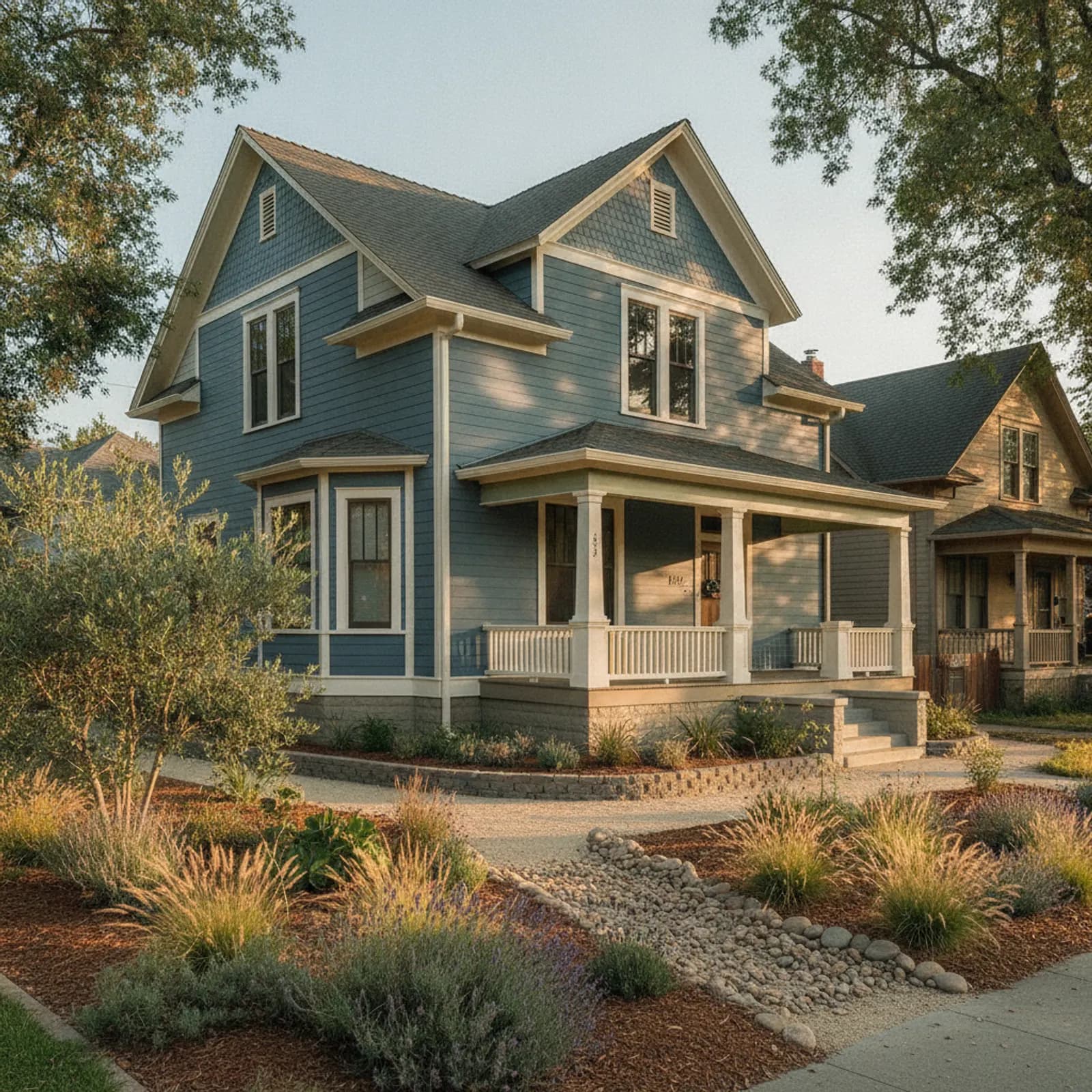
Exterior renovation in Gridley
Gridley is an established valley farm town in southern Butte County, long known as a center of the region's rice and stone-fruit country and home to the annual Butte County Fair. It is one of the older incorporated communities in the area, and that age shows in its housing: a walkable older downtown grid lined with early-twentieth-century homes, valley bungalows and farmhouses, mid-century ranch neighborhoods, and a band of newer tract homes on the south and west edges. That long history means a large share of Gridley's homes carry siding that was installed generations ago and has spent decades under hard valley sun, making the town a steady, deep-rooted re-side market.
Why it matters here specifically
Gridley's defining re-side challenge is age stacked on top of heat. The controlling stressor is long, intense southern-valley sun, but the bigger surprise is usually what decades under that sun have already done behind the boards. On the older downtown grid, original sheathing, prior patch repairs, and dry rot at sills and corners turn up far more often than on newer towns, so we treat substrate condition as part of the scope from the start and keep that contingency visible rather than buried in the bid. We specify factory-finished fiber cement to push the cosmetic-refresh interval well past what field paint survives here, and we match period-correct profiles to the early-twentieth-century homes so the durability upgrade never costs the street its character.
Considering an exterior project in Gridley?
Gridley housing and architecture
Gridley's older core holds early-twentieth-century homes, valley bungalows, and farmhouses with simple, period-honest detailing, while the surrounding neighborhoods add mid-century ranch homes and newer south- and west-edge tracts. The downtown-grid homes reward period-correct lap exposure, proportioned window casings, and corner boards that keep their established character intact. The ranch and tract homes respond well to a modern lap-and-batten re-side and a refreshed palette that lifts long, plain elevations. Because Gridley's housing skews older than newer towns, we treat character preservation and substrate condition as central to the scope rather than an afterthought, designing each re-side to fit the home's era instead of a single template.
Built for Gridley's southern-valley heat
Gridley sits on the flat southern Butte valley floor, and its controlling exterior factor is intense, sustained summer heat and UV. Summers run long and hot, and the older downtown homes often have only partial mature-tree shade, so south- and west-facing walls absorb heavy afternoon sun day after day. The daily heat swing expands and contracts cladding hard, and field paint on these aging homes chalks and peels well before its time. We specify fiber cement with factory fade-resistant finishes, gapping and fastening tuned to that heat movement, and finish colors chosen so a sun-struck west wall is managing the load rather than baking the trim behind it. Moisture is a secondary, detailing-managed concern relative to the sun.
Recommended materials for Gridley
James Hardie fiber cement with a factory finish is the core recommendation for Gridley. The factory finish matters most on the town's older homes, where it pushes the cosmetic-refresh interval well past what field paint survives under southern-valley UV, and the material's profiles suit both downtown character homes and the newer tracts. Fiber cement is non-combustible and dimensionally stable through Gridley's big daily heat swings. Period-sensitive profiles keep the early-twentieth-century downtown homes reading correctly, while a cleaner modern lap works for the ranch and tract stock. Because Gridley is a low-fire valley town, the choice is driven by sun durability and character rather than fire hardening.
What an exterior project costs in Gridley
Gridley pricing turns on home size and stories, profile and trim complexity, which runs higher on the detailed older downtown homes, and especially on substrate and dry-rot condition once old cladding comes off. Because so much of Gridley's stock is genuinely old, demolition more frequently uncovers original sheathing, prior patch repairs, and dry-rot at sills and corners, so we keep that contingency visible rather than buried in the bid. Window integration and the weather-management scope also factor in. We provide a written, scoped estimate after an on-site assessment so Gridley bids can be compared on substance instead of headline numbers that ignore an old home's real condition.
The older downtown grid
Gridley's walkable downtown grid holds the town's most character-sensitive re-side work: early-twentieth-century homes and bungalows on established, sometimes tree-lined streets. The right approach on these blocks is restraint — match the original exposure and trim proportions, keep the character lines intact, and let the durability gain happen quietly underneath the period-correct look. Lots in the older core can be tighter than the surrounding acreage, so we plan staging to protect mature landscaping and respect close neighbors. A re-side here should read as if it has always belonged on the street while quietly modernizing how the home performs.
Farmhouses and newer-edge tracts
Beyond the core, Gridley spreads into farmhouses on the surrounding rice and orchard ground and into newer tract neighborhoods on the south and west edges. The farmhouses sit exposed on open parcels and take full sun like their Durham-area neighbors, making factory-finished fiber cement an easy call. The newer tracts carry uniform builder cladding aging on the same schedule across whole streets, which is where a fresh-palette re-side does the most to lift both the individual home and its block. We scope each for the durability and curb-appeal payoff that fits its setting.
City of Gridley, city utilities, and Gridley Fire
Working exteriors in Gridley coordinates with a few local authorities. Building permits come through the City of Gridley Community Development Department (Gridley is one of Butte County's five incorporated cities). Electric and gas are PG&E. Water and wastewater are supplied by the City of Gridley municipal utilities. Fire response is the Gridley Fire Department (city) alongside the Butte County Fire Department and CAL FIRE Butte Unit on wildland calls into the rice ground and the eastern foothill margins. The older downtown grid along Hazel Street sits within a locally recognized historic corridor that shapes design considerations on visible exterior work.
HZ10 and the rice-ground valley FHSZ reality
Gridley is in James Hardie's HZ10 climate zone; installing HZ5 is a documented warranty misapplication. On the fire side, essentially every parcel in and around Gridley sits in Low or unmapped FHSZ territory under California's 2025 LRA Fire Hazard Severity Zone map — this is flat, irrigated rice ground, and wildland fire is not the local threat. Chapter 7A moved into the standalone WUI Code on January 1, 2026, but does not typically drive Gridley's spec. The 2018 Camp Fire on the Paradise ridge to the east reset Butte County's regional insurance conversation without touching Gridley's mapped-fire posture.
Our process in Gridley
- Step 1
Consultation
We listen to your goals and assess your home on site — exposure, substrate, and architecture.
- Step 2
Design & Proposal
A clear written proposal with the right system specified for your climate and a transparent scope.
- Step 3
Expert Installation
Trained crews install to manufacturer best practices with careful weather-management detailing.
- Step 4
Walkthrough & Support
A final walkthrough, full cleanup, and a clear written record of the scope completed — work we stand behind.
Gridley rewards an exterior approach that respects both its hard southern-valley sun and the age of its older homes, from the downtown grid to the newest edge tracts. We scope every Gridley project on site so the spec fits the home and its real condition, and your written estimate governs the work.
FAQ
Gridley — Common Questions
Fiber cement with a factory fade-resistant finish. Gridley's long, hot southern-valley summers punish field paint, and factory-finished fiber cement holds color and integrity far longer on these sun-exposed homes.
Yes. We choose period-appropriate profiles, trim, and exposures so an early-twentieth-century home modernizes its durability without losing the character that fits Gridley's older streets.
Much of Gridley's stock is genuinely old, and original builder-grade or field-painted cladding was never meant for decades of southern-valley UV. Chalking, peeling, and fading on sun-facing walls is the typical end-of-life pattern.
Gridley sits on the low-exposure southern valley floor, so wildfire risk is low compared with the foothill communities to the east. Fiber cement is non-combustible regardless, which is a quiet benefit here.
It can. Demolition on older homes often reveals original sheathing, prior patch repairs, or dry-rot at sills and corners, so we keep a visible contingency for substrate condition in the estimate.
Yes — the older downtown grid, valley bungalows and farmhouses on surrounding ag land, mid-century neighborhoods, and the newer south- and west-edge tracts.
When feasible, yes. Doing both at once ensures correct flashing integration, avoids duplicated trim work, and produces a better-sealed, better-looking exterior on an older home in one project.
A correctly installed fiber cement system commonly performs 30+ years in Gridley's climate, with factory finishes extending how long the exterior looks new under heavy valley sun.
Helpful Exterior Guides