
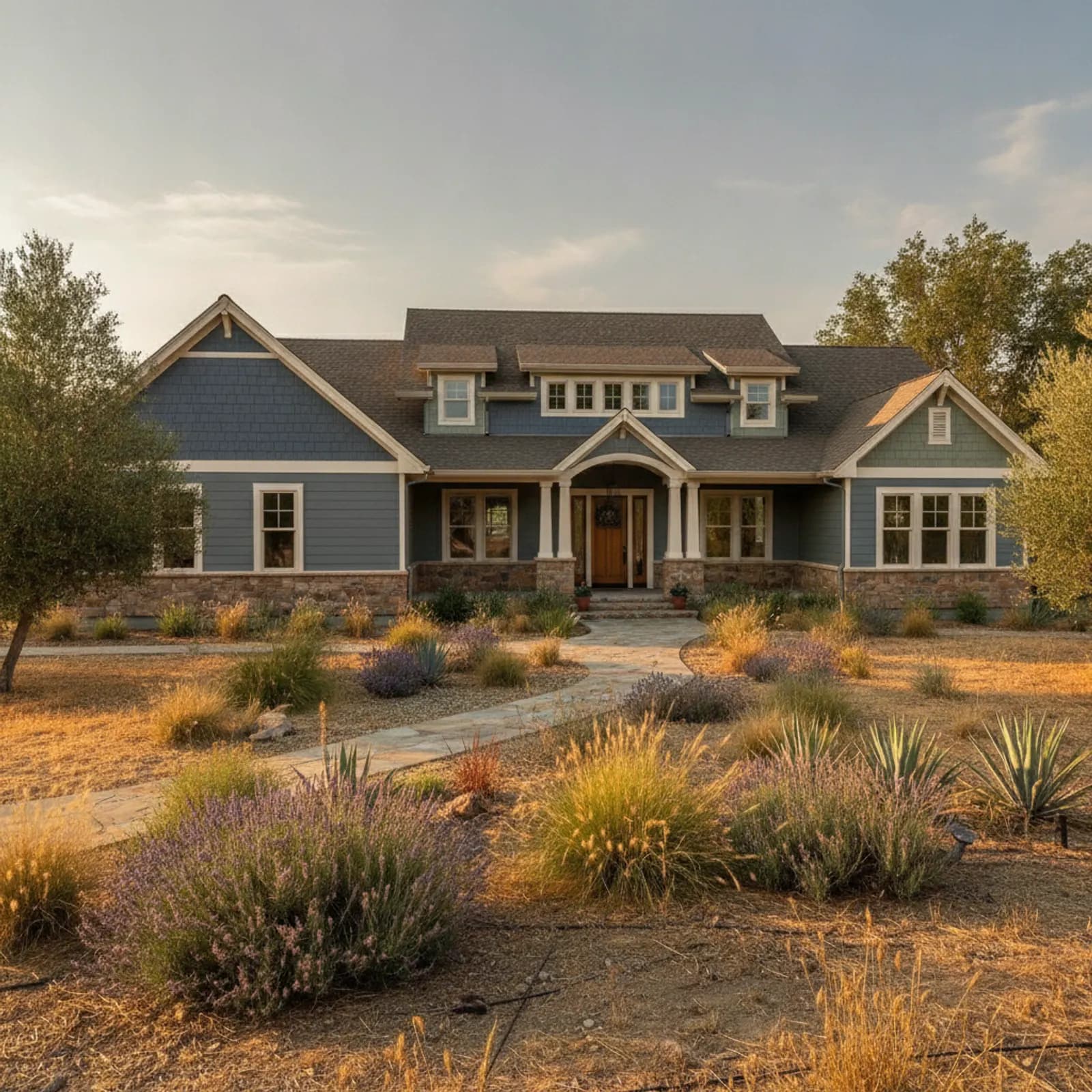
Exterior renovation in Palermo
Palermo is an unincorporated community south of Oroville in Butte County, spread across rural lots, small ranchettes, and acreage parcels where the open valley floor begins to rise toward the foothills. Its housing is largely rural and informal: older country homes, mid-century ranches, manufactured homes on land, and a scattering of newer custom homes on the higher foothill-edge parcels. There's little tract development here, so most Palermo re-sides involve homes that have weathered decades of hard valley sun on exposed rural lots. The community's low-density, semi-rural character shapes both the work and how we stage it.
Why Palermo sits on a climate seam
What makes Palermo distinct from the flat towns north and west of it is its position on the transition between valley and foothill. Most of the community lives under the same hot, high-UV valley regime that governs Oroville and Gridley, but the eastern, higher edges brush up against grass-and-oak rangeland that carries a real, if moderate, grass-fire consideration in dry years. So Palermo is a town that's mostly a heat problem with a fire footnote that grows as you move toward the rangeland — and an honest spec reads that gradient parcel by parcel.
Considering an exterior project in Palermo?
Palermo housing and architecture
Palermo's stock is rural and varied: older country and farmhouse homes, mid-century ranches on larger lots, manufactured homes on private land, and newer custom or acreage homes on the foothill-edge rises. The older rural homes and ranches modernize well with a durable factory-finished lap re-side that erases years of sun-faded field paint. Manufactured and acreage homes take a straightforward, value-minded cladding package. The higher custom homes near the rangeland warrant a more deliberate, fire-aware specification matched to their grass-and-oak setting. We scope each parcel for what it is rather than running one profile across such a spread-out community.
Palermo's valley-to-foothill climate
Heat and UV govern Palermo for most of the community. Summers run long, hot, and dry across the open lower lots, and that sun load is what chalks and fades coatings on south and west walls. As parcels climb toward the eastern foothill edge, the dry grass-and-oak rangeland adds a real fire season on top of the heat. So the base spec everywhere is fade-resistant, heat-durable cladding, with the higher rangeland-adjacent parcels layering grass-fire detailing onto that same heat-hardened foundation. Moisture is a secondary, easily-detailed concern next to the dominant sun and the seasonal fire load.
Foothill-edge fire detailing in Palermo
Most of Palermo carries low wildland exposure, but the eastern and higher parcels along the grass-and-oak rangeland carry a moderate, grass-driven fire consideration — meaningful in a county shaped by severe fire history, even where the dominant fuel is range grass rather than heavy timber. For those parcels we specify non-combustible cladding and harden the vulnerable details where embers and grass fire gather: eaves, vents, and ground-to-wall transitions. Lower valley-floor homes still get non-combustible fiber cement at no material change, so the safer cladding comes standard while the added hardening is reserved for parcels that genuinely sit against the range.
Recommended materials for Palermo
James Hardie fiber cement with a fade-resistant factory finish is the core recommendation across Palermo. It handles the valley heat and high UV that govern most of the community, and because it's non-combustible it also covers the foothill-edge grass-fire consideration without switching products. That lets the whole area share one cladding family: lower lots for heat durability, rangeland-adjacent homes for the same durability plus added eave, vent, and transition hardening. We reserve heavier wildland detailing for the parcels that truly face the grass-and-oak range rather than applying it uniformly.
What an exterior project costs in Palermo
Palermo pricing follows the standard drivers — size and stories, trim and corner complexity, and the condition of the substrate and any dry-rot found behind failing cladding once it's removed. Foothill-edge parcels add modest fire-detailing scope, and the community's rural lots and longer, sometimes unpaved drives can add access and staging cost where delivery and crew movement are harder. Manufactured-home re-sides have their own scope considerations. We assess on site and provide a written, itemized estimate so bids can be compared on substance rather than headline numbers.
Rural lots and ranchettes
Much of Palermo is acreage, ranchettes, and informal rural lots where homes sit far apart on private drives. That low density changes the job: material delivery and debris removal can mean longer hauls, and crew access has to be planned around gates, unpaved drives, and the space the work actually needs. These homes are also fully sun-exposed with no urban canopy, so their original cladding is often the most weathered in the area and the strongest candidate for a full re-side. We scope the access realities up front because they genuinely affect schedule and bid.
The grass-and-oak foothill edge
Palermo's eastern and higher parcels brush against the dry grass-and-oak rangeland that climbs toward the foothills, and that's where the fire consideration becomes real. Grass fire moves fast and throws embers, so even though the fuel is lighter than the timbered ridges to the east, hardened cladding and detailed eaves and vents matter on these lots. We treat the rangeland margin as its own zone and specify accordingly, rather than assuming the whole community shares the lower valley floor's low exposure.
Butte County, South Feather Water and Power, and Palermo Fire
Working exteriors in Palermo coordinates with a few local authorities. Palermo is unincorporated Butte County — there is no city government, so building permits come through the Butte County Development Services Department rather than a municipal department. Electric and gas are PG&E, and the whole Oroville-Palermo corridor is documented high-PSPS territory. Water is supplied by South Feather Water and Power Agency and by California Water Service (Cal Water) Oroville District in adjacent areas, with private wells common on rural acreage. Fire response is the Palermo-Honcut Fire Protection District (local district) alongside CAL FIRE Butte Unit on wildland calls, with the Butte County Sheriff coordinating events.
HZ10 and the rangeland-edge FHSZ reality
Palermo is in James Hardie's HZ10 climate zone; installing HZ5 is a documented warranty misapplication. On the fire side, the flat western Palermo grid sits in Low or Moderate FHSZ territory under California's 2025 LRA Fire Hazard Severity Zone map, while eastern and higher parcels along the grass-and-oak rangeland carry Moderate to High designations. The 2018 Camp Fire began on the ridge above Concow just to the east, and the 2020 Bear Fire (North Complex) burned adjacent terrain — both plain reminders of what wind-driven fire does on this corridor. On designated rangeland-edge parcels the 2025 California Wildland-Urban Interface Code governs the exterior wall. Chapter 7A moved into the standalone WUI Code on January 1, 2026.
Our process in Palermo
- Step 1
Consultation
We listen to your goals and assess your home on site — exposure, substrate, and architecture.
- Step 2
Design & Proposal
A clear written proposal with the right system specified for your climate and a transparent scope.
- Step 3
Expert Installation
Trained crews install to manufacturer best practices with careful weather-management detailing.
- Step 4
Walkthrough & Support
A final walkthrough, full cleanup, and a clear written record of the scope completed — work we stand behind.
Palermo rewards an exterior strategy that respects its valley-to-foothill seam — heat-durable finishes across the lower lots, grass-fire detailing where the rangeland begins, and access planning for its rural parcels. We scope every Palermo project on site and specify per address before any work starts.
FAQ
Palermo — Common Questions
Fade-resistant James Hardie fiber cement — it handles the hot valley sun that governs most of Palermo and also covers the foothill-edge grass-fire consideration without a material change.
Most of the community is low-exposure valley floor, but the eastern and higher parcels along the grass-and-oak rangeland carry a moderate, grass-driven fire consideration that warrants hardened detailing.
Original cladding reaches end of life after decades, and the open rural sun accelerates fading and chalking on south and west walls. Fade-resistant fiber cement resolves the cause.
Yes — much of Palermo is rural lots and ranchettes; we plan delivery, staging, and crew access for the longer private drives these parcels often have.
Yes — manufactured and acreage homes are common here and have their own scope considerations, which we assess on site before quoting.
Yes — parcels against the dry grass-and-oak rangeland warrant non-combustible cladding plus hardened eaves, vents, and ground-to-wall transitions; lower valley lots carry lower exposure.
When feasible, yes — it ensures correct flashing integration and avoids duplicated trim work in one project.
A correctly installed fiber cement system commonly performs 30+ years in Palermo's valley-and-foothill-edge climate.
Helpful Exterior Guides