
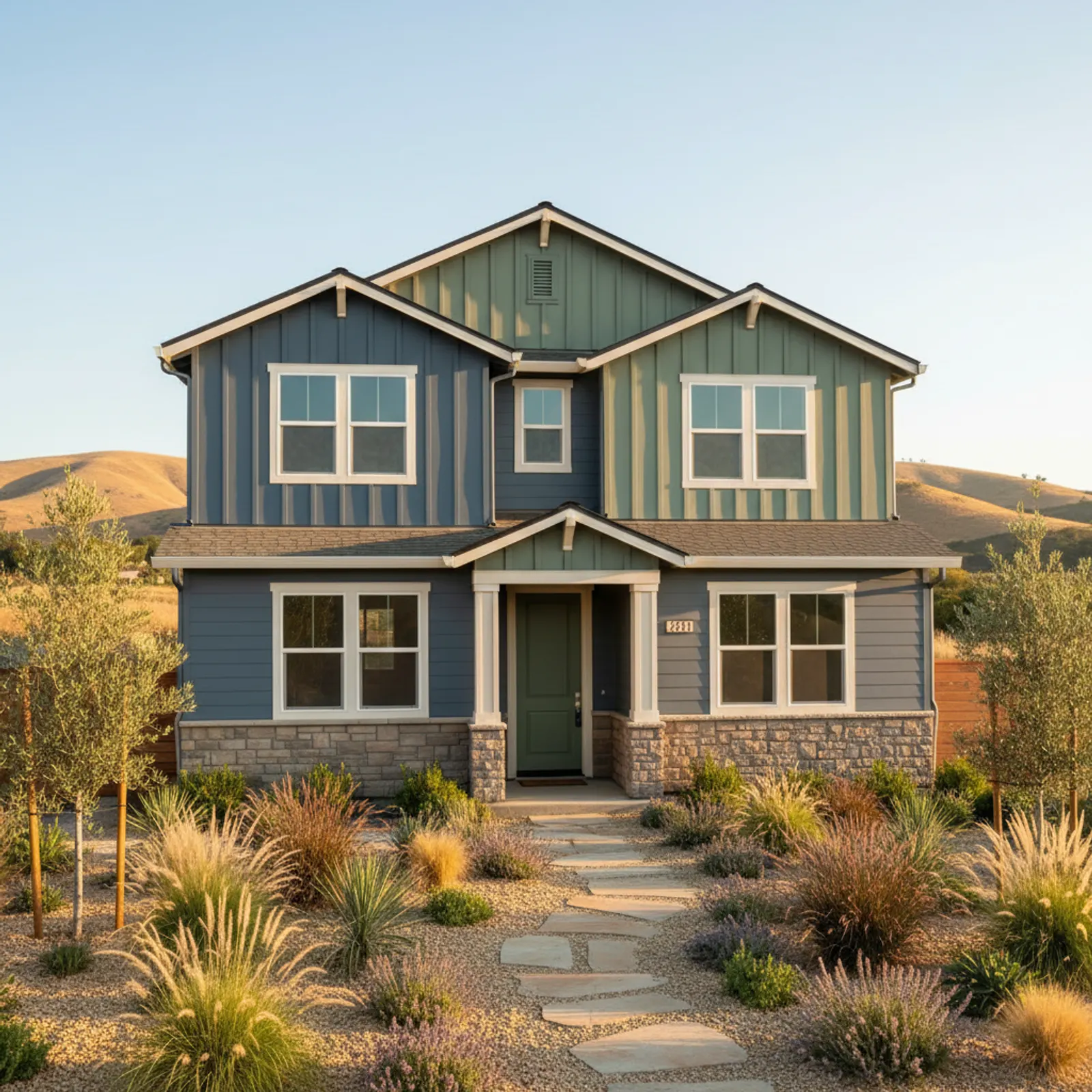
Exterior Contractor in Morgan Hill
Morgan Hill sits south of San Jose in the agricultural-and-tract belt — newer family tracts, older ranch and acreage homes, and the wooded foothill edges climbing toward the surrounding mountains. The exposure profile is mixed: most central parcels are essentially low-fire valley tract; the foothill-edge lots pick up real wildfire exposure.
An integrated Morgan Hill exterior is what scopes each parcel to its actual exposure rather than applying a default city spec. The integrator's value here is honest per-parcel assessment — central tract gets standard modernization; foothill-edge gets hardening detail; rural acreage gets compound-scope.
What an integrated Morgan Hill exterior includes
On a Morgan Hill central tract an integrated scope strips failed cladding, corrects the WRB, integrates window replacement, and re-clads in fiber cement with a refined trim package. On foothill-edge parcels the same scope adds ember-resistant vents and hardened eaves. Rural acreage parcels may include outbuildings and accessory structures in the same project.
Where the split-trade exterior fails in Morgan Hill
Morgan Hill fails when a default city spec gets applied across mismatched parcels — central tract hardening that wasn't needed, foothill-edge cladding without the vent and eave detail that the parcel warrants. An integrator scopes per address.
Materials and detailing we specify for Morgan Hill
Fiber cement with factory ColorPlus finishes for valley durability, integrated window package where needed, and hardening detail scaled to actual parcel exposure. Foothill-edge parcels get Class A hardening; central tract gets standard valley scope.
How Morgan Hill's production tracts and downtown lots scope differently
The steady re-side demand in Morgan Hill comes mostly from the master-planned neighborhoods filling the flats below the foothills, where builder-grade cladding installed a generation ago is now hitting the end of its service window. On these production tracts the work is repetitive and predictable: matching the original elevation rhythm, keeping HOA-visible street faces consistent, and correcting the water-resistive barrier shortcuts that volume builders tend to leave behind. The picture changes near the rebuilt town center and the older lots around it, where smaller infill parcels, tighter setbacks, and a mix of remodel-era additions mean an exterior contractor cannot lean on a single repeated detail. Then there is the vineyard-adjacent and rural-residential land rising into the nearby foothills, where acreage homes carry outbuildings and longer wall runs that turn one job into a compound scope. We assess each parcel against its real housing stock rather than treating every Morgan Hill address as the same tract elevation, because the spec that fits a planned community face rarely fits an infill remodel or a hillside ranch.
Specifying for South County summer heat and a fire-aware hillside margin
Morgan Hill runs hotter than the cooler central-valley cities to its north, and that valley-heat exposure shapes every exterior choice here. Sustained South County summer temperatures punish south- and west-facing walls, so we favor fade-stable color systems, factory finishes that hold up to UV cycling, and fastening and expansion detailing that tolerates repeated thermal movement without telegraphing oil-canning or opening joints. Moisture pressure is light in this climate, so the priority shifts from drainage-first design toward heat and longevity. The other variable is fire: flatland parcels in the valley center behave like ordinary low-risk tract, but the lots on the rural and elevated edges rising into the mountains around town pick up genuine wildfire consideration. For those parcels we steer the exterior spec toward ember-resistant assemblies, closed eaves and soffits, and noncombustible cladding choices at the most exposed elevations. The dividing line cuts straight through Morgan Hill, so the honest move is to set the heat-and-fire spec per parcel instead of defaulting the whole city to one exterior package.
Why this matters in Morgan Hill
- Specified for South County conditions
- James Hardie fiber cement as the recommended system
- Correctly detailed weather-resistive barrier and flashing
- Installed by a crew with 20 years combined experience
Recommended systems for Morgan Hill
- James Hardie fiber cement
- fire-aware detailing on rural edge
- factory finishes
Exterior Contractor for Morgan Hill homes
The full exterior contractor approach — materials, weather-resistive detailing, and the manufacturer standards we install to — is covered on the main service page, then specified for Morgan Hill's conditions on this one.
Our Morgan Hill process
- Step 1
Consultation
We listen to your goals and assess your home on site — exposure, substrate, and architecture.
- Step 2
Design & Proposal
A clear written proposal with the right system specified for your climate and a transparent scope.
- Step 3
Expert Installation
Trained crews install to manufacturer best practices with careful weather-management detailing.
- Step 4
Walkthrough & Support
A final walkthrough, full cleanup, and a clear written record of the scope completed — work we stand behind.
FAQ
Exterior Contractor in Morgan Hill — FAQ
On parcels climbing into the wooded foothills around town, yes — real elevated exposure. Central valley tract is essentially low-fire.
Yes — compound-scope projects are common on Morgan Hill acreage and we scope outbuildings in the same project where it makes sense.
On homes with original or first-generation builder windows, yes — and the WRB-to-window flashing only gets correctly detailed when both are part of the same project.
Most Morgan Hill single-family homes are three to six weeks of active work; acreage and compound projects can run longer.
Keep Exploring
More for Morgan Hill homeowners
More in Morgan Hill
Other exterior services in Morgan Hill
Nearby Service Areas
Exterior Contractor near Morgan Hill
Back to
Santa Clara County & Morgan Hill
Helpful Exterior Guides