
Fire-Resistant Siding in San Jose
Direct answer: the San Jose valley floor is low wildfire exposure — this is not foothill or WUI terrain. Fire-resistant siding in San Jose is a low-regret choice and a western-foothill-fringe nuance, not an urgent need, and we won't apply foothill urgency to a flatland San Jose address.
Where any real fire nuance exists in San Jose
The vast majority of San Jose — east side, central, south — carries low exposure. The only nuance is the western edge climbing toward the Santa Cruz Mountains and the Diablo Range foothills, where exposure rises; those parcels warrant non-combustible cladding and fire-aware detailing, while the valley-floor city does not need foothill-grade hardening.
Free across the city, the point on the western fringe
San Jose's neighborhood-by-neighborhood fiber-cement case already stands on heat and finish; Class A is a free consequence across the east and central bulk. On the western parcels climbing toward the Santa Cruz Mountains and Diablo foothills it flips to the actual reason, with fire-aware detailing. Same material, different role by location.
Why fiber-cement is the default re-side spec for San Jose's postwar tracts
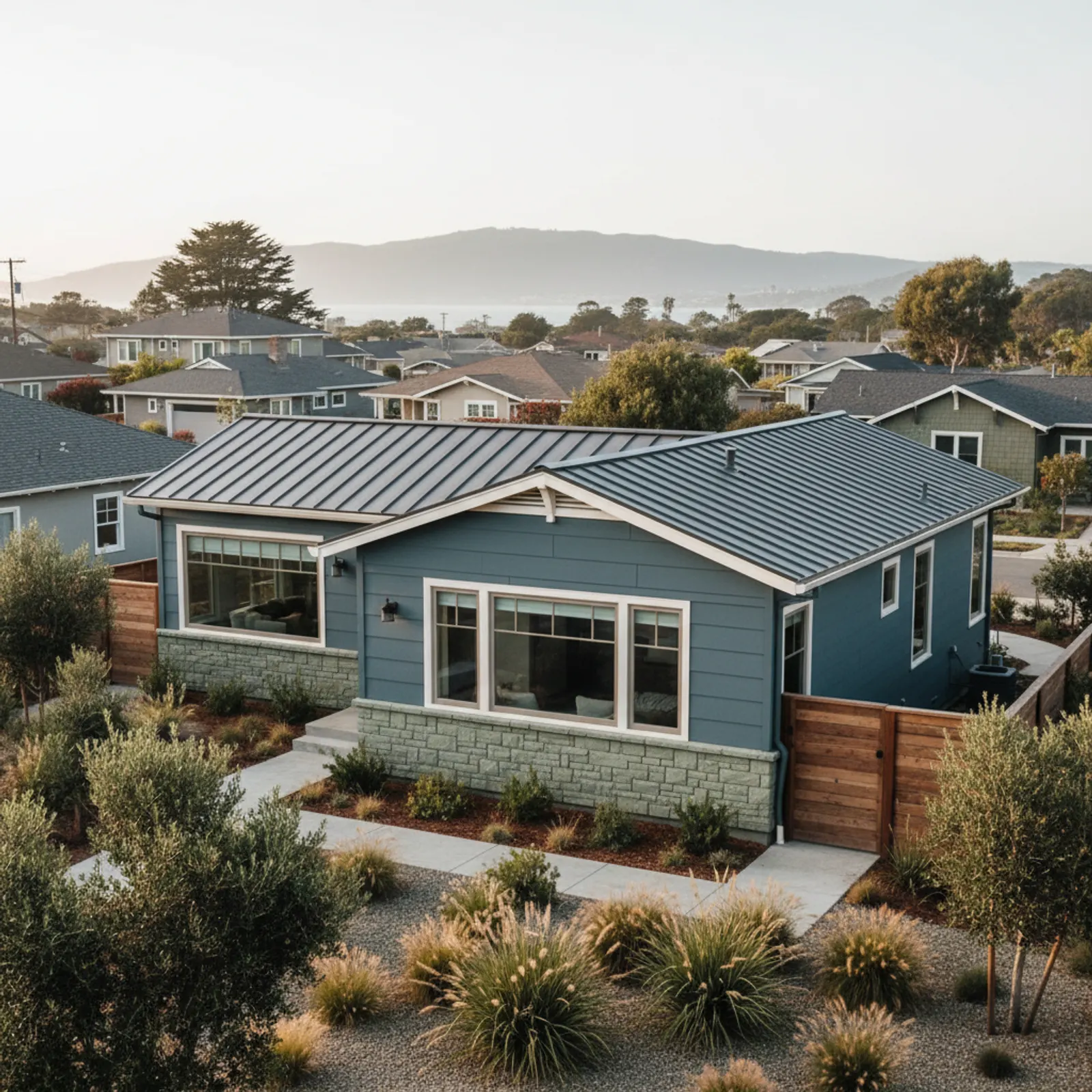
The deepest pool of work here is the sprawling postwar tract housing across the east and south sides, much of it now aging out of the thin builder cladding it left the factory with. On these single-story ranch and split-level homes, fire-resistant fiber-cement is the spec that does double duty: it is non-combustible, but it also delivers the modern, refined exterior that a high-value Silicon Valley market now expects. Homeowners rarely treat this as a like-for-like swap. They use the re-side to update proportions, widen reveals, and shift to crisp horizontal lap or panel-and-batten looks that read contemporary rather than 1960s. Because these tracts sit squarely on the low-exposure valley floor, the fire rating is a no-downside bonus rather than the driving reason, so the decision usually turns on appearance, longevity, and resale value. We size board widths and trim profiles to the actual scale of the home, and we flash and detail every penetration cleanly so the finished wall looks intentional, not merely re-clad.
Handling Eichlers and Willow Glen character homes without erasing their identity
San Jose's most design-sensitive re-sides happen on its Eichler enclaves and the character homes of Willow Glen, the Rose Garden, and Naglee Park. These are not generic tract walls, and a fire-resistant fiber-cement product has to be detailed to respect the original architecture. On Eichlers, that means preserving the clean post-and-beam lines, the flat or low-slope rooflines, and the deliberately minimal trim that defines the mid-century look; oversized fascia or chunky corner boards would ruin the home instantly. On the older Willow Glen and Rose Garden homes, the opposite discipline applies, since their cladding often carries period reveals, belt courses, and porch detailing worth reproducing in a non-combustible material. We match exposure and shadow lines to what the house already wears rather than imposing a single off-the-shelf profile. The non-combustible rating is a quiet upgrade over original wood siding, but on these blocks the real test is whether the new wall looks like it always belonged, which is exactly the bar these neighborhoods set.
Why this matters in San Jose
- Specified for South Bay / Silicon Valley conditions
- James Hardie fiber cement as the recommended system
- Correctly detailed weather-resistive barrier and flashing
- Installed by a crew with 20 years combined experience
Recommended systems for San Jose
- James Hardie fiber cement
- refined lap and flat-panel profiles
- factory finishes
- period-sensitive trim packages
Fire-Resistant Siding for San Jose homes
The full fire-resistant siding approach — materials, weather-resistive detailing, and the manufacturer standards we install to — is covered on the main service page, then specified for San Jose's conditions on this one.
Our San Jose process
- Step 1
Consultation
We listen to your goals and assess your home on site — exposure, substrate, and architecture.
- Step 2
Design & Proposal
A clear written proposal with the right system specified for your climate and a transparent scope.
- Step 3
Expert Installation
Trained crews install to manufacturer best practices with careful weather-management detailing.
- Step 4
Walkthrough & Support
A final walkthrough, full cleanup, and a clear written record of the scope completed — work we stand behind.
FAQ
Fire-Resistant Siding in San Jose — FAQ
Most San Jose homes are low-exposure valley floor, so it's a low-regret upgrade rather than a necessity. Western foothill-fringe parcels benefit more; we assess each address honestly.
The flatland city is low exposure; only the western edge toward the Santa Cruz Mountains/Diablo Range rises toward foothill risk. We don't overstate it for a valley-floor address.
No — the fiber cement we recommend for durability is already non-combustible, so Class A fire performance comes at no added material cost.
On low-exposure valley-floor San Jose the effect is usually modest; it matters more on western foothill-fringe parcels. We document materials used if your carrier asks.
Keep Exploring
More for San Jose homeowners
More in San Jose
Other exterior services in San Jose
Nearby Service Areas
Fire-Resistant Siding near San Jose
Back to
Santa Clara County & San Jose
Helpful Exterior Guides