
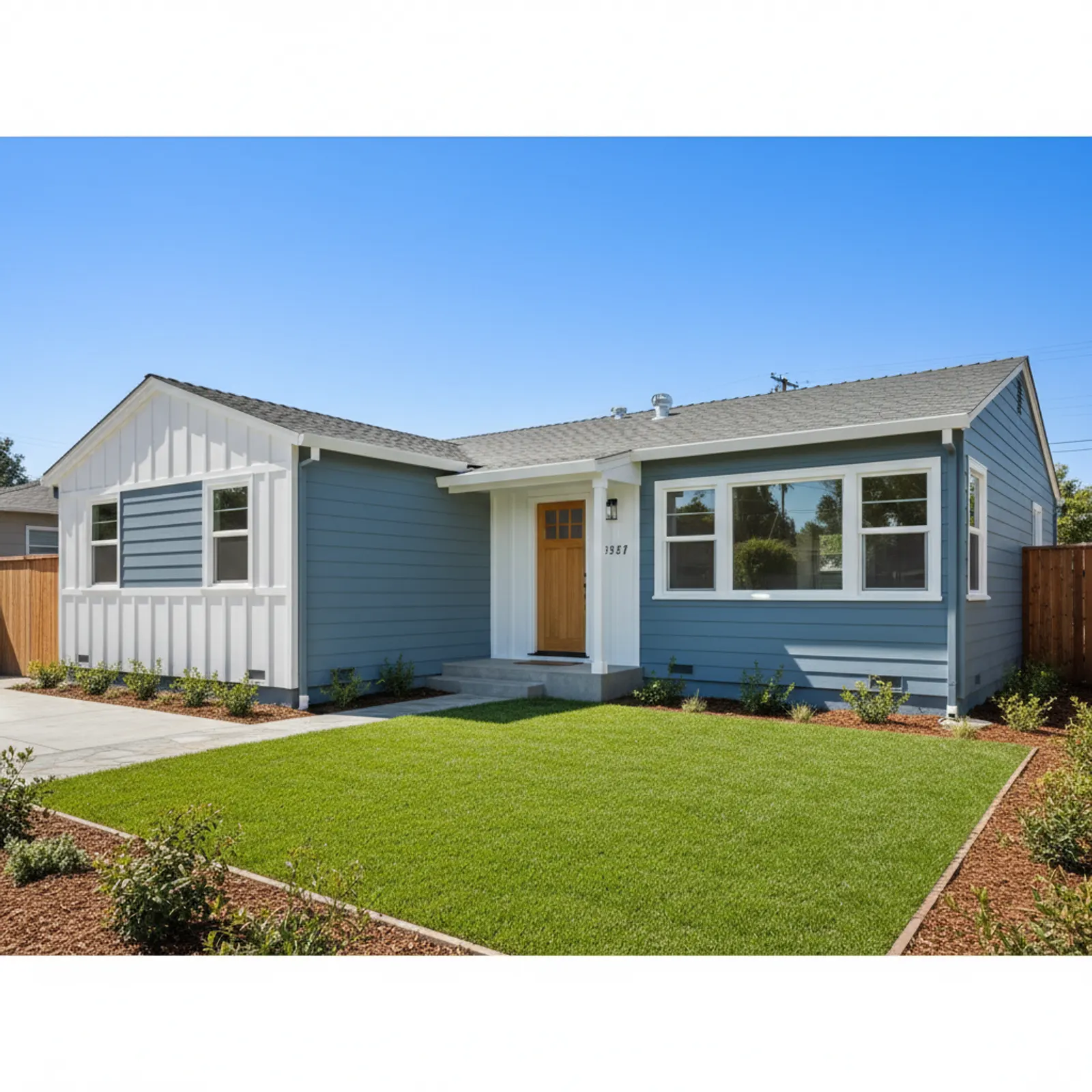
Exterior renovation in Santa Clara
The city of Santa Clara sits at the center of Silicon Valley with one of the region's deepest stocks of mid-century and postwar housing. It is a steady, high-value re-side market: large tract neighborhoods built from the 1950s through the 1970s, older homes near the historic core and university, and newer infill — most well past the service life of their original siding.
Why it matters here specifically
In Santa Clara the controlling factor isn't weather — it's age. The mild South Bay climate means failure is driven by decades-old postwar and economy cladding reaching the end of its service life, not by salt or fire, so the bar is finish durability and exacting detailing rather than surviving an extreme. The local wrinkle is utility and process: the city is served by Silicon Valley Power, the municipal utility, not PG&E, so any work near the service mast, meter, or overhead drop coordinates through SVP, and rooftop solar on these postwar homes often needs a licensed coordination step before siding comes off. We flag those items at the estimate, pull the permit under the proper trade, and sequence utility, HOA, and solar sign-offs early so the schedule doesn't stall once walls are open to weather.
Considering an exterior project in Santa Clara?
Santa Clara housing and architecture
Santa Clara's stock is dominated by single-story and split-level postwar tract homes, with Eichler and mid-century pockets, older homes near Santa Clara University and the Old Quad, and newer infill. The tracts modernize strongly with a clean lap-and-batten re-side and refreshed palette; mid-century homes reward flat-panel detailing.
Santa Clara's mild climate
Santa Clara enjoys a mild Mediterranean South Bay climate — moderate sun, low rainfall, low wildfire and moisture exposure. The performance bar is finish durability and exacting detailing rather than surviving an extreme.
Recommended materials for Santa Clara
James Hardie fiber cement with a factory finish is the core recommendation for Santa Clara — non-combustible, dimensionally stable, and far more color-stable than field paint, with profiles spanning postwar tracts to mid-century homes. Engineered wood is acceptable on the many low-risk parcels where deep wood character is wanted.
What an exterior project costs in Santa Clara
Santa Clara pricing turns on home size and stories, profile and trim complexity, substrate condition once cladding is removed, window integration, and the weather-management scope. We provide a written, scoped estimate after an on-site assessment so bids can be compared on substance.
Neighborhood layout and job-site access in Santa Clara
Working a re-side in Santa Clara is shaped less by the homes than by the streets around them. The postwar tracts off El Camino and toward Old Quad sit on tight 50-to-60-foot lots with shared driveways and detached garages set close to the line, so staging scaffold, a dump trailer, and material drops takes planning to avoid blocking a neighbor. Close to the university campus and the convention-center corridor, parking enforcement and permit-zone signage are real constraints on crew vehicles, and the steady commuter traffic on Lawrence, Bowers, and Pruneridge means deliveries are easiest mid-morning rather than at rush hour. Many Eichler and mid-century pockets have low-pitched roofs and wide eaves that put fascia and trim within reach of shorter staging, which speeds flat-panel work. We walk the lot before scheduling to confirm where the lift, the cut station, and the debris bin will live, so the project runs without straining the relationship you have with the people next door.
Permits, HOAs, and utility realities for a Santa Clara re-side
Santa Clara runs its own building department, and a like-for-like siding replacement is typically a straightforward permit, while changing wall assembly, adding exterior insulation, or altering openings can trigger added review. The bigger local wrinkle is power: the city is served by Silicon Valley Power, the municipal utility, not PG&E, so any work near the service mast, meter, or overhead drop is coordinated through SVP rather than the investor-owned utility most Bay Area homeowners expect. Newer infill tracts and a handful of planned communities carry HOA architectural rules that govern color and material, so we confirm approved palettes before committing to a finish. Solar is common on these postwar roofs, and panels or conduit running down a wall often need a licensed coordination step before siding comes off. We flag these items at the estimate stage, pull the permit under the proper trade, and sequence utility and HOA sign-offs early so the schedule does not stall once the crew is on site and walls are open to weather.
Our process in Santa Clara
- Step 1
Consultation
We listen to your goals and assess your home on site — exposure, substrate, and architecture.
- Step 2
Design & Proposal
A clear written proposal with the right system specified for your climate and a transparent scope.
- Step 3
Expert Installation
Trained crews install to manufacturer best practices with careful weather-management detailing.
- Step 4
Walkthrough & Support
A final walkthrough, full cleanup, and a clear written record of the scope completed — work we stand behind.
Santa Clara's deep postwar stock rewards a modern, durable re-side — strong protection and a clear curb-appeal lift.
FAQ
Santa Clara — Common Questions
Fiber cement with a factory finish — durable, low-maintenance, and color-stable, with profiles that suit postwar tracts and mid-century homes alike.
Original postwar and economy cladding reaches the end of its service life after decades regardless of climate; failure here is age- and material-driven.
Low — the city is flatland South Bay. Non-combustible fiber cement remains a sound, low-regret choice.
Yes — a modern lap-and-batten program with refreshed color is among the most effective curb-appeal upgrades on these homes.
Yes — period-appropriate profiles and trim where the home calls for it, in durable fiber cement.
When feasible, yes — it ensures correct flashing integration and avoids duplicated trim work.
Very — factory-finished fiber cement needs only periodic cleaning and occasional caulk checks for many years in this mild climate.
A correctly installed fiber cement system commonly performs 30+ years in Santa Clara's mild climate.
Helpful Exterior Guides