
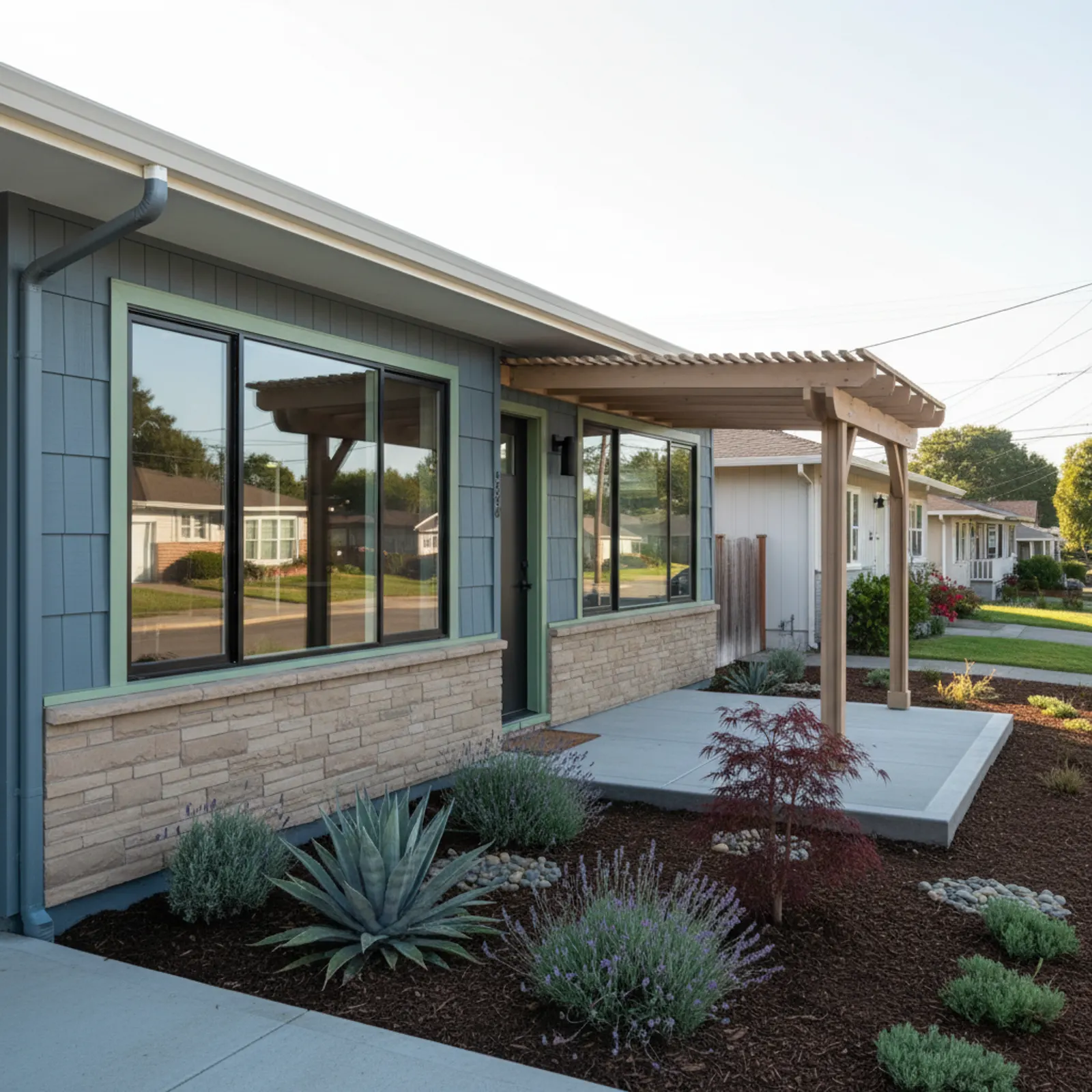
Exterior Contractor in Santa Clara
Santa Clara is a postwar production city with a deep stock of tract homes from the 1950s through the 1970s, plus older homes in Old Quad and around the University, and newer high-end infill scattered across the city. Most homes are reaching the second re-side cycle, and the modernization market is active: owners are updating cladding, windows, and trim together to lift the visual quality of the production-era exterior.
An integrated Santa Clara exterior is what makes that modernization read as deliberately designed rather than as a sequence of separate trade updates. The market is design-aware enough to notice when the composition doesn't hold together.
What an integrated Santa Clara exterior includes
On a typical Santa Clara postwar ranch an integrated scope strips failed cladding (often hardboard or 1980s vinyl), corrects the WRB, integrates window replacement, and re-clads in fiber cement with a refined trim package and modernized color program. Old Quad and University-area older homes get character-preserving profile and trim selection.
Where the split-trade exterior fails in Santa Clara
Santa Clara's failure mode is the modernization that doesn't quite land — separate trades each pick defaults, and the home reads as updated but uncomposed. An integrator owns the composition across cladding, windows, soffit, and trim.
Materials and detailing we specify for Santa Clara
Fiber cement (James Hardie or equivalent) with factory ColorPlus finishes in the modernized palette range, refined trim with reveal lines designed to the home's architecture, and frame color coordinated with the cladding. Old Quad older homes warrant period-appropriate profile selection.
Sequencing an exterior on a Silicon Valley work-from-home block
A Santa Clara re-side rarely happens on an empty house. Across the postwar tracts off Homestead and El Camino, and in the denser pockets near Santa Clara University, many owners now work from home, and the original 1950s-to-1970s footprints sit close to the lot lines and to neighbors. That changes how an exterior contractor stages the job. Tear-off noise, compressor runs, and saw stations have to be planned around video calls, and dust control matters more when a home office window is feet from the scaffold. On the tight side yards typical of these tracts, staging cladding, scaffolding, and a dumpster without blocking the driveway or a shared fence line takes real coordination. We phase the work face by face, keep one access path clear, and protect the AC condenser and any rooftop solar conduit that postwar roofs in this city often carry. Sequencing the trades so the home stays weather-tight and livable each evening is part of the scope here, not an afterthought. On an occupied, working household, how the project is run is as visible as how the finished exterior looks.
Detailing the mild South Bay climate actually rewards
Santa Clara sits in a forgiving inland-valley pocket of the South Bay: moisture risk is low, there is no snow load and no coastal salt, and summer heat is only moderate. That profile shifts where an exterior contractor should spend the budget. With little driving rain and no salt-laden air, the failures we see on these homes are less about rot and more about decades of UV and thermal cycling: south- and west-facing walls toward San Jose and Sunnyvale that chalk, fade, and check, plus brittle original caulk at the trim joints of 1950s-70s tract construction. So the spec leans into UV-stable, fade-resistant finishes, generous expansion allowance at long horizontal runs, and high-movement sealant at every penetration rather than heavy storm-grade flashing better suited to a wetter or windier site. We still flash and integrate the weather barrier correctly behind new cladding, because the wall assembly should be sound regardless of the gentle climate. The point is matching the detailing to Santa Clara's real exposure, so the money goes into the longevity and crisp appearance this design-aware market notices.
Why this matters in Santa Clara
- Specified for South Bay conditions
- James Hardie fiber cement as the recommended system
- Correctly detailed weather-resistive barrier and flashing
- Installed by a crew with 20 years combined experience
Recommended systems for Santa Clara
- James Hardie fiber cement
- factory finishes
- modern profiles
Exterior Contractor for Santa Clara homes
The full exterior contractor approach — materials, weather-resistive detailing, and the manufacturer standards we install to — is covered on the main service page, then specified for Santa Clara's conditions on this one.
Our Santa Clara process
- Step 1
Consultation
We listen to your goals and assess your home on site — exposure, substrate, and architecture.
- Step 2
Design & Proposal
A clear written proposal with the right system specified for your climate and a transparent scope.
- Step 3
Expert Installation
Trained crews install to manufacturer best practices with careful weather-management detailing.
- Step 4
Walkthrough & Support
A final walkthrough, full cleanup, and a clear written record of the scope completed — work we stand behind.
FAQ
Exterior Contractor in Santa Clara — FAQ
Yes — profile selection, trim proportions, and finish are documented and replicated where the architecture warrants.
On any home with original or first-generation windows, yes — the modernization vision requires coordinated window frames and proportions.
Many newer Santa Clara communities do for visible exterior changes; older neighborhoods typically don't. We handle submissions as part of the project.
Most Santa Clara homes are four to six weeks of active work depending on size and scope.
Keep Exploring
More for Santa Clara homeowners
More in Santa Clara
Other exterior services in Santa Clara
Nearby Service Areas
Exterior Contractor near Santa Clara
Back to
Santa Clara County & Santa Clara
Helpful Exterior Guides