
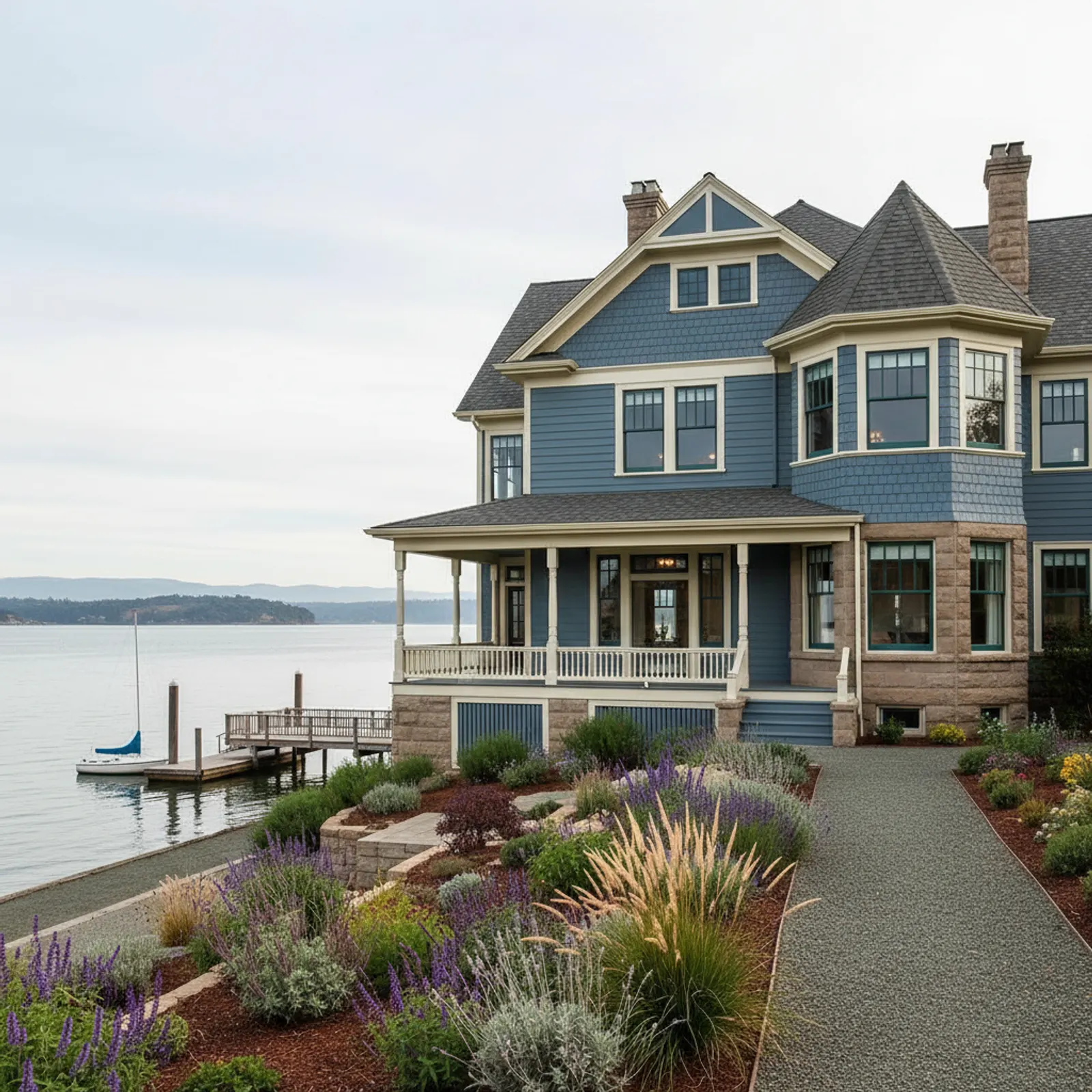
Siding in Benicia
A Benicia re-side is a strait-wind problem on a heritage stock. This small former state-capital town sits right on the Carquinez Strait, where a pronounced wind funnel drives rain and brackish, salt-tinged moisture hard against waterfront and hillside elevations — and where one of California's oldest historic districts (the Arsenal / old town) demands period-faithful work. Distinct from strait-side Vallejo's large affordable Victorian scale and inland Vacaville's dry heat.
So a Benicia project is scoped around wind-driven water management and corrosion-aware detailing, with exact heritage profiles for the protected old town.
Strait wind is the distinctive factor
Benicia's Carquinez wind funnel pushes rain and salt-laden damp into joints and flashing far harder than still-air sites. We detail for wind-driven water — robust flashing laps, drainage-plane continuity, corrosion-aware fasteners — so the envelope sheds and dries under pressure.
Heritage fidelity for the old town
Benicia's historic-district and waterfront homes carry significant architectural character; the work replicates period profiles and trim faithfully while engineering the wind-and-corrosion failure points out — preserved look, hardened performance.
Hillside access on the bluffs above the strait
Re-siding a Benicia hillside home is as much an access challenge as a material one. The lots that climb the bluffs above the Carquinez Strait often pitch steeply, sit on narrow shared lanes, and turn a straightforward tear-off into a staging puzzle. Scaffold has to be tied and leveled on a grade, and exposed downhill elevations catch the worst of the wind funnel, so we sequence those walls first and keep them weather-tight before the wind picks up in the afternoon. On these homes the cladding decisions follow the slope: where a wall reads as a sail facing open water, we tighten fastener schedules and back the seams more aggressively than we would on a flat inland lot. Material gets staged in tight runs because there is rarely room to drop a full delivery, and debris removal is planned around limited turnaround for trucks. None of that changes the finished look, but it shapes the timeline and the bid, and it is why a hillside Benicia job rarely scopes like a flat one in Fairfield.
Why brackish damp punishes the wrong fasteners
Near the strait, the moisture pushing into a wall is not clean rain. It carries a salt tinge off the brackish water of the Carquinez, and that detail decides which fasteners and flashings survive on a Benicia re-side. Ordinary electro-galvanized nails and thin coil staples corrode from the head out, staining the cladding and loosening the hold long before the siding itself fails. So we spec hot-dip galvanized or stainless fasteners on the water-facing elevations, pair them with compatible flashing metals to avoid galvanic reactions, and seal cut ends rather than leaving raw fiber exposed to the damp. Where downtown waterfront walls meet trim and window heads, the flashing laps are sized for wind-driven water that arrives sideways, not straight down. This is the failure mode that quietly defines coastal-influenced Benicia work: a wall that looks fine for a few seasons, then bleeds rust streaks and softens at the joints. Getting the metal right at the start is far cheaper than reopening a finished elevation later to chase corrosion that started at the nail.
Why this matters in Benicia
- Specified for North Bay / Delta conditions
- fiber cement over detailed drainage plane as the recommended system
- Correctly detailed weather-resistive barrier and flashing
- Installed by a crew with 20 years combined experience
Recommended systems for Benicia
- fiber cement over detailed drainage plane
- wind- and corrosion-aware detailing
- period-sensitive trim
Fiber Cement Siding for Benicia homes
The full fiber cement siding approach — materials, weather-resistive detailing, and the manufacturer standards we install to — is covered on the main service page, then specified for Benicia's conditions on this one.
Our Benicia process
- Step 1
Consultation
We listen to your goals and assess your home on site — exposure, substrate, and architecture.
- Step 2
Design & Proposal
A clear written proposal with the right system specified for your climate and a transparent scope.
- Step 3
Expert Installation
Trained crews install to manufacturer best practices with careful weather-management detailing.
- Step 4
Walkthrough & Support
A final walkthrough, full cleanup, and a clear written record of the scope completed — work we stand behind.
FAQ
Siding in Benicia — FAQ
Benicia's distinctive factor is the Carquinez Strait wind funnel driving rain and salt-tinged damp, on a small, refined historic stock — versus Vallejo's large affordable Victorian scale or Vacaville's dry interior heat.
Strait wind drives water and salt into joints and flashing far harder than still air — usually wind-driven moisture past under-detailed flashing, not the cladding alone. Wind-aware detailing fixes the root cause.
Yes — faithful period profiles and trim are central to how we approach Benicia's historic district and waterfront homes.
Low — Benicia is a developed waterfront town; wind-driven moisture and moderate salt, not fire, are the controlling factors. Non-combustible fiber cement is still a sound, low-regret default.
Yes — both take the strait wind; hillside elevations especially benefit from wind-aware flashing and corrosion-aware fastening.
Keep Exploring
More for Benicia homeowners
More in Benicia
Other exterior services in Benicia
Helpful Exterior Guides