Exterior renovation in Benicia
Benicia is a historic small city on the Carquinez Strait — a former state capital with a beautifully preserved downtown, waterfront homes, and hillside neighborhoods overlooking the water. Its exterior priorities are distinctive for Solano County: wind-driven bay moisture and some salt influence near the strait, plus the careful handling its irreplaceable historic fabric demands.
What the Benicia market expects from a re-side
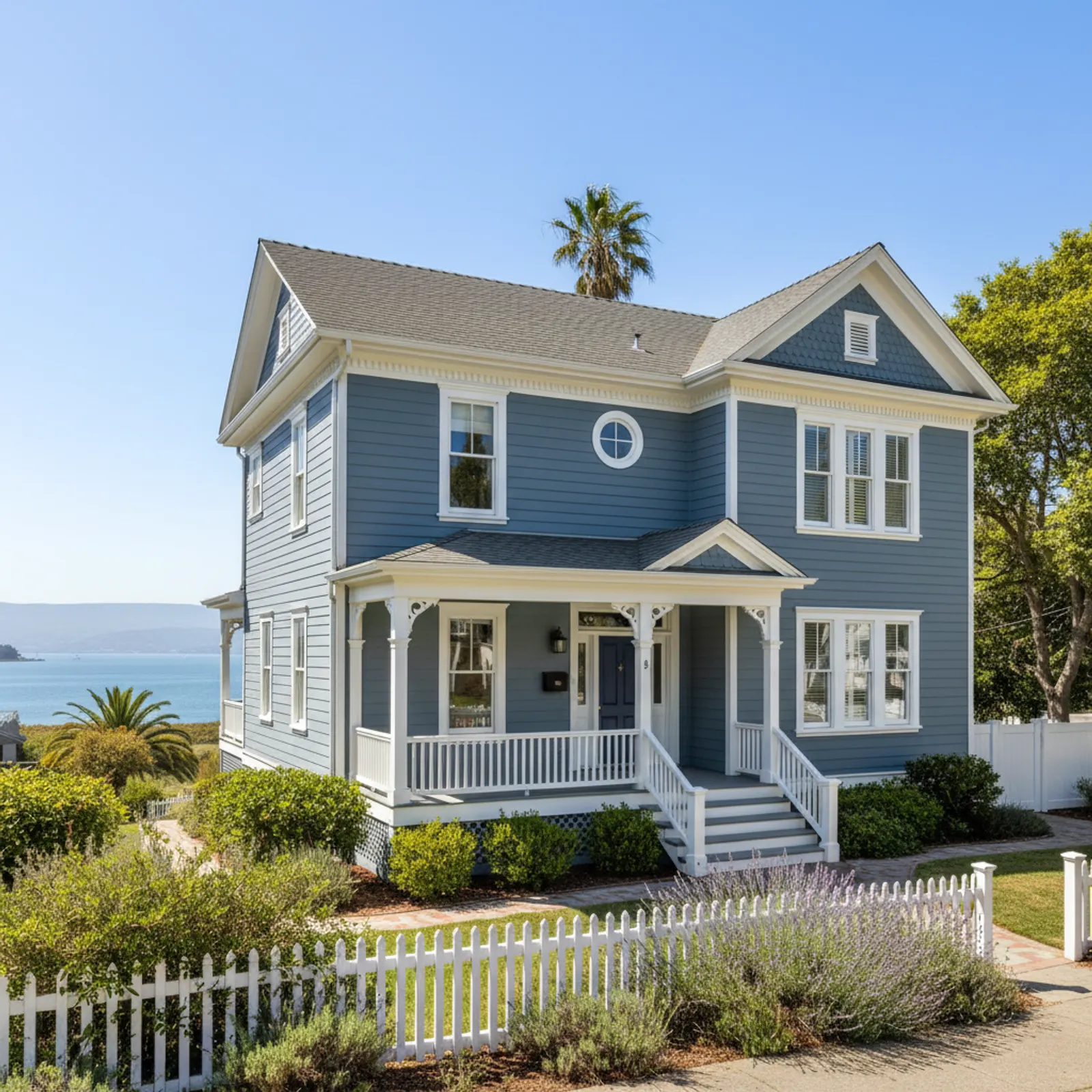
Re-siding near Benicia's Old Town and the First Street corridor is not a same-week permit pull, and that shapes the whole project. The city protects its 19th-century fabric closely, so properties inside or adjacent to the historic overlay often trigger design review that looks hard at clapboard exposure, corner-board and water-table profiles, and window casing depth before any cladding change. A blanket fiber-cement wrap that would sail through a newer Solano subdivision can stall here if the reveal or trim reads wrong against a preserved Victorian. So material selection and the permit conversation happen together: we plan profiles that satisfy the reviewing body while still delivering modern wind- and moisture-managed protection behind the visible face, and we budget calendar time for that approval. On non-historic hillside and edge-of-town homes the path is far simpler, which is exactly why confirming which category an address falls into is the first step.
Considering an exterior project in Benicia?
Benicia housing and architecture
Benicia's stock blends 19th-century and early-20th-century historic homes around the downtown and Old Town, mid-century hillside neighborhoods with strait views, and newer development on the city's edges. The historic homes demand genuinely period-sensitive profiles and trim; the hillside and waterfront homes add wind and salt-aware detailing.
Benicia's strait-edge climate
Benicia sits where the Carquinez Strait funnels strong, sustained wind, with bay-driven moisture and a measurable salt influence on waterfront and near-strait parcels. Heat is moderate; wind-driven rain, moisture, and corrosion govern the specification here.
Recommended materials for Benicia
Fiber cement over a rigorously detailed drainage plane, with wind- and corrosion-aware fastening on waterfront parcels, is the core recommendation — in genuinely period-appropriate profiles for the historic core and durable straightforward profiles elsewhere. It resists moisture-driven decay far better than the original wood on many Benicia homes.
What an exterior project costs in Benicia
Benicia pricing turns on home size and stories, the often-high trim complexity of historic homes, substrate and rot condition once cladding is removed (frequently significant on older wind- and salt-exposed houses), window integration, and the wind-, moisture-, and corrosion-management scope. We provide a written, scoped estimate after an on-site assessment.
Working within Benicia's historic district review
Anyone re-siding near Benicia's Old Town and the First Street corridor quickly learns that the city protects its 19th-century fabric closely. Properties inside or adjacent to the historic overlay often trigger design review before any cladding change, and that review looks hard at clapboard exposure, corner-board and water-table profiles, window casing depth, and whether a proposed product reads as period-appropriate from the street. A blanket fiber-cement wrap that would sail through in a newer Solano subdivision can stall here if the reveal or trim looks wrong against a preserved Victorian or early-1900s cottage. The practical upshot is that material selection and the permit conversation happen together, not in sequence. We plan profiles that satisfy the reviewing body while still delivering modern moisture protection behind the visible face, and we budget calendar time for that approval rather than assuming a same-week pull. On non-historic hillside and edge-of-town homes the path is far simpler, but it pays to confirm which category a given address falls into before scoping the job.
Access and staging on Benicia's hillside lots
The neighborhoods climbing above the strait give Benicia its views, but they complicate the physical side of an exterior job. Many hillside parcels sit on narrow, curving streets with steep driveways, limited frontage, and retaining walls that leave little flat ground for staging materials, scaffolding, or a dumpster. Crews frequently work off graduated scaffold and ladder jacks on the downhill elevations rather than rolling staging, which slows the pace compared with a flat lot. Delivery also matters: long siding planks and trim stock can be awkward to maneuver up tight switchbacks, so we coordinate drop timing and sometimes stage from the street with shorter carry runs. Parking for the crew and protecting neighbors' access on a constrained block is part of the plan, not an afterthought. Downtown and waterfront homes bring their own access wrinkles, with small setbacks, shared lot lines, and proximity to public sidewalks. Walking the site before quoting lets us price the real labor of getting around the building, which on a steep Benicia lot is a meaningful share of the job.
PG&E, City of Benicia utilities, and Old Town historic review
Working exteriors in Benicia coordinates with a few local authorities. Electric and gas both come from PG&E. Water is supplied by the City of Benicia Water Department, city-owned. Fire response is the Benicia Fire Department. On the permit side, the City of Benicia Community Development Department handles building permits, and the Downtown Benicia Historic District — one of the more intact 19th-century commercial and residential districts in the Bay Area, with buildings on the National Register — carries Historic Preservation Review Commission oversight, with material, profile, and color regulated on contributing structures. We flag utility, permit, and heritage items at the estimate stage.
HZ10 and Benicia's Carquinez Strait exposure
Benicia is in James Hardie's HZ10 climate zone; installing HZ5 is a documented warranty misapplication. On the fire side, most of Benicia sits along the Carquinez Strait in Low FHSZ territory or unmapped under California's 2025 LRA Fire Hazard Severity Zone map, with the outer eastern hills carrying Moderate designations. The strait exposure means wind-driven bay moisture and some salt influence are the controlling stressors, not fire. The code frame changed on January 1, 2026, when Chapter 7A moved into the standalone WUI Code, but on a Benicia re-side the moisture, wind, and heritage work is where the real focus lives.
Our process in Benicia
- Step 1
Consultation
We listen to your goals and assess your home on site — exposure, substrate, and architecture.
- Step 2
Design & Proposal
A clear written proposal with the right system specified for your climate and a transparent scope.
- Step 3
Expert Installation
Trained crews install to manufacturer best practices with careful weather-management detailing.
- Step 4
Walkthrough & Support
A final walkthrough, full cleanup, and a clear written record of the scope completed — work we stand behind.
Benicia rewards an exterior built for strait wind and salt, executed with the care its historic homes deserve.
FAQ
Benicia — Common Questions
Fiber cement over a rigorously detailed drainage plane with wind- and corrosion-aware fastening on waterfront parcels — period-appropriate profiles for the historic core.
The Carquinez Strait funnels strong, sustained wind that drives rain into walls; flashing and fastening detail is unusually important here.
On waterfront and near-strait parcels, yes — we add corrosion-resistant fastening and detailing there on top of the moisture baseline.
Yes — genuinely period-appropriate profiles and trim are essential in the historic core and central to our approach there.
Usually trapped wind-driven moisture from poor flashing detailing, plus salt near the strait. Wind-aware, drying-capable, corrosion-resistant detailing fixes the cause.
Comparatively minor — wind, moisture, and salt govern here. Non-combustible fiber cement remains a sound, low-regret choice.
When feasible, yes — correct flashing integration is especially important in a wind-driven-rain, high-moisture environment.
A correctly detailed, wind- and corrosion-aware fiber cement system commonly performs 30+ years in Benicia's strait-edge climate.
Explore
Exterior Services
Helpful Exterior Guides