
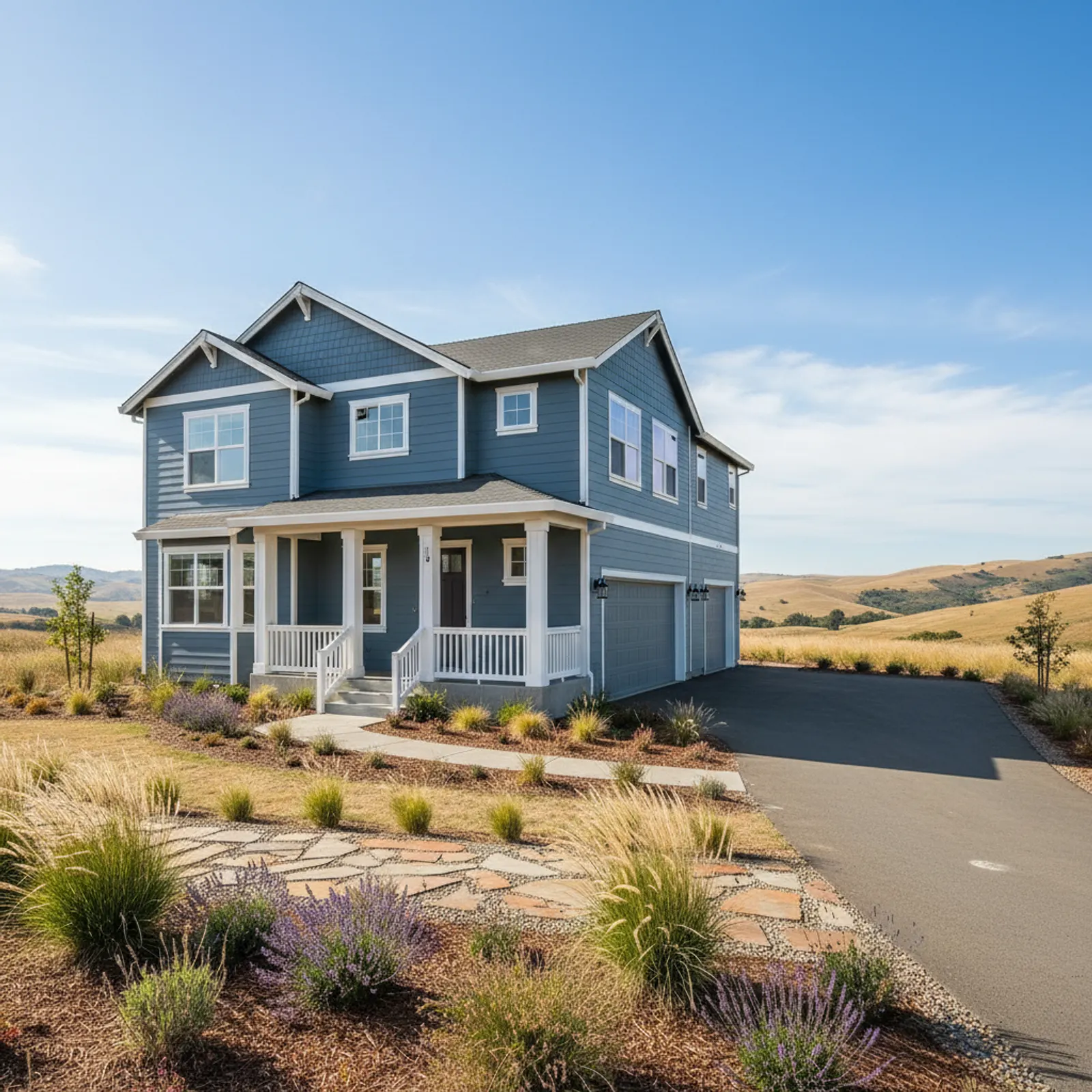
Exterior renovation in Fairfield
Fairfield sits at the hinge of Solano County, between the hot interior valley and the windy Suisun corridor, and that location defines its exterior demands. The city's housing is largely tract and master-planned, from Paradise Valley and Green Valley to Cordelia and the central neighborhoods, much of it now reaching the age where original builder-grade siding and trim fail. What sets Fairfield apart from a typical valley city is wind: the Suisun gap funnels strong, sustained gusts that drive rain into walls and stress cladding and trim well beyond what calmer valley locations see.
A maturing re-side market
Much of Fairfield went up during the long building boom that ran from the 1970s through the 2000s, which means a large share of the city's homes are now in the window where original cladding, caulk joints, and window flashing have aged out at once. That timing, combined with the local wind load, is why so many Fairfield exteriors are due not for a patch but for a full, properly detailed re-side that resets the weather barrier from the studs out.
Considering an exterior project in Fairfield?
Fairfield housing and architecture
Fairfield's stock is dominated by 1980s through 2000s tract and master-planned homes, with older town homes near the historic core and newer development climbing toward Cordelia and Green Valley. These production elevations respond well to a modern lap-and-batten re-side and a refreshed palette that lifts a dated builder look. The older homes near downtown carry simpler massing and benefit from period-appropriate trim proportions. Across all of it the wind exposure means fastening and flashing detail matters more here than the cladding profile alone.
Built for Fairfield's heat and wind
Fairfield combines hot interior-valley summers and heavy UV with strong, sustained wind off the Suisun corridor, and the wind is the controlling stressor. We specify fade-resistant fiber cement for the heat and sun, but the defining detail is wind-aware fastening and rigorous flashing so wind-driven rain cannot work into the assembly behind siding, around windows, and at penetrations. Finish selection accounts for sun-loaded west and south elevations, and joint and corner detailing is tightened to survive years of gust-driven moisture rather than a calm-valley average.
Recommended materials for Fairfield
James Hardie fiber cement with a factory finish and wind-aware fastening is the core recommendation for Fairfield: dimensionally stable in heat, non-combustible, and, fastened correctly, resilient against the Suisun wind that punishes lesser assemblies. The factory finish holds color far better than field paint under the local UV load. Engineered wood is acceptable on low-exposure interior parcels, but for Fairfield's wind and durability margin we generally steer toward fiber cement as the safer long-run choice.
What an exterior project costs in Fairfield
Fairfield pricing follows the standard drivers, including size and stories, trim complexity, substrate and dry-rot condition, and window integration, with particular attention here to wind-aware fastening and flashing detail that a cheaper bid may skip. Homes in master-planned tracts may carry design-review or HOA expectations on color and profile that shape scope. Sun-loaded and wind-exposed elevations sometimes hide more moisture damage than they show, so substrate discovery can move the number. We provide a written, scoped estimate after an on-site assessment so bids can be compared on substance.
Neighborhoods and their stock
Fairfield reads as several distinct submarkets. Paradise Valley and the hillside-edge tracts carry larger, often two-story production homes with complex elevations. Green Valley and Cordelia lean newer and more master-planned, with HOA palettes to respect. The central and older-town neighborhoods nearer downtown hold smaller, simpler homes where straightforward lap and clean trim do the most work. We scope each of these differently because their housing eras, sizes, and exposure to the Suisun wind are not the same.
Access and staging realities
Many Fairfield tracts are tight on side-yard clearance and fence lines, which affects how cladding is staged, cut, and carried, and the prevailing wind means cutting and finishing have to be planned around gust windows so dust and debris are controlled. Two-story elevations on the hillside-edge parcels add lift and access considerations. We walk the site to confirm staging before committing a schedule rather than discovering constraints mid-project.
Resale and market context
Fairfield is a value-driven market where a clean, modern exterior reads strongly at sale against a sea of dated builder elevations. A properly detailed re-side that also visibly resolves the city's wind-and-UV wear, with crisp flashing and a fade-stable finish, signals a maintained home to buyers and inspectors alike. That practical curb-appeal return is part of why we push for finish durability rather than the cheapest cladding that will fade or chalk within a few seasons.
Our process in Fairfield
- Step 1
Consultation
We listen to your goals and assess your home on site — exposure, substrate, and architecture.
- Step 2
Design & Proposal
A clear written proposal with the right system specified for your climate and a transparent scope.
- Step 3
Expert Installation
Trained crews install to manufacturer best practices with careful weather-management detailing.
- Step 4
Walkthrough & Support
A final walkthrough, full cleanup, and a clear written record of the scope completed — work we stand behind.
Fairfield rewards an exterior built for heat and, just as importantly, for sustained Suisun wind, and we detail for both. Every neighborhood here carries a different age, size, and exposure profile, so we scope each Fairfield project on site. Your written estimate governs the work.
FAQ
Fairfield — Common Questions
The Suisun gap funnels strong, sustained wind that drives rain into walls and stresses cladding and trim. Wind-aware fastening and rigorous flashing are essential here, beyond a typical valley spec.
Fade-resistant James Hardie fiber cement with wind-aware fastening — it handles the interior heat and the Suisun wind together.
Yes — these tract and master-planned neighborhoods are reaching re-side age and respond well to a modern profile and trim program.
Generally low; some grassland-edge parcels carry a modest seasonal consideration where non-combustible cladding is advisable.
Wind-driven rain finding poorly fastened or flashed joints is a common Fairfield failure mode; correct wind-aware detailing resolves the root cause.
When feasible, yes — it ensures correct flashing integration, which matters even more in a wind-driven-rain environment.
Yes — Paradise Valley, Green Valley, Cordelia, the central neighborhoods, and the historic core.
A correctly installed, wind-detailed fiber cement system commonly performs 30+ years in Fairfield's climate.
Explore
Exterior Services
Helpful Exterior Guides