
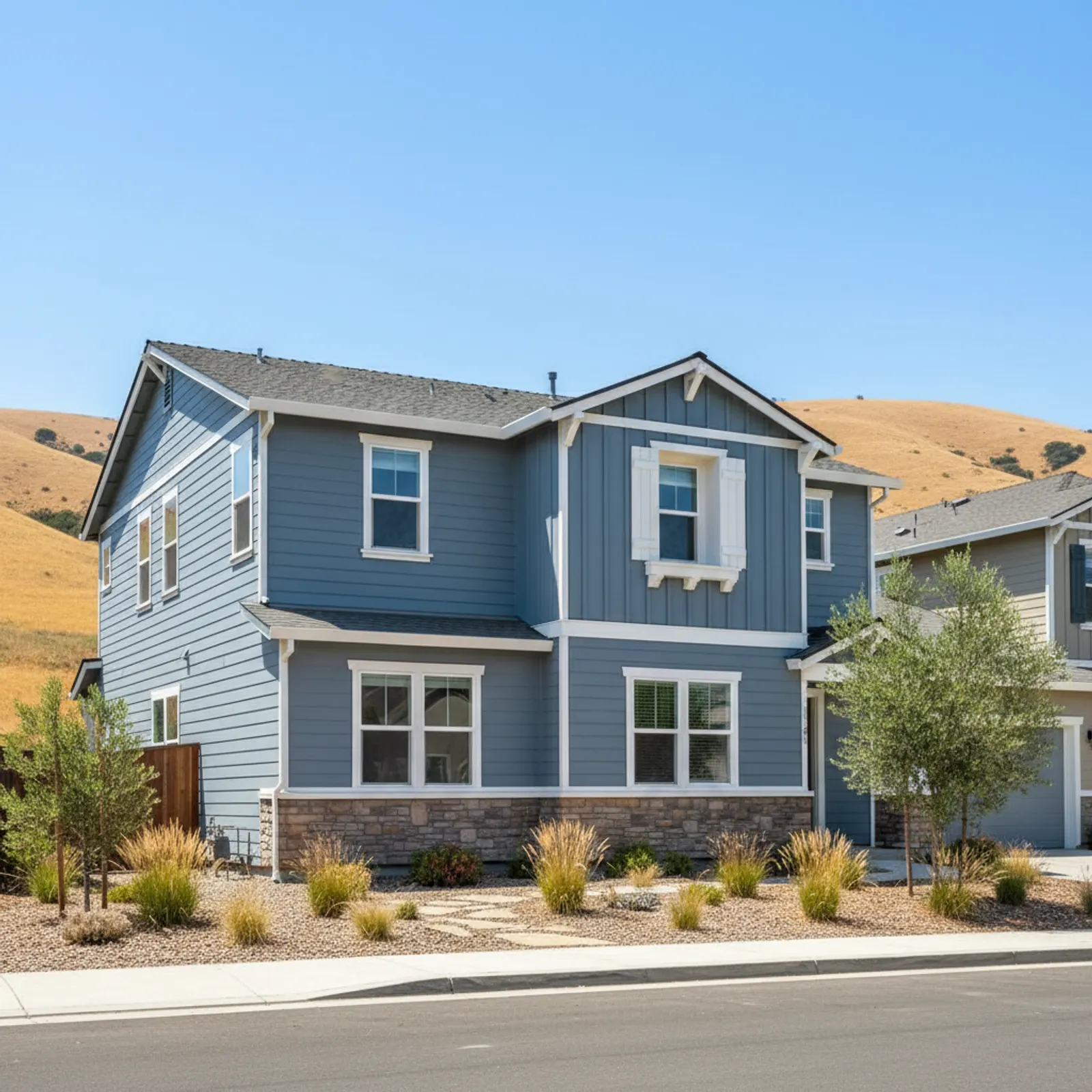
Exterior renovation in Vacaville
Vacaville sits between Sacramento and the Bay Area, a steadily growing Solano County city of master-planned tract neighborhoods, an older downtown, and rural-residential and ranch land climbing toward the Vaca Mountains and the English Hills. Its exterior story is mostly valley heat, with a real fire-aware consideration on the foothill-leaning margins and the hills affected by the LNU Lightning Complex fire.
A production-to-foothill gradient
What makes Vacaville unusual is how quickly the setting changes across town. The production core sits on the open valley floor, where heat and the wind funneling through the Vaca gap drive the spec, while parcels climbing toward the hills carry a genuine fire consideration the flatland core does not. That gradient means two Vacaville homes a few miles apart can call for meaningfully different detailing, which is why we read the parcel's position before recommending a system.
Considering an exterior project in Vacaville?
Vacaville housing and architecture
Vacaville's stock is largely 1980s through 2010s production tract homes, older homes near the historic downtown, and rural-residential and ranchette parcels spread toward the hills. The newer tract homes are now reaching re-side age and modernize strongly with a clean lap-and-batten program and refreshed trim, since most share a predictable vintage and detailing. Downtown-adjacent older homes warrant more period-sensitive profiles, while the hill-edge and rural parcels warrant a fire-aware specification on top of the standard heat-and-wind detailing the valley demands.
Vacaville's interior-valley climate
Vacaville's controlling stressor is interior-valley heat paired with strong UV and notable wind through the Vaca gap, the pass that funnels air between the Coast Range and the valley floor. Summers run hot and dry while winters stay mild, so the spec is driven less by moisture than by heat movement, color fade, and wind-driven rain forced into wall assemblies. That pushes the detailing toward fade-resistant finishes, careful flashing, and wind-aware fastening rather than the moisture management a coastal town would need.
Foothill-edge fire detailing in Vacaville
Production-core Vacaville on the valley floor carries lower wildfire exposure, but rural-residential and hill-edge parcels toward the Vaca Mountains and English Hills carry a moderate-to-elevated consideration, underscored locally by the LNU Lightning Complex fire. For those exposed parcels we specify non-combustible cladding and harden the vulnerable assemblies, detailing eaves, vents, and wall-to-roof transitions so embers have fewer paths in. We assess fire exposure honestly by where the home actually sits and will not overstate the risk on a flatland production lot.
Recommended materials for Vacaville
James Hardie fiber cement with a fade-resistant factory finish and wind-aware fastening is the core recommendation for Vacaville. It handles the interior heat and the UV load that fades field paint quickly, stands up to Vaca-gap wind-driven rain when the flashing is detailed correctly, and, being non-combustible, covers the hill-edge fire consideration without a separate material change. That single system serves both the valley-floor tracts and the foothill-leaning parcels, which simplifies the spec across Vacaville's varied terrain.
What an exterior project costs in Vacaville
Vacaville pricing follows the usual drivers: home size and number of stories, trim complexity, and the substrate and dry-rot condition revealed once old cladding comes off. Window integration and wind-aware flashing detail add scope, and hill-edge parcels carry added fire-detailing work the flatland tracts do not. Rural and ranchette properties can also bring access and staging realities that a compact tract lot avoids. We provide a written, scoped estimate after an on-site assessment, and that written estimate governs the project.
Master-planned tracts reaching re-side age
The bulk of Vacaville's housing is 1980s through 2010s production neighborhoods, and the earlier of these are now squarely in re-side territory as original cladding fades and weathers. Because these homes share builder vintages, footprints, and detailing, a clean profile-and-trim program modernizes them efficiently and predictably. Access on these planned lots is usually straightforward, which keeps the work moving, though we still confirm each home's stories, substrate, and window condition rather than assuming a tract is uniform.
Downtown and rural-residential parcels
Beyond the tracts, Vacaville runs from an older historic downtown to rural-residential and ranchette parcels climbing toward the hills. Older downtown-adjacent homes often want more period-sensitive profiles and trim than a production tract, while rural parcels add larger building envelopes, longer driveways, and the foothill fire consideration. These properties reward a parcel-specific scope, since the staging, the substrate surprises, and the fire detailing all vary far more than they do on a uniform planned street.
Wind and the Vaca gap
The wind that funnels through the Vaca gap is a defining local factor that calmer valley towns do not share. It drives rain into wall assemblies and stresses fasteners, so flashing integration and fastening detail carry more weight here than the cladding choice alone. We plan the weather-management scope around that wind exposure, which is also why correct window flashing matters more on a Vacaville re-side than it would in a sheltered interior location.
Our process in Vacaville
- Step 1
Consultation
We listen to your goals and assess your home on site — exposure, substrate, and architecture.
- Step 2
Design & Proposal
A clear written proposal with the right system specified for your climate and a transparent scope.
- Step 3
Expert Installation
Trained crews install to manufacturer best practices with careful weather-management detailing.
- Step 4
Walkthrough & Support
A final walkthrough, full cleanup, and a clear written record of the scope completed — work we stand behind.
Vacaville rewards an exterior strategy that respects its heat, its Vaca-gap wind, and its production-to-foothill gradient. We scope every Vacaville project on site, match the fire and weather detailing to where the home actually sits, and set it down in a written estimate before work begins.
FAQ
Vacaville — Common Questions
Fade-resistant James Hardie fiber cement with wind-aware fastening — it handles the interior heat and Vaca-gap wind and covers the hill-edge fire consideration without a material change.
Rural and hill-leaning parcels toward the Vaca Mountains carry a moderate-to-elevated consideration underscored by the LNU fire; production-core homes carry lower exposure.
The Vaca gap funnels notable wind that drives rain into walls, making flashing and fastening detail more important than in calmer valley locations.
Yes — the 1980s–2010s production homes are reaching re-side age and modernize strongly with a clean profile and trim program.
Original tract cladding reaches end of life after decades, and heat plus wind-driven moisture accelerate it where detailing is poor. Fade-resistant, wind-aware detailing resolves it.
When feasible, yes — correct flashing integration matters more in a wind-driven-rain environment.
Home hardening can support insurability on exposed parcels. We document the materials and assemblies used; insurers set their own criteria.
A correctly installed fiber cement system commonly performs 30+ years in Vacaville's climate.
Explore
Exterior Services
Helpful Exterior Guides