
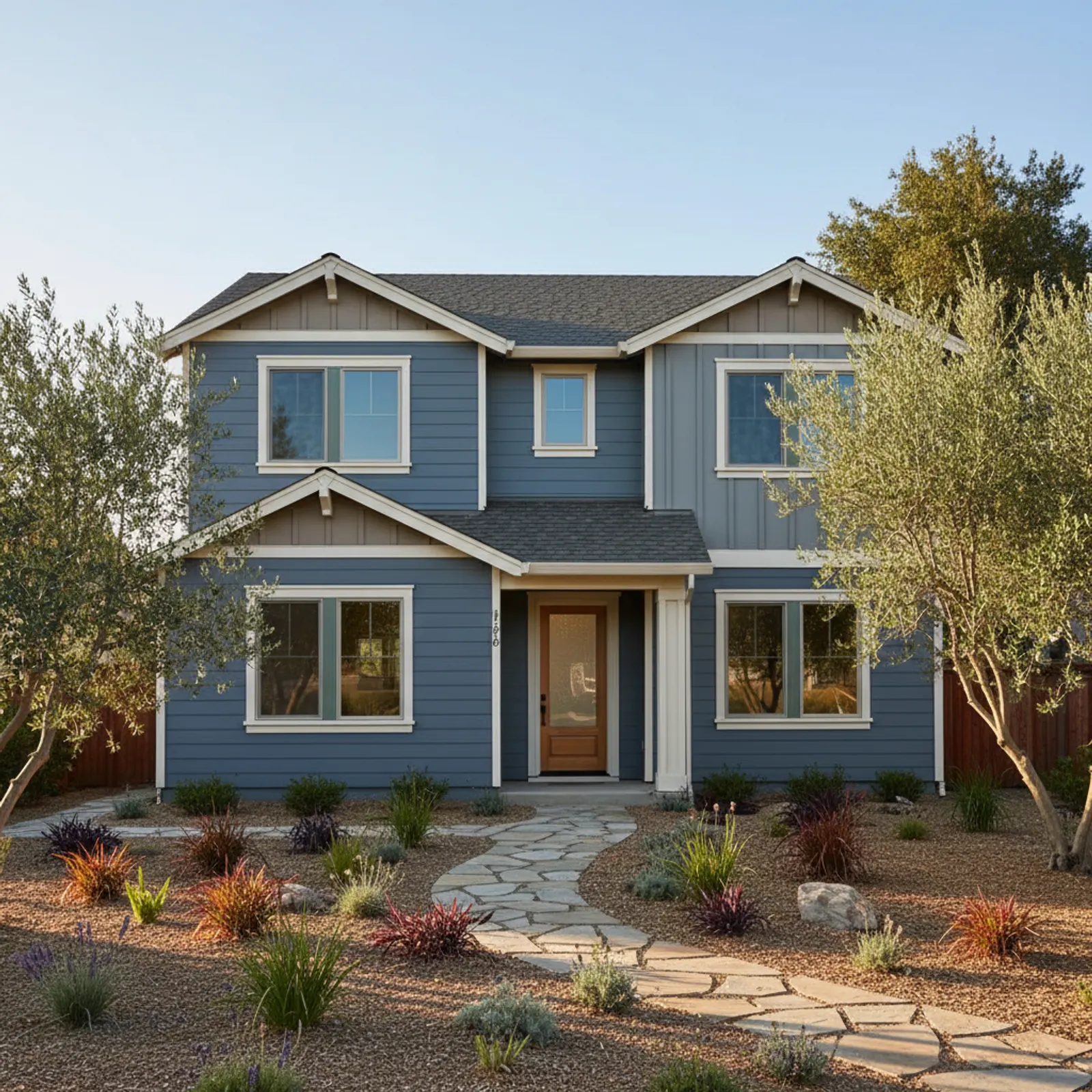
Exterior Contractor in Fairfield
Fairfield is a Solano County family city — Travis-adjacent neighborhoods, master-planned subdivisions like Paradise Valley and Green Valley, older tract homes through central Fairfield, and a continuing wave of family-oriented infill. The exposure profile is straightforward: hot summers, moderate winter moisture, minimal fire exposure on most parcels, modestly elevated exposure on the hillside edges toward Green Valley.
A Fairfield exterior contractor delivers a complete envelope project — cladding, windows, WRB, trim, refined finish — as one accountable scope rather than as a sequence of separate trade engagements. Fairfield owners are pragmatic and want a project that finishes; the integrator's value is doing it once.
What an integrated Fairfield exterior includes
On a typical Fairfield production home an integrated scope strips failed builder cladding, corrects the WRB, integrates window replacement where the originals are dated, and re-clads in fiber cement with a refined trim package and modernized color program. Green Valley and other hillside-edge parcels add ember-resistant vents and hardened eaves where exposure warrants it.
Where the split-trade exterior fails in Fairfield
Fairfield's failure mode is the same as most production-tract markets: separate trades, separate flashing strategies, an interface failure waiting to happen at the window-to-WRB seam. An integrator scopes the whole envelope at once.
Materials and detailing we specify for Fairfield
Fiber cement with factory ColorPlus finishes for heat and moisture durability, integrated window package where needed, and a clean modern trim package. Hillside-edge parcels (Green Valley) get hardening detail scaled to actual exposure.
Sequencing one exterior crew around the Suisun wind window
The single most underrated planning factor for an exterior contractor in Fairfield is when the wind blows, not just that it does. The Suisun gap pushes sustained afternoon wind through Cordelia and the central neighborhoods almost daily in the warm months, and that pattern dictates how an integrated crew stages a job. Open wall cavities, loose housewrap, and freshly set trim do not tolerate gusts well, so we schedule the vulnerable phases of an envelope project for calmer morning hours and close walls back up before the daily build. Tear-off on tract and master-planned homes gets confined to sections we can dry in the same day rather than stripping a whole elevation and leaving it exposed. Material staging matters too: panel stacks and underlayment rolls become sails on an open Fairfield lot. Running cladding, windows, weather barrier, and trim as one coordinated scope lets us hold that morning-to-afternoon rhythm across every trade, which a split-trade approach with separate subs arriving on separate days cannot reliably do here.
Wind-driven rain detailing for aging builder-grade walls
Much of Fairfield's housing stock in Paradise Valley, Green Valley, and the older central tracts has reached the age where the original builder-grade siding, trim, and flashing are failing at the same time. Where wind is steady, that combination is worse than ordinary age would predict, because the Suisun corridor drives rain horizontally into walls rather than letting it run straight down. Water finds the weak laps, the unsealed butt joints, and the head flashings that were never sized for sideways pressure. As an exterior contractor handling the full envelope, we treat those interfaces as the real project rather than chasing cosmetic siding swaps. That means integrating the weather-resistive barrier with window flashing as a continuous shingled system, detailing kickout flashing where roof meets wall on the two-story plans common in these subdivisions, and back-caulking trim joints that face the prevailing wind. The payoff of doing cladding, windows, and trim under one accountable scope is that no flashing lap gets orphaned at a handoff between trades, which is exactly where these aging Fairfield walls tend to leak.
Why this matters in Fairfield
- Specified for Interior Valley conditions
- James Hardie fiber cement as the recommended system
- Correctly detailed weather-resistive barrier and flashing
- Installed by a crew with 20 years combined experience
Recommended systems for Fairfield
- James Hardie fiber cement
- wind-aware fastening
- factory finishes
Exterior Contractor for Fairfield homes
The full exterior contractor approach — materials, weather-resistive detailing, and the manufacturer standards we install to — is covered on the main service page, then specified for Fairfield's conditions on this one.
Our Fairfield process
- Step 1
Consultation
We listen to your goals and assess your home on site — exposure, substrate, and architecture.
- Step 2
Design & Proposal
A clear written proposal with the right system specified for your climate and a transparent scope.
- Step 3
Expert Installation
Trained crews install to manufacturer best practices with careful weather-management detailing.
- Step 4
Walkthrough & Support
A final walkthrough, full cleanup, and a clear written record of the scope completed — work we stand behind.
FAQ
Exterior Contractor in Fairfield — FAQ
On Green Valley hillside lots and parcels backing to the hills, real moderate exposure. Central tract is essentially low-fire.
Most newer master-planned Fairfield communities do. We prepare the submission packet as part of the project scope.
On homes with original or first-generation builder windows, yes — the integration only works correctly when both are part of the same project.
Most Fairfield single-family homes are three to six weeks of active work depending on size and scope.
Keep Exploring
More for Fairfield homeowners
More in Fairfield
Other exterior services in Fairfield
Nearby Service Areas
Exterior Contractor near Fairfield
Helpful Exterior Guides