
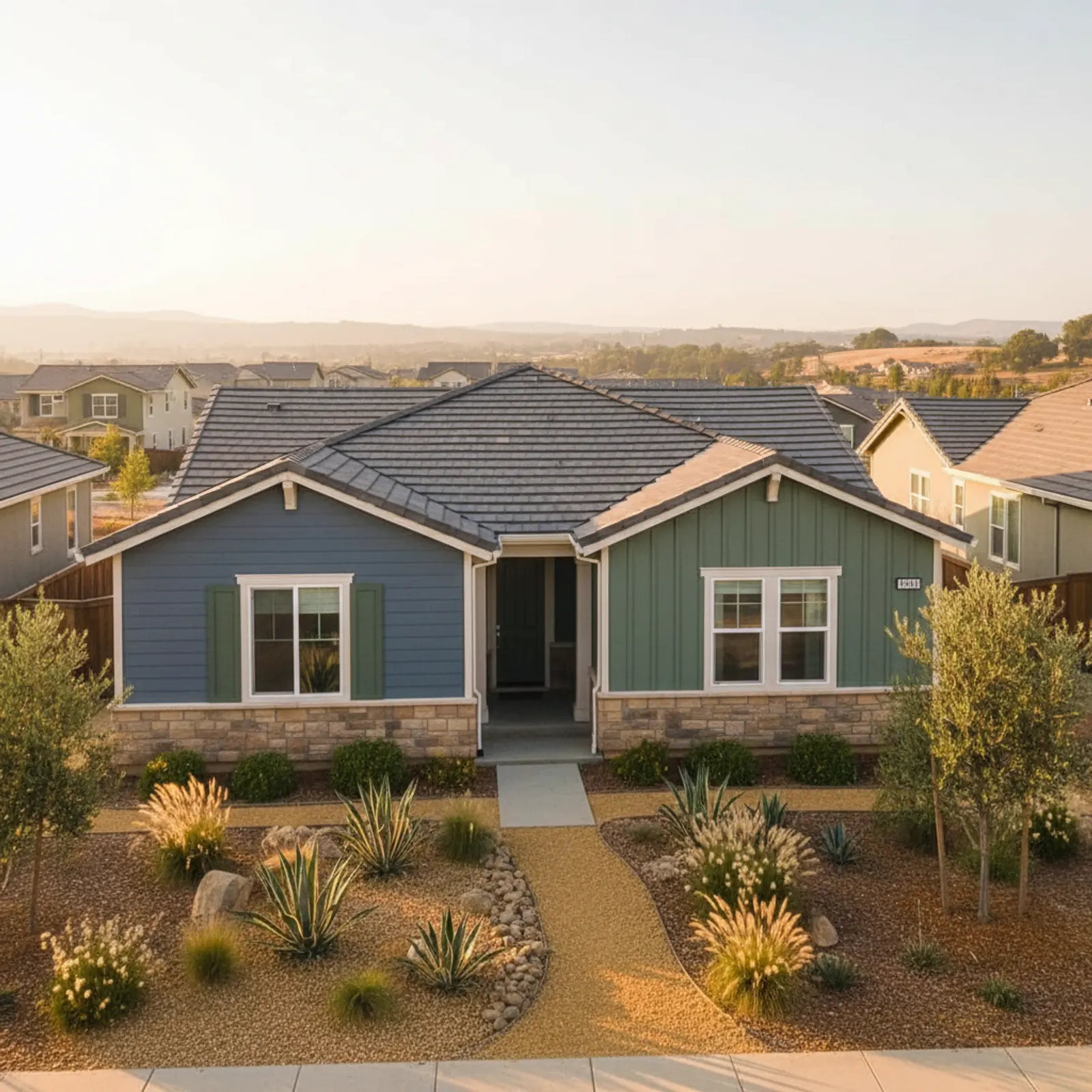
Fire-Resistant Siding in Fairfield
Plainly: Fairfield is low wildfire-exposure — interior-valley suburbia, not foothill or wooded terrain. Fire-resistant siding here is a low-regret default with only a modest grassland-edge nuance on the city's open margins, not an urgent need.
Travis Air Force Base and the surrounding undeveloped grassland do produce occasional grass-fire activity, and Green Valley parcels backing the hills carry slightly more exposure than central tract. But these are nuances, not the headline — heat-and-wind durability is the actual project driver in Fairfield.
Fairfield's modest exposure picture
Interior Fairfield carries low exposure. The only nuance is the surrounding grassland and hill margins, where seasonal grass fire is a modest consideration on outermost parcels — not the wooded WUI risk of foothill communities.
Rides with the next-owner durability spec
Fairfield's Travis-AFB relocation market makes resale-grade durability the driver — fiber cement that inspects clean for the next owner. Class A non-combustibility is a free byproduct, modestly useful only on the outermost grassland margins; not a fire pitch for an interior Suisun-gap address.
Where the Suisun wind, not flame, sets the fire-rated spec
On most Fairfield homes the case for fire-resistant siding gets made by the wind, not the wildfire map. The Suisun gap pushes strong, sustained gusts across Cordelia and the central tracts, and that same air movement is what turns a stray grass-fire ember from Travis or the open margins into something that lands on a wall. Noncombustible fiber cement earns its place here because it does two jobs at once: it shrugs off windborne embers and it takes the constant wind-driven rain loading that batters west- and north-facing elevations. We treat the assembly as a system, not just a board. Tightly fitted joints, fastener patterns rated for the local wind exposure, and sealed end-cuts keep gusts from working behind the cladding where they would otherwise find the old builder-grade sheathing. The fire rating is the easy part; surviving decades of Fairfield's gap-funneled wind is the harder spec, and it is the one that quietly decides how long the install actually holds.
Green Valley's hill-backed lots versus the central-tract baseline
Fairfield is not one exposure picture, and fire-resistant siding decisions should follow the lot, not the city name. Parcels in Green Valley and along Paradise Valley that back onto open hillside or grassland sit closer to the grass-fire activity that occasionally moves off the undeveloped margins, so those elevations are where a fully noncombustible wall, ember-resistant venting, and careful soffit detailing genuinely pay off. The deeper central neighborhoods read differently: interior suburbia surrounded by other homes and paving, where fire-rated cladding is a sensible low-regret upgrade rather than a pressing need. Much of this housing has reached the age where the original builder siding and trim are failing anyway, so the practical move is to fold the fire-resistant material into a re-side that was already due. We scope the hill-facing walls to a stricter standard and let the protected interior elevations ride the durability baseline, which keeps the budget aimed at the elevations in Fairfield that actually carry the exposure rather than spreading it evenly across a house that does not need it.
Why this matters in Fairfield
- Specified for Interior Valley conditions
- James Hardie fiber cement as the recommended system
- Correctly detailed weather-resistive barrier and flashing
- Installed by a crew with 20 years combined experience
Recommended systems for Fairfield
- James Hardie fiber cement
- wind-aware fastening
- factory finishes
Fire-Resistant Siding for Fairfield homes
The full fire-resistant siding approach — materials, weather-resistive detailing, and the manufacturer standards we install to — is covered on the main service page, then specified for Fairfield's conditions on this one.
Our Fairfield process
- Step 1
Consultation
We listen to your goals and assess your home on site — exposure, substrate, and architecture.
- Step 2
Design & Proposal
A clear written proposal with the right system specified for your climate and a transparent scope.
- Step 3
Expert Installation
Trained crews install to manufacturer best practices with careful weather-management detailing.
- Step 4
Walkthrough & Support
A final walkthrough, full cleanup, and a clear written record of the scope completed — work we stand behind.
FAQ
Fire-Resistant Siding in Fairfield — FAQ
Most Fairfield homes are low-exposure interior valley, so it's a low-regret upgrade rather than a necessity. Outer grassland-edge parcels carry a modest consideration; we assess honestly.
No — Fairfield is interior-valley suburbia with low exposure; wooded foothill communities are the high-exposure ones. We don't overstate Fairfield's risk.
No — the fiber cement we recommend for Fairfield's heat and wind is already non-combustible, so Class A fire performance is included.
In low-exposure Fairfield the effect is usually modest; it matters far more in WUI areas. We document materials used if your carrier asks.
Keep Exploring
More for Fairfield homeowners
More in Fairfield
Other exterior services in Fairfield
Nearby Service Areas
Fire-Resistant Siding near Fairfield
Helpful Exterior Guides