
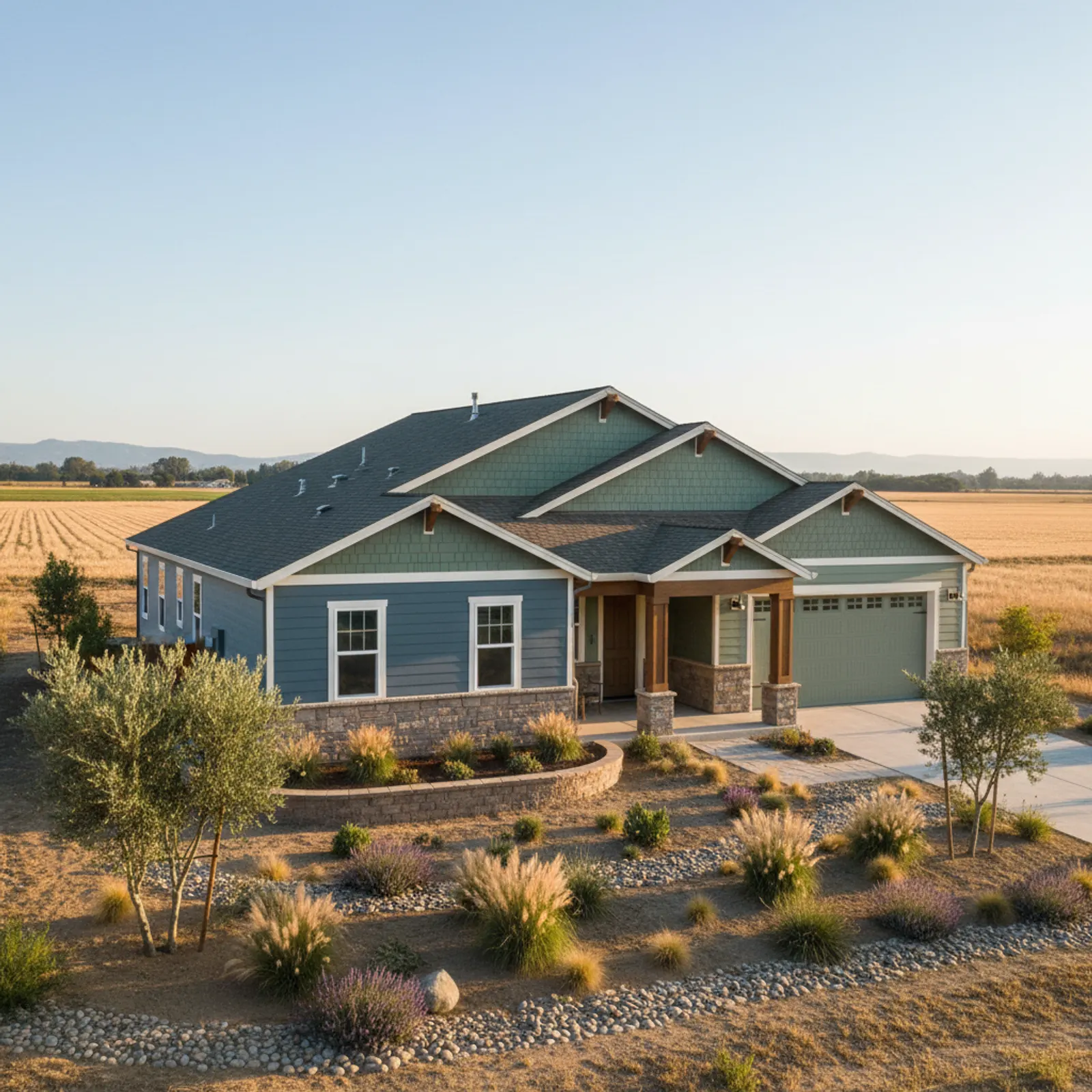
Siding in Dixon
A Dixon re-side is hot, windswept, open-ag-land work — no fire, no marine damp. This small flat farm town between Davis and Vacaville sits in fully open agricultural country: intense interior-valley heat and UV plus persistent strong open-field wind (and the dust and uplift it drives) are the controlling factors, on a practical small-town, ag-edge, and modest-tract stock.
So a Dixon project is scoped around heat-and-UV-stable cladding and genuinely wind-aware fastening and detailing — value-driven, with no fire or moisture overstatement.
Heat, UV, and open-field wind
Dixon's exposed flat-land position means strong, sustained wind on top of hot, high-UV summers. We re-clad in dimensionally stable, fade-resistant fiber cement and pay particular attention to wind-rated fastening and edge/trim detailing so the open-field wind can't work the cladding loose.
A practical farm-town market
Dixon's small-town and ag-edge homes want durable, low-maintenance value — a heat-stable, wind-secured re-clad that ends the repair cycle without estate-grade cost.
Wind-driven dust and the fastener schedule it forces
Out on the Solano plain there is nothing between Dixon and the next farm row to break the wind, so siding here takes a steady mechanical beating that gentler towns never see. Sustained gusts crossing open ag land carry fine field dust that works its way behind loose laps and scours the bottom edge of every course. That changes how we install rather than just what we install. On Dixon re-sides we tighten fastener spacing beyond the minimum, drive nails into the stud line rather than sheathing alone, and back-prime cut ends so the exposed fiber-cement core does not wick or chalk where the wind finds it. Butt joints get flashed and sealed instead of caulk-only, because caulk alone fails fast under constant movement. Trim, corners, and the starter course are where uplift pries first, so those get extra mechanical anchoring and a tighter reveal. The goal on an exposed Dixon home is a wall assembly that does not rattle, gap, or let grit migrate behind the cladding over a long run of windy summers.
Two housing stocks, two siding approaches
Dixon is really two building eras sitting side by side, and a Siding job behaves differently in each. Around the old downtown core you find older small-town houses with original wood lap, narrower stud bays, and decades of patch-and-paint history; pulling that cladding often reveals tired sheathing, undersized framing nailers, or prior repairs that have to be sorted before new fiber cement goes up. These homes reward a careful tear-off and a fresh weather-resistant barrier rather than a cover-over. The newer modest subdivisions on the edge of town are a cleaner story: more uniform framing, straighter walls, and predictable courses, where the work is mostly matching profile and reveal so the re-side reads as intentional, not patched. We scope each address to its era instead of pricing every Dixon house the same. An old-downtown bungalow and a recent tract home on the same street can need very different prep hours even for an identical cladding choice, and being honest about that up front is how a project stays on budget here.
Why this matters in Dixon
- Specified for Interior Valley / Ag Edge conditions
- James Hardie fiber cement as the recommended system
- Correctly detailed weather-resistive barrier and flashing
- Installed by a crew with 20 years combined experience
Recommended systems for Dixon
- James Hardie fiber cement
- wind-aware fastening
- low-maintenance finishes
Fiber Cement Siding for Dixon homes
The full fiber cement siding approach — materials, weather-resistive detailing, and the manufacturer standards we install to — is covered on the main service page, then specified for Dixon's conditions on this one.
Our Dixon process
- Step 1
Consultation
We listen to your goals and assess your home on site — exposure, substrate, and architecture.
- Step 2
Design & Proposal
A clear written proposal with the right system specified for your climate and a transparent scope.
- Step 3
Expert Installation
Trained crews install to manufacturer best practices with careful weather-management detailing.
- Step 4
Walkthrough & Support
A final walkthrough, full cleanup, and a clear written record of the scope completed — work we stand behind.
FAQ
Siding in Dixon — FAQ
Dixon is flat open-ag land with NO foothill fire fringe — its distinctive factor is strong open-field wind on top of interior heat/UV, versus Vacaville's heat-plus-moderate-foothill-fire split.
Sustained open-field wind works at fasteners and edges while hot, high-UV summers cycle the material — wind-rated fastening and heat-stable cladding fix the root causes.
Low — Dixon is flat agricultural valley with no wildland interface. Heat, UV, and wind, not fire, are the controlling factors. Non-combustible fiber cement is still a sound, low-regret default.
Minor — Dixon is hot and dry; heat, UV, and wind are the real factors, not damp.
We scope practically for this farm-town value market — a durable, heat-stable, wind-secured fiber cement re-clad without estate-grade cost.
Keep Exploring
More for Dixon homeowners
More in Dixon
Other exterior services in Dixon
Helpful Exterior Guides