
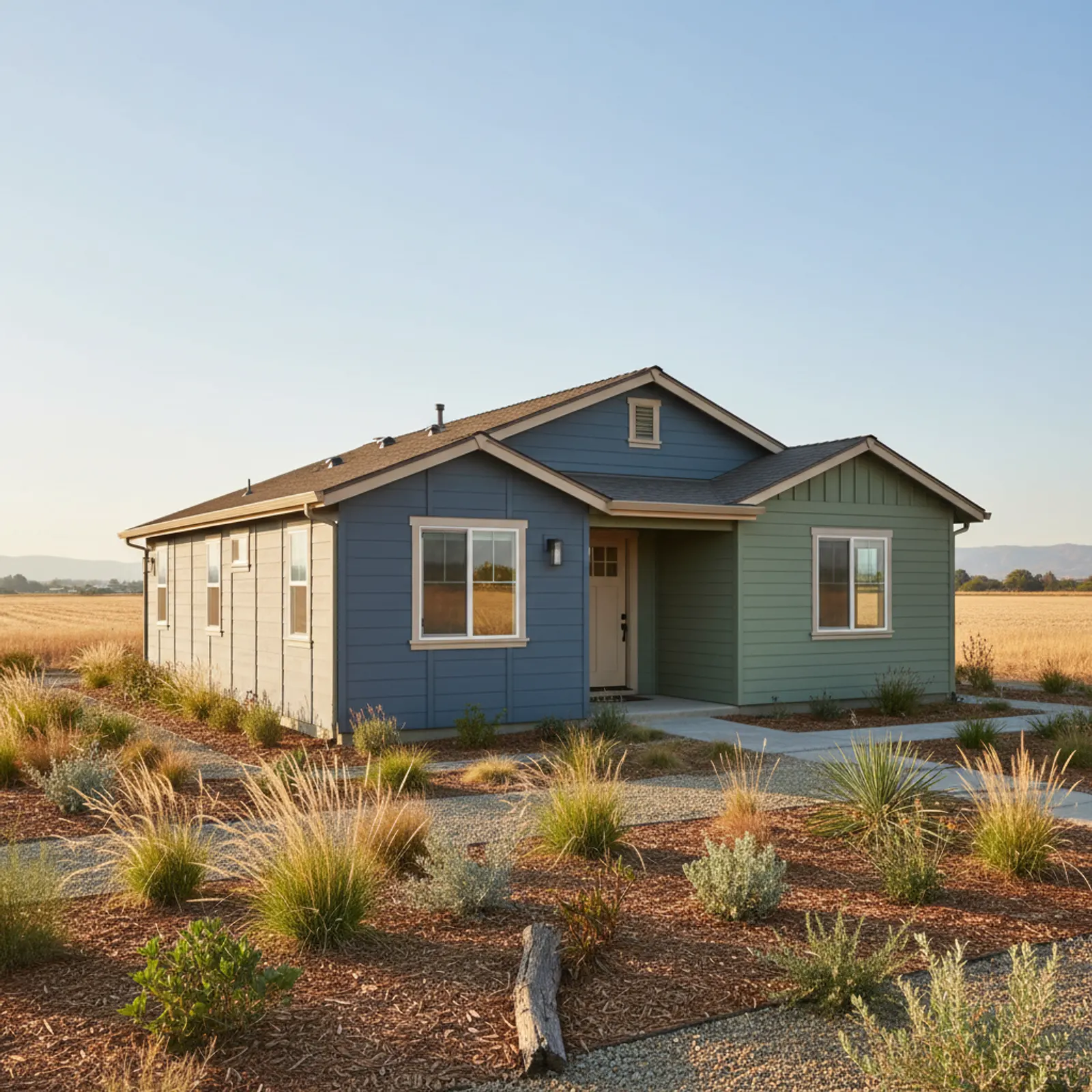
Fire-Resistant Siding in Dixon
Direct answer: Dixon is flat open agricultural valley with low wildfire exposure — heat, UV, and open-field wind, not fire, are the controlling factors. Fire-resistant siding here is a low-regret choice, not a need, and we won't manufacture urgency for a Dixon address.
Dixon's developed housing footprint sits surrounded by managed farmland with no canyon, no forested edge, no meaningful brush adjacency. Grass-fire activity in the surrounding fields is occasional but doesn't reach the city's developed parcels. The honest scope is heat-and-wind cladding with Class A non-combustibility coming free with fiber cement.
Dixon's exposure reality
Dixon's small-town and ag-edge homes carry low wildfire exposure — flat farmland with no wildland interface. We tell Dixon owners plainly that heat, UV, and wind are the real concerns, not fire.
Part of the total-exposure value spec
Dixon's case is the open Solano plain — full sun, unobstructed wind, field dust, nothing to break any of it — answered by correctly installed value-grade fiber cement. Class A non-combustibility is included; on flat farmland with no wildland interface it's a margin we state plainly, not sell.
Why open-field wind drives the fastener spec on Dixon homes
On a city ringed by farmland between Vacaville and Davis, the load that actually tests fire-resistant cladding here is not flame, it is the steady wind that runs across cut fields with nothing to break it. Fiber cement is the natural answer in Dixon because it solves two problems at once: the Class A non-combustible rating arrives at no extra cost, and the panel weight plus a tight fastening schedule stand up to gusts that would rattle thinner board. On exposed lots near the open ag edge, we tighten nail spacing, hit framing rather than sheathing alone, and pay attention to corners and gable ends where uplift concentrates. Vented soffits and trim get the same scrutiny, since wind-driven dust off the surrounding farms finds any loose joint. The point is that a Dixon home gets a fire-rated wall almost incidentally, while the engineering attention goes where the real stress is. We spec the system for the exposure that genuinely controls performance here, not for a wildfire threat the parcels do not face.
Fitting the work to Dixon's old downtown and newer tracts
Dixon's housing splits roughly into two groups, and fire-resistant siding plays out differently across them. The older homes near the historic downtown core often carry decades-old wood or stucco that has baked under interior-valley sun, and a re-clad there is as much about correcting sun-tired, checked surfaces as adding a non-combustible skin. The modest newer subdivisions on the city's edges tend to have simpler, more uniform elevations, which makes panel layout and trim returns cleaner and the job faster to scope. In both cases the honest selling point is heat and UV durability, with the Class A rating riding along free with fiber cement rather than being the reason to buy. Access on the newer tracts is usually straightforward with side yards and standard setbacks, while the older lots can be tighter and may need more care staging materials. We size the scope, color hold-up, and trim detailing to the specific block rather than treating every Dixon address as one generic exterior, and we won't oversell fire risk to push a larger job.
Why this matters in Dixon
- Specified for Interior Valley / Ag Edge conditions
- James Hardie fiber cement as the recommended system
- Correctly detailed weather-resistive barrier and flashing
- Installed by a crew with 20 years combined experience
Recommended systems for Dixon
- James Hardie fiber cement
- wind-aware fastening
- low-maintenance finishes
Fire-Resistant Siding for Dixon homes
The full fire-resistant siding approach — materials, weather-resistive detailing, and the manufacturer standards we install to — is covered on the main service page, then specified for Dixon's conditions on this one.
Our Dixon process
- Step 1
Consultation
We listen to your goals and assess your home on site — exposure, substrate, and architecture.
- Step 2
Design & Proposal
A clear written proposal with the right system specified for your climate and a transparent scope.
- Step 3
Expert Installation
Trained crews install to manufacturer best practices with careful weather-management detailing.
- Step 4
Walkthrough & Support
A final walkthrough, full cleanup, and a clear written record of the scope completed — work we stand behind.
FAQ
Fire-Resistant Siding in Dixon — FAQ
Dixon is low-exposure flat farmland, so it's a low-regret upgrade rather than a necessity. We won't overstate fire risk for this address.
Low — flat open agricultural valley with no wildland interface. Heat, UV, and wind are the controlling factors.
No — the fiber cement we recommend for Dixon's heat and wind durability is already non-combustible, so Class A performance is included.
Heat- and UV-stable cladding and wind-rated fastening, plus air-sealed windows — the failures that actually affect open-ag-land Dixon homes.
Keep Exploring
More for Dixon homeowners
More in Dixon
Other exterior services in Dixon
Nearby Service Areas
Fire-Resistant Siding near Dixon
Helpful Exterior Guides