
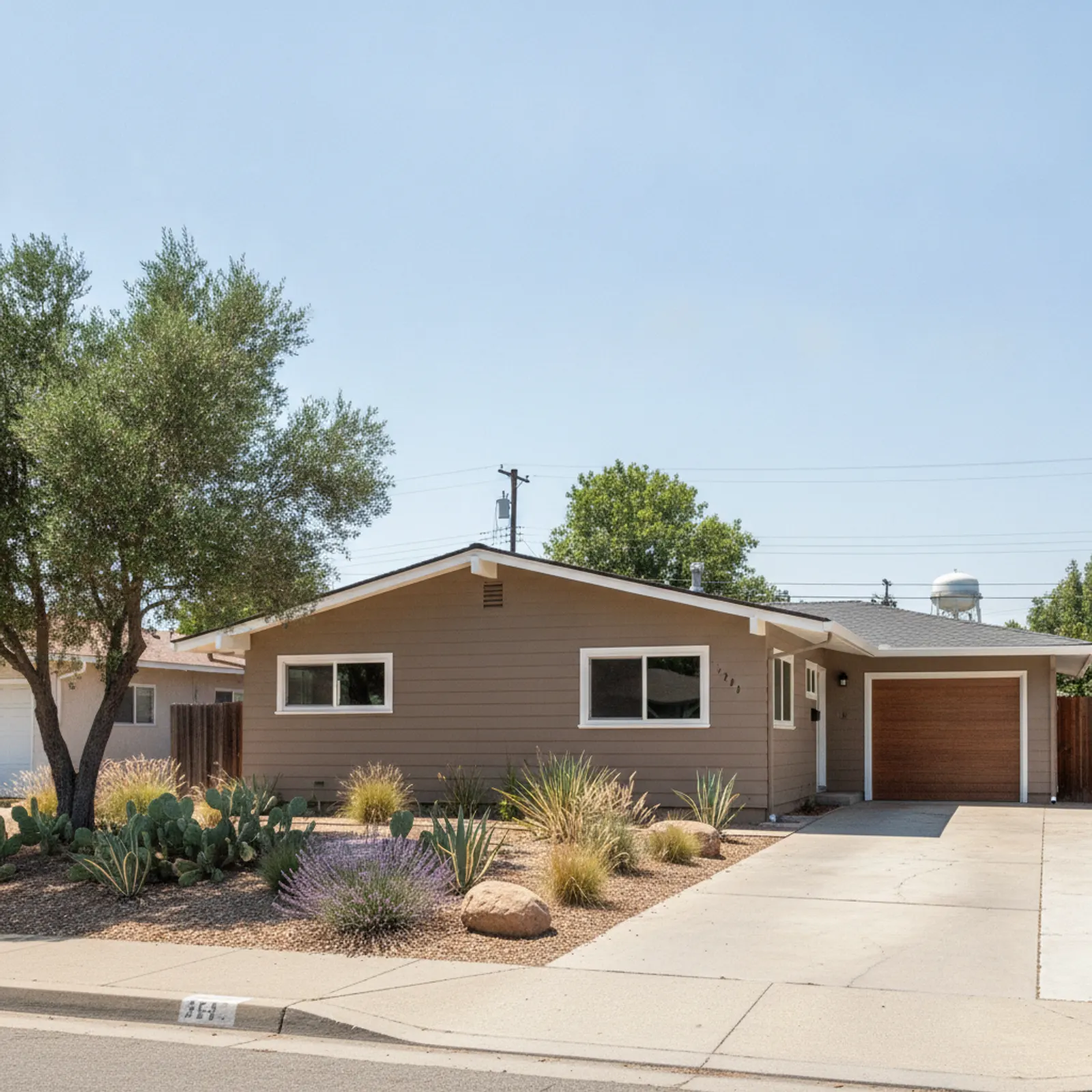
Exterior renovation in Turlock
Turlock was platted as a railroad and colony town on the flat southern Stanislaus plain, and its street grid still carries the layers of the people who built it: the Swedish colonists who settled the land around 1900, the Portuguese and Azorean families who anchored its dairies, and the Assyrian community that arrived from the Urmia region in the 1910s and made the south side a lasting cultural center. On top of that heritage the city added post-war and mid-century ranch tracts, a rental-heavy belt that grew up around California State University, Stanislaus off the Monte Vista corridor, and newer master-planned subdivisions pushing into the Northwest Triangle and the northeast edge. Much of the older stock still wears the original hardboard, T1-11, and builder-grade lap it was finished with decades ago, which keeps Turlock a broad and unhurried re-side market rather than a single-neighborhood one.
What actually wears out siding here
Two forces do the damage in Turlock, and only one of them is the sun. The first is the open valley UV load that bleaches paint and powders economy cladding on a flat, thinly shaded townsite. The second is the fine agricultural dust that drifts in off the surrounding almond orchards, alfalfa, and dairy ground, especially through harvest and tillage — it settles into a chalky finish and dulls color faster than owners expect, so a wall on the orchard-facing side of town can look tired even where the paint itself is sound. Fire and river flooding are not the concern here; Turlock sits well out on the ag floor. A re-side in this city is really about putting a hard, wash-down surface on homes that have been taking sun and orchard dust together for thirty or forty years.
Considering an exterior project in Turlock?
Turlock housing and architecture
The oldest character homes cluster in the colony-era grid around Main Street, Crane Park, and the historic south-side neighborhoods long tied to the Assyrian and Portuguese communities — modest early-twentieth-century bungalows and cottages that read best with a narrow-exposure lap and honest, proportioned trim. Out from that core sit broad dairy-country ranch neighborhoods that take a clean lap or a lap-and-batten field cleanly, and the Monte Vista rental corridor near Stanislaus State, where the priority is a tough, low-fuss exterior over fine detail. The newest homes — the Northwest Triangle subdivisions and the northeast tracts — are repeated builder elevations that come alive with a considered trim and color program. We match the approach to each of these Turlocks rather than running one recipe from the colony grid to the edge subdivisions.
Built for Turlock heat and orchard dust
We build Turlock exteriors for a long, high-UV valley summer and for the agricultural grit that comes with living inside almond and dairy country. Fiber cement with a baked-on factory color is the answer to both: the finish resists the bleaching that ruins field paint out here, and its hard, dense face sheds the orchard dust that grinds into softer cladding and holds it. Board choice is only half of it — the detailing carries the rest. We set the gaps and fasteners for the wide day-to-night temperature swing common on the open plain, and we weight color and profile toward the west- and south-facing walls that take the worst of the afternoon glare on Turlock's low-canopy streets. Moisture stays a minor, flashing-managed item this far from any river.
Recommended materials for Turlock
For most Turlock homes the core recommendation is James Hardie fiber cement with a factory finish — non-combustible, stable through the valley's heat cycling, and far more color-fast than site paint under this UV and dust load. On the dairy-country ranches and the edge tracts a clean lap or lap-and-batten field with a refreshed palette modernizes the elevation while finally giving the wall a surface built for the plain it sits on. On the colony-grid and south-side character homes we keep the exposure and trim period-appropriate so the block's older lines stay intact. This is a practical, hard-working town — poultry, dairy, and university families who value an exterior that stays put and hoses clean — and the spec we write reflects that. Engineered wood is still a fair option on these ag-floor lots where an owner wants deep wood grain, and we will lay out that trade honestly.
What an exterior project costs in Turlock
Price in Turlock follows home size and stories, the profile and trim you choose, what the crew finds behind the old cladding once it comes off, window integration, and the water-management scope. The colony-era and south-side homes are the ones most likely to hand you a surprise at tear-off — original sheathing and sill framing that has breathed heat and dust for the better part of a century. The Monte Vista rental stock near Stanislaus State often shows deferred upkeep that widens the job. The Northwest Triangle and northeast subdivisions, being young and uniformly framed, tend to price cleanly, though some carry HOA design review that governs color and material. Streets are wide and access is easy across most of the city. We walk the home, then hand you an itemized written estimate, so you are comparing real scope and not a single per-foot figure.
The colony grid, downtown, and the historic south side
Turlock's oldest fabric — the Swedish-colony street grid around Main Street and Crane Park, and the south-side neighborhoods that grew with the Assyrian and Portuguese communities — holds its most heritage-sensitive re-side work. These are modest but characterful early homes, and the right move is restraint: hold the original exposure and trim proportions, keep the block's period feel, and let the durability gain happen quietly under a factory-finished skin. They are also the homes most likely to hide dry rot or layered old siding behind the weathered face, which we plan for at the estimate rather than uncover mid-project.
The Stanislaus State and Monte Vista rental corridor
The housing that fills in around California State University, Stanislaus and along the Monte Vista corridor lives a harder life — denser parcels, student and faculty turnover, and exteriors that can go years between real maintenance. Owners and investors here want a low-upkeep skin that stands up to the valley sun and to heavier use, not fine period detailing. A durable, fade-resistant, wash-down fiber cement re-side protects the asset, cuts the paint-cycle cost that eats into a rental, and lifts a home that changes hands often between tenants and owners.
Northwest Triangle and northeast tract growth
Turlock's newer subdivisions — the Northwest Triangle and the northeast edge among them — extend the city in streets of repeated builder elevations that all reach their first real refresh at once. A modern lap-and-batten program with a refined trim and color package gives one of those production homes its own identity while trading its value-engineered cladding for a heat-stable, dust-shedding system. Where a homeowners association governs the palette, we confirm the approved colors and materials before we scope so the finish we install is the one that clears design review the first time.
City of Turlock, Turlock Irrigation, and Turlock Fire
Working exteriors in Turlock coordinates with a few local authorities. Building permits come through the City of Turlock Community Development Department (Turlock is Stanislaus County's second-largest city and home to Cal State Stanislaus). Electric is uniquely local — the Turlock Irrigation District (TID) is one of only four community-owned California utilities providing both irrigation water and retail electric service; gas is PG&E. Domestic water and wastewater are supplied by the City of Turlock municipal utilities. Fire response is the City of Turlock Fire Department alongside Stanislaus Consolidated Fire Protection District and CAL FIRE Tuolumne-Calaveras Unit (TCU) on wildland calls.
HZ10 climate on Turlock's ag-plain setting
Turlock is in James Hardie's HZ10 climate zone; installing HZ5 is a documented warranty misapplication. On the fire side, essentially all of Turlock sits in Low or unmapped FHSZ territory under California's 2025 LRA Fire Hazard Severity Zone map — this is Central Valley ag-plain ground, and wildland fire is not the local threat. Chapter 7A moved into the standalone WUI Code on January 1, 2026, but does not typically drive Turlock's spec.
Our process in Turlock
- Step 1
Consultation
We listen to your goals and assess your home on site — exposure, substrate, and architecture.
- Step 2
Design & Proposal
A clear written proposal with the right system specified for your climate and a transparent scope.
- Step 3
Expert Installation
Trained crews install to manufacturer best practices with careful weather-management detailing.
- Step 4
Walkthrough & Support
A final walkthrough, full cleanup, and a clear written record of the scope completed — work we stand behind.
Turlock rewards an exterior built for the plain it sits on — sun, orchard dust, and a practical ag-and-university town — whether that is a colony-era bungalow near Crane Park, a dairy-country ranch, a Stanislaus State rental, or a Northwest Triangle tract home. We scope every Turlock project on site and put it in a written, itemized estimate, so your decision rests on real scope rather than a headline number.
FAQ
Turlock — Common Questions
Fiber cement with a baked-on factory finish. Out on Turlock's open plain a home takes both hard summer UV and fine dust off the surrounding orchards and dairies, and a factory-finished, hose-clean fiber cement face holds color and stays put far better than site paint or economy cladding. It is also non-combustible, a sound low-regret choice even though wildfire is not a real concern this far into the ag floor.
It does. Fine agricultural dust drifts in off Turlock's almond, alfalfa, and dairy ground, especially at harvest and tillage, and it settles into soft or field-painted cladding as a chalky film that dulls color early. A dense factory-finished fiber cement surface sheds that dust and washes clean, which is a genuine advantage on the orchard-facing side of town.
Yes. The university-area and Monte Vista rental stock is a core part of Turlock work. These homes benefit most from a durable, low-maintenance, wash-down exterior that takes heavier use and cuts the repaint cycle that eats into a rental — we scope them for longevity and value rather than fine period detail.
Yes. On Turlock's oldest homes — the colony-era grid near Main Street and Crane Park and the historic south-side neighborhoods — we hold the original exposure and trim proportions so the block keeps its period character while the wall gains a modern, durable skin. We also plan for the dry rot and layered old siding these homes often hide, addressing it at the estimate rather than mid-project.