
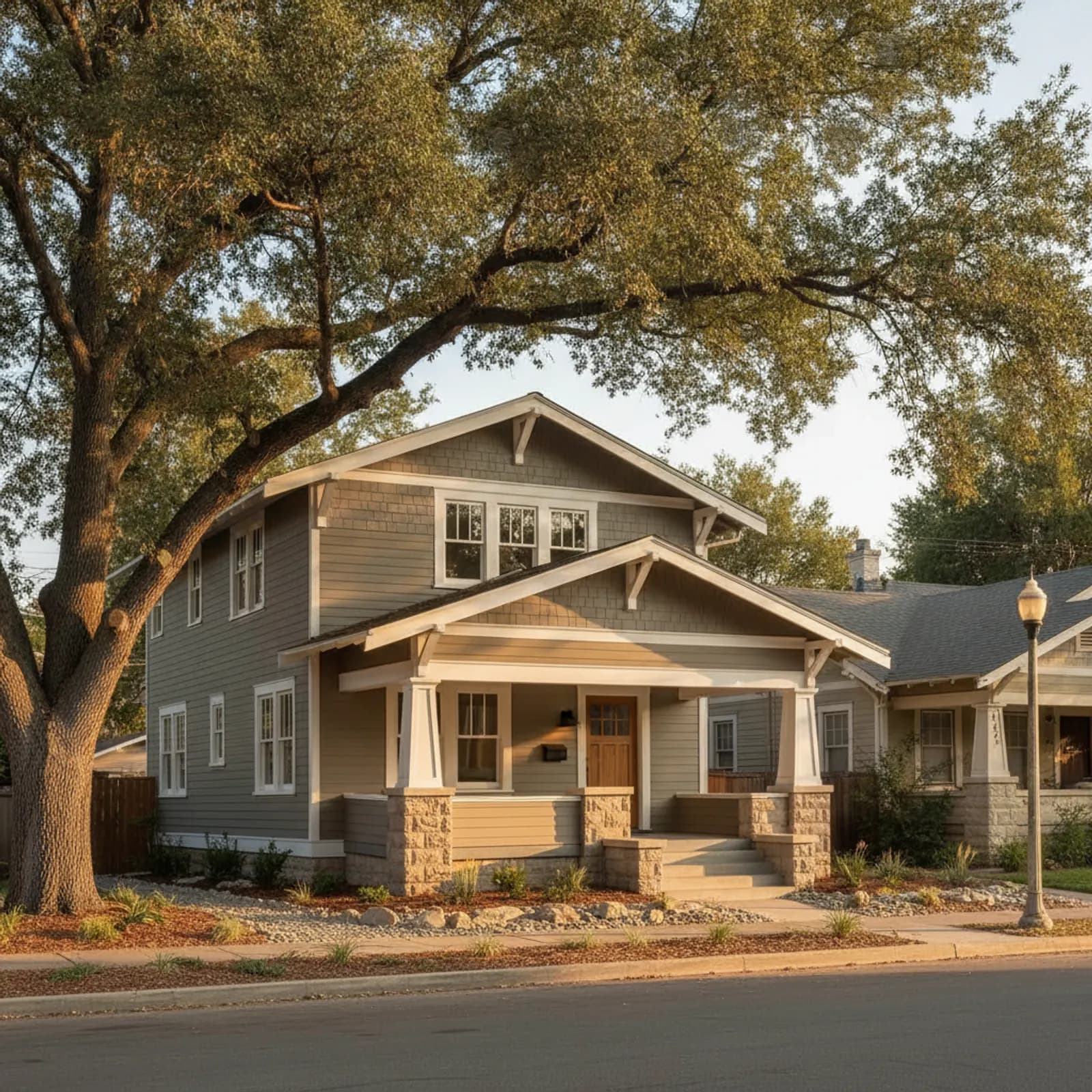
Exterior renovation in Modesto
Drive under the 1912 arch downtown and its motto — Water Wealth Contentment Health — still reads like a mission statement for the city around it. Canal water turned this stretch of the San Joaquin Valley into orchard and vineyard country, the wealth built the McHenry Mansion and the shaded blocks near it, and a century of steady growth filled in ring after ring of neighborhoods: 1920s bungalows close to downtown, the low ranch-house streets where teenagers cruised through the American Graffiti years, and the production subdivisions that carried the city out to Village One and the northeast. At roughly 220,000 people, with Gallo — the world's largest winery — headquartered in town, Modesto is the biggest city we work in south of Sacramento, and nearly every one of those growth rings is now due for the exterior renewal its original builders deferred to a future that has arrived.
How this valley spends a wall
Modesto's climate collects payment from an exterior in two installments. Summer takes the large one: months of cloudless sky over a city that routinely clears the hundred-degree line, delivering the ultraviolet dose that breaks down paint binders and the daily thermal cycling that works boards loose from their fastening. Winter takes the quieter one: tule fog, the dense ground cloud this part of the valley is known for, can sit over the city for days at a stretch, holding walls damp and sunless while condensation probes trim joints and sill lines. Cladding chosen against one bill and not the other fails early either way. The assemblies we install are selected to cover both — dimensionally stable through the heat, indifferent to the fog — and detailed so neither season finds a path behind the boards.
Considering an exterior project in Modesto?
Five generations of Modesto neighborhoods
Modesto's housing reads like tree rings. At the center sit the downtown-adjacent blocks of the McHenry Mansion's Victorian generation; around them, the College Area and La Loma, where 1920s-1940s bungalows and period cottages live under some of the oldest street canopy in the valley; then the vast mid-century belt of low-slung ranches that made this a cruising town; then the 1970s-1990s expansions; and finally Village One and the northeast subdivisions, master-planned and stucco-accented, now old enough for their first serious exterior cycle. Our profile and trim decisions track those rings — tight reveals and true casings where a bungalow street demands them, longer laps and braver color where a ranch elevation can carry it, and accent-and-batten strategies that give a repeated production plan a face of its own.
Sun, shade, and fog: Modesto's three exposures
Few cities demonstrate what tree canopy does to siding as clearly as Modesto. In the College Area, mature ash, sycamore, and camphor filter the summer sun, so walls there fade slowly and unevenly — dappled, orientation-dependent wear that demands careful color judgment during any partial work. Out in the newer subdivisions the same sun lands unfiltered on full two-story elevations, and whole streets go chalky in unison. Winter flips the variable: fog and shade keep the older neighborhoods damp longest, so their trim and lower courses need drainage and ventilation attention the sunbaked tracts can mostly skip. One city, three exposure profiles — and a competent scope begins by identifying which one a given house actually lives in. Wildfire, for the record, is not among Modesto's problems: irrigated valley floor surrounds the city in every direction, and only the county's far eastern reaches ever bring fire into a siding conversation.
What we specify in Modesto
Factory-finished James Hardie fiber cement leads our recommendation across all of Modesto's rings because it is the rare cladding that answers the city's full climate ledger: the oven-cured color coat withstands the valley's ultraviolet intensity, the board neither swells through fog season nor moves excessively through summer cycling, and the maintenance interval stretches to match how long families actually stay in these neighborhoods. On bungalow and Victorian-era homes we pair it with rebuilt wood casings and era-faithful reveals; on ranch and production stock we draw from lap, batten, and shingle-texture combinations to bring the elevation forward. Engineered wood stays on the menu for owners chasing deep grain on this low-fire valley floor, and we price both paths side by side rather than steering.
How Modesto projects price
The honest cost drivers here are era and elevation. A single-story cruising-era ranch with open access is the cleanest scope in the city; a two-story Village One production home adds staging and sheer wall area; a College Area bungalow adds trim carpentry and the near-certainty of discoveries — decades of patch jobs and hidden moisture at the fog-shaded sill lines chief among them. Partial re-sides and accent replacements are common on the newer stock and price accordingly, and some subdivisions carry association color and material review, which we clear before a specification is final. Every figure we quote follows a physical walk of the property and arrives broken into line items, because a Modesto estimate built from a formula misses exactly the variables that matter.
The College Area and La Loma canopy blocks
The College Area and La Loma hold Modesto's most careful work. These are 1920s-1940s houses on streets the city planted generously enough that the canopy now writes the rules: scaffolding threads between limbs, staging respects root zones and neighboring driveways, and the light reaching each wall arrives filtered and uneven, so finish colors have to be judged on the street rather than in a showroom. The houses repay the effort. Held reveals, restored casings, and a period palette on one of these blocks do more than protect a single home — they keep intact a streetscape the whole city recognizes as its best self.
Cruise-era ranches and Graffiti Summer curb appeal
Modesto throws Graffiti Summer every June because George Lucas grew up cruising these streets, and the neighborhoods that era built — mile after mile of low 1950s and '60s ranches — are the workhorse of our Modesto calendar. Their original hardboard has taken sixty valley summers and mostly shows it. The encouraging part is that no housing type converts a re-side into curb appeal more efficiently: long horizontal elevations, simple rooflines, and generous glass mean a well-chosen lap profile and a considered two-tone palette can move one of these houses from tired to sharp in a single project, with the heat-rated assembly underneath doing the quiet half of the job for decades afterward.
Village One and the northeast production wave
Village One and the surrounding northeast subdivisions were Modesto's big master-planned bet of the 1990s, and their first exterior generation is closing out on schedule — builder paint gone flat, hardboard accents swelling at the butt joints, streets of near-identical elevations aging in lockstep. Owners there usually arrive with two goals: stop the deterioration, and stop looking like the four houses nearest them. A re-side answers both. Swapping value-engineered accent panels for fiber cement fields, upgrading the trim story, and stepping outside the original builder palette — with design-review sign-off wherever an association holds it — separates a house from its street while putting genuinely heat-rated material on those walls for the first time in their lives.
Modesto Irrigation District, PG&E gas, and City of Modesto permits
Working exteriors in Modesto coordinates with a set of authorities distinctive to Stanislaus County. Electric is supplied by the Modesto Irrigation District (MID), a customer-owned public agency that serves most of the city — this is a genuine local distinction, since much of California operates on PG&E for electric. Natural gas is PG&E. Water is supplied by the City of Modesto Water Department, city-owned. Fire response is the Modesto Fire Department. On the permit side, the City of Modesto's Community and Economic Development Department handles building permits, and the McHenry Mansion / downtown core, portions of the College Area, and La Loma include designated historic-preservation resources where visible exterior work on contributing structures falls under review. Newer HOA subdivisions in Village One and adjacent northeast tracts carry architectural review. We flag utility, permit, and heritage items at the estimate stage.
HZ10 climate and Modesto's low-fire valley position
Modesto is in James Hardie's HZ10 climate zone — the West's hot-summer, low-freeze belt — and HZ10 is the correct spec for a Modesto home; installing HZ5 is a documented warranty misapplication. On the fire side, essentially all of Modesto sits on the irrigated valley floor in Low FHSZ territory or unmapped under California's 2025 LRA Fire Hazard Severity Zone map — the WUI Code does not typically apply. Non-combustible fiber cement remains a low-regret upgrade regardless. The controlling exterior spec here is UV, heat, and tule-fog moisture management, not fire; the code frame change on January 1, 2026 (Chapter 7A → WUI Code) does not typically alter a Modesto re-side.
Our process in Modesto
- Step 1
Consultation
We listen to your goals and assess your home on site — exposure, substrate, and architecture.
- Step 2
Design & Proposal
A clear written proposal with the right system specified for your climate and a transparent scope.
- Step 3
Expert Installation
Trained crews install to manufacturer best practices with careful weather-management detailing.
- Step 4
Walkthrough & Support
A final walkthrough, full cleanup, and a clear written record of the scope completed — work we stand behind.
From the arch downtown to the newest corner of Village One, Modesto's neighborhoods each earned their character differently, and their exteriors deserve scopes that respect the difference. We walk every Modesto property before pricing it, match the specification to the growth ring the house actually sits in, and put the whole thing in writing before anything is scheduled.
FAQ
Modesto — Common Questions
Factory-finished fiber cement, and not by a small margin. Modesto pairs an extreme summer — long hundred-degree runs under intense ultraviolet — with a damp, foggy winter, and fiber cement is the one mainstream cladding unbothered by both: the oven-cured finish resists the sun that powders field paint, and the board itself neither swells nor rots through fog season.
Over time, yes — not dramatically, but persistently. Days of fog keep wall surfaces damp and sunless, and that sustained moisture works at trim joints, sill lines, and any spot where caulk substituted for flashing. It matters most in the older, tree-shaded neighborhoods that dry out slowest, which is why our scopes there put extra weight on drainage detail, ventilation behind trim buildups, and clearances at the wall base.
That is precisely the assignment. We hold the original siding reveal so the shadow lines stay true, rebuild window casings and corner boards to the house's own proportions, and select colors under the actual filtered light of the street — a swatch that works in a parking lot can read wrong under a seventy-year-old sycamore. The character stays; the maintenance burden goes.
Often not. The 1990s production homes commonly paired stucco fields with hardboard accent sections, and the hardboard is usually what gives out first. Replacing just those sections with fiber cement, re-flashed and color-matched or deliberately contrasted, is a legitimate scope we price regularly — after checking that the surrounding assembly is sound and clearing any HOA design review your neighborhood carries.