
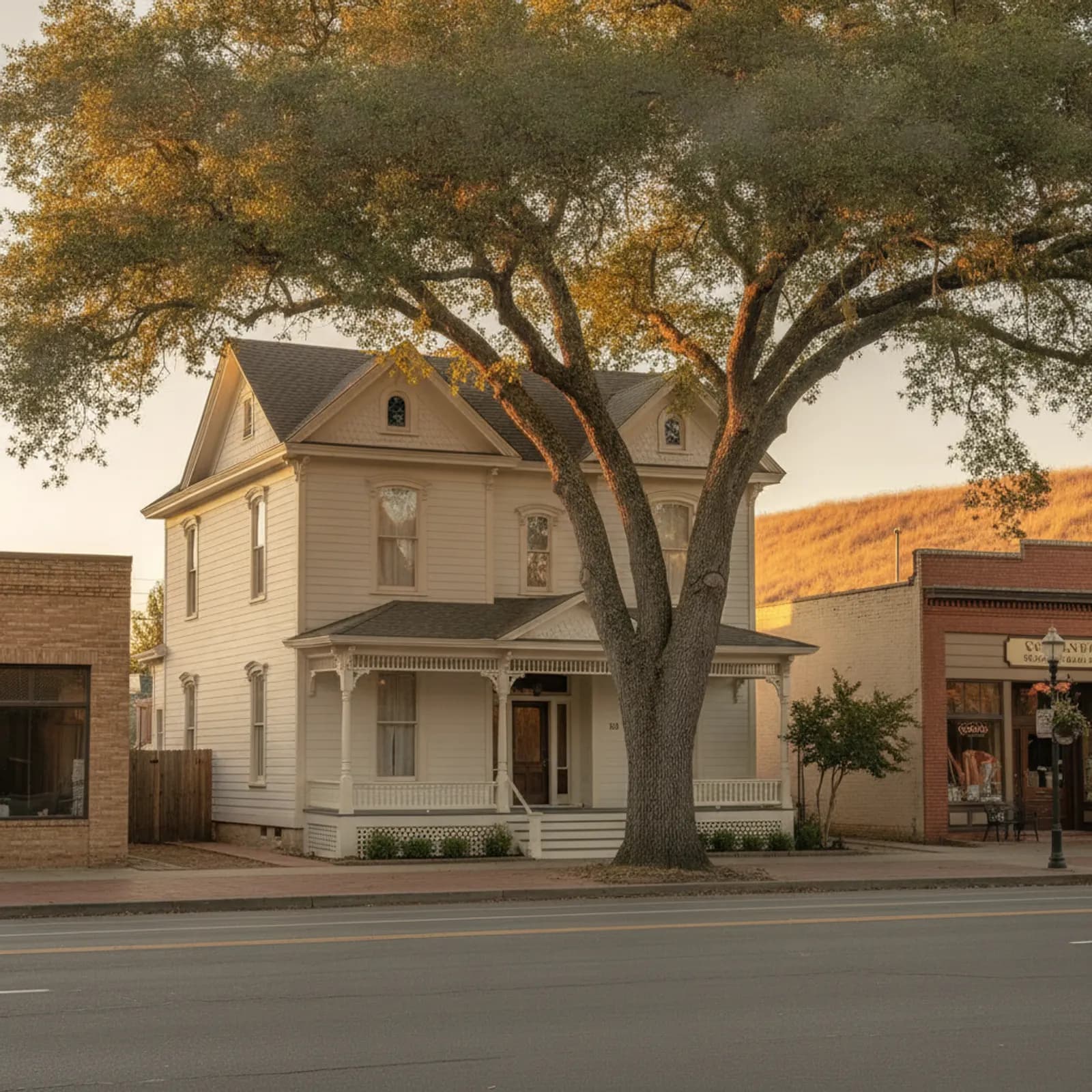
Siding work in a courthouse town
Colusa has been the seat of its county since the Gold Rush era, and it still looks the part: the 1861 courthouse anchors a square that sits only a few blocks from where the town's main streets run up against the Sacramento River levee. The houses tell the same long story. Courthouse-era Victorians and foursquares hold the old grid, bungalow blocks from the early twentieth century ring them, and quieter mid-century streets fill the ground between downtown and the rice fields that surround the city in every direction. When we take cladding off a Colusa wall, we are usually retiring material that already served two or three generations. The job is to put back something that serves the next ones as well — and still looks like it belongs on these particular streets.
Three exposures worth naming
A Colusa wall has to survive three different things, and only one of them is obvious. The obvious one is summer sun — months of it, unbroken, hardest on whichever faces catch the afternoon. The second is winter: tule fog settles over the river flats here for days at a stretch, and a wall that never fully dries between December and February ages on a different schedule than one in a drier corner of the valley. The third is the working landscape itself. Rice dryers, mills, and harvest traffic put fine dust into the fall air, and it collects on ledges, sills, and textured surfaces. None of this calls for anything exotic. It calls for a finish that shrugs off UV, assemblies that let a damp wall dry, and surfaces that rinse clean with a hose.
Considering an exterior project in Colusa?
What Colusa's houses ask for
The blocks between the courthouse square and the levee hold the demanding work. On a Victorian or a foursquare, the depth of a reveal and the width of a corner board are part of the streetscape, and a re-side that flattens a facade gets noticed quickly in a town of a few thousand people. The bungalow ring asks for proportion more than ornament — casings and belly bands in the right relationship to the wall. The mid-century streets are simpler: clean horizontal lines that accept a straightforward lap field, and often the most weathered original material in town. Closer to the river park and the boat launch, cottages on the lower ground live nearest the fog and take the most careful moisture thinking. Each of those situations gets its own answer.
Heat in summer, damp in winter
From late spring into October, Colusa's exterior problem is ultraviolet light and heat cycling — finishes bleach, boards move daily, and afternoon-facing walls do the aging for the whole house. That half of the year argues for factory-cured color rather than paint applied on a ladder, and for movement allowances built into every course. Then the year flips. Tule fog can hold this stretch of the river at saturation for long spells, dew rides on shaded walls well past noon, and irrigation keeps humidity in the air through the shoulder seasons. The winter half argues for generous ground clearances, ventilated wall assemblies, primed cut ends, and flashing at every horizontal transition. A specification that only answers the sun is only half a specification here.
Materials matched to the river grid
Cement-board siding with a baked-on factory color coat is what we reach for first in Colusa, because it answers both halves of the year at once: the color is cured under controlled conditions so the sun works on it slowly, and the board itself is indifferent to fog damp. On the old grid we run smooth-face lap at widths that echo the original reveal, install true corner boards rather than thin trim substitutes, and set metal head flashings over openings instead of trusting caulk alone. On mid-century and newer streets, a wider lap or a batten field suits the architecture. That the board also does not burn is a genuine benefit — though on this rice-and-river valley floor it is a side benefit, not the reason for the choice.
Where the money goes on a Colusa re-side
The number moves with wall area and height, with how much trim carpentry the home's era demands, and with what tear-off reveals. On the old grid, tear-off often exposes old-growth shiplap that is still perfectly sound — and sometimes exposes sill-line rot on fog-side walls, or two or three layers of past cladding stacked over a century. Both outcomes change the scope, in opposite directions. Whether windows and doors get replaced in the same mobilization matters too, since integrating them once is cheaper than trimming twice. We walk the house before we put a figure on it, and the proposal we leave itemizes the scope so you can see exactly what each part of the project costs.
Between the courthouse and the levee
Colusa's old center is small enough that every re-side on it is visible from the square, and the town's character rides on those blocks staying coherent. We treat that as a design constraint, not a sales line: board exposure chosen to match what the house wore originally, casings kept at their historic width, and ornament left in place and worked around rather than stripped for convenience. Houses this age also carry surprises behind the walls, so we open a test area early when the tear-off looks layered. The goal is a house that reads as restored rather than resurfaced.
Rice country, refuges, and fall dust
Colusa sits at the center of California's rice belt, with the Colusa National Wildlife Refuge and flooded winter fields close by. That geography shows up on exteriors in small, cumulative ways: harvest season puts chaff and grain dust on every horizontal surface, the wetland landscape keeps shoulder-season humidity higher than the open west side of the county, and equipment traffic keeps a film of fine grit moving through town each fall. Smooth factory finishes shed that grime with a rinse; heavily textured products hold it. It is a modest consideration, but over thirty years it is the difference between a wall that stays clean and one that always looks tired.
The fog-side wall
Every Colusa house has one wall that spends winter damp — usually the north face, or whichever elevation the fog shades longest. That wall is where we look first during an assessment, because it is where clearance shortcuts, unprimed board ends, and caulk-only joints fail years ahead of the rest of the house. Our detailing there is deliberate: bottom edges held well clear of grade and hardscape, weep paths left open, and every field cut sealed before it goes on the wall. It is unglamorous work that no one sees when the job is done, which is exactly why it gets skipped by crews in a hurry.
City of Colusa, city utilities, and Colusa County Fire
Working exteriors in Colusa coordinates with a few local authorities. Building permits come through the City of Colusa Community Development Department (Colusa is the county seat and one of only two incorporated cities in Colusa County). Electric and gas are PG&E, and water and wastewater are supplied by the City of Colusa municipal utilities directly. Fire response is the Colusa Fire Department (a small paid-and-volunteer department) alongside the Colusa County Fire Department and CAL FIRE Sonoma-Lake-Napa Unit (LNU) on wildland calls into the west-side range and the Sutter Buttes corridor. The historic courthouse-square district carries local design-review considerations distinct from a routine building permit — the 1861 Colusa County Courthouse is a designated California Historical Landmark.
HZ10 and the west-valley grass-edge FHSZ reality
Colusa is in James Hardie's HZ10 climate zone; installing HZ5 is a documented warranty misapplication. On the fire side, the downtown Colusa core and the Sacramento-River-adjacent grid sit in Low or unmapped FHSZ territory under California's 2025 LRA Fire Hazard Severity Zone map — irrigated rice ground and the river buffer the town from the west-side dry range. West-facing properties on the town's edge, and rural parcels running toward the Bear Creek and Cortina Ridge foothills, carry Moderate to High designations where annual grassland cures to fast fuel each summer. On those wildland-adjacent parcels the 2025 California Wildland-Urban Interface Code governs the exterior wall. Chapter 7A moved into the standalone WUI Code on January 1, 2026.
Our process in Colusa
- Step 1
Consultation
We listen to your goals and assess your home on site — exposure, substrate, and architecture.
- Step 2
Design & Proposal
A clear written proposal with the right system specified for your climate and a transparent scope.
- Step 3
Expert Installation
Trained crews install to manufacturer best practices with careful weather-management detailing.
- Step 4
Walkthrough & Support
A final walkthrough, full cleanup, and a clear written record of the scope completed — work we stand behind.
A re-side in Colusa should respect what this town already is — a river seat with a genuinely old center — while quietly solving the sun, the fog, and the dust that wear its houses down. We walk every Colusa project in person before pricing it, and the itemized proposal we hand you is the scope we build.
FAQ
Colusa — Common Questions
Cement-board siding with a factory-baked color coat. It ages slowly under the long summer sun, is indifferent to the damp that winter tule fog holds against a wall, and rinses clean after rice-harvest dust settles each fall. On the older grid near the courthouse we match board widths and trim to the home's era.
The fog itself doesn't hurt anything — weeks of dampness with no drying time is what punishes shortcuts. Walls that sit shaded and wet through winter fail first at unprimed cut ends, caulk-only joints, and bottom edges set too close to grade, so those are the details we engineer deliberately on every Colusa job.
Yes. What makes those houses read correctly is reveal depth, corner-board width, and window casing proportion — all things modern cement board can reproduce faithfully. We match those elements to the original rather than defaulting to a builder profile, so the house comes out restored instead of flattened.
It's a modest one — the city is surrounded by flooded rice ground and the river, which is about as low-fuel as California gets. The cement board we install doesn't ignite, which is a worthwhile side benefit, but in Colusa the specification is driven by sun, fog damp, and dust, not fire.
Helpful Exterior Guides