
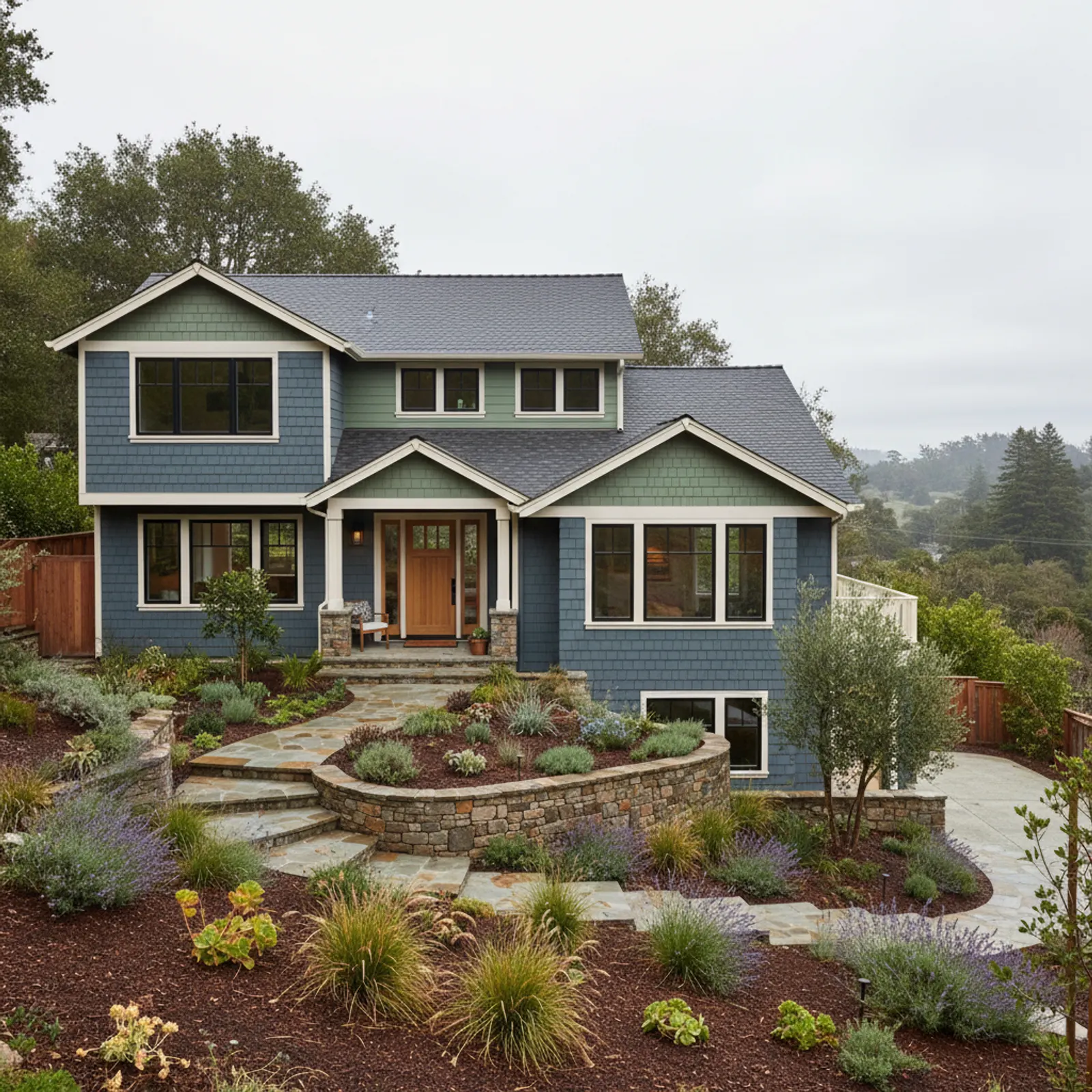
Fiber Cement Siding in San Anselmo
Fiber cement is the core San Anselmo recommendation because it answers both halves: Class A non-combustibility for the high wooded Ross Valley ridges, and moisture-driven-decay resistance over a robust drying-and-flood-aware plane for the creekside historic core.
One material, two San Anselmo cases
On the wooded hillsides fiber cement's non-combustibility is decisive, paired with hardened detailing; on the creekside flats it's the decay resistance over a flood-aware drying plane that matters. The board is constant; the detailing follows the parcel.
Why wood fails in both cases here
Wood is combustible on the high-fire ridges and rots in the flood-damp creek core; fiber cement resists both, and matches wood's finish quality so the safer, more durable material carries no aesthetic penalty.
One wall, flood at the base and fire on the ridge
San Anselmo Ross-Valley parcels can face creek flooding low and ember exposure high. Fiber cement is a genuinely good fit for that bind, but only when the base detailing handles periodic wetting and the upper assembly is hardened — we scope both to the specific parcel.
Detailing fiber cement around San Anselmo's antique downtown character
Replacing siding in San Anselmo's historic core is not just a board swap. Many of the older homes lining the walkable antiques district carry decorative trim, narrow reveals, and proportions that downtown's character expects to see preserved. Fiber cement earns its place here because it can be milled and lapped to match those original profiles while quietly shedding the wood's vulnerability to Ross Valley dampness. We match the existing exposure and shadow lines so a re-clad home still reads as period-correct from the sidewalk, then back the boards with a drainage-and-ventilation plane the original wood never had. Trim boards, frieze details, and corner treatments get reproduced in cement rather than left as the soft, rot-prone wood that fails first near the creekside flats. The result keeps the antique-town look intact at street level while removing the moisture failure point underneath it. For a town that values its older housing stock, that combination of authentic appearance and rot resistance is the reason fiber cement, not vinyl or new wood, becomes the long-term answer.
Hillside access and ember-zone install realities on the Ross Valley slopes
The wooded slopes rising on both sides of the valley change how a fiber cement job actually gets built, not just what spec it uses. Many Ross Valley hillside homes sit above steep, narrow streets with limited staging room, so scaffolding, board delivery, and cut stations have to be planned for a tight, sloped lot rather than an open yard. Because these parcels carry high wildfire exposure, the install goes beyond hanging Class A board. We treat the whole envelope as an ember-defense system: caulked and flashed joints, fire-rated soffit and eave details, and noncombustible trim where wind-driven embers tend to lodge against a slope-facing wall. Vents and the gap behind the cladding get screened or detailed so the same drying plane that fights North Bay moisture does not become an ember entry path. On a downhill elevation we sequence the work so the most fire-exposed faces are sealed first. Skipping these hillside-specific steps is how a technically correct material still leaves a Ross Valley home under-protected on the very side that matters most.
Why this matters in San Anselmo
- Specified for North Bay conditions
- non-combustible fiber cement as the recommended system
- Correctly detailed weather-resistive barrier and flashing
- Installed by a crew with 20 years combined experience
Recommended systems for San Anselmo
- non-combustible fiber cement
- drainage-plane detailing
- fire-hardened detailing
Fiber Cement Siding for San Anselmo homes
The full fiber cement siding approach — materials, weather-resistive detailing, and the manufacturer standards we install to — is covered on the main service page, then specified for San Anselmo's conditions on this one.
Our San Anselmo process
- Step 1
Consultation
We listen to your goals and assess your home on site — exposure, substrate, and architecture.
- Step 2
Design & Proposal
A clear written proposal with the right system specified for your climate and a transparent scope.
- Step 3
Expert Installation
Trained crews install to manufacturer best practices with careful weather-management detailing.
- Step 4
Walkthrough & Support
A final walkthrough, full cleanup, and a clear written record of the scope completed — work we stand behind.
FAQ
Fiber Cement Siding in San Anselmo — FAQ
Yes — its Class A non-combustibility is decisive on the high-exposure wooded ridges, paired with hardened detailing, with no finish penalty versus wood.
Yes — over a robust flood-aware drying plane it resists the recurring flood and valley damp far better than wood.
Slowly — the cool, shaded Ross Valley climate is gentle on factory finish; the substrate keeps performing beyond any refresh.
Yes — period-appropriate profiles with accurate reveals and replicated trim suit the historic creekside stock.
Keep Exploring
More for San Anselmo homeowners
More in San Anselmo
Other exterior services in San Anselmo
Nearby Service Areas
Fiber Cement Siding near San Anselmo
Helpful Exterior Guides