
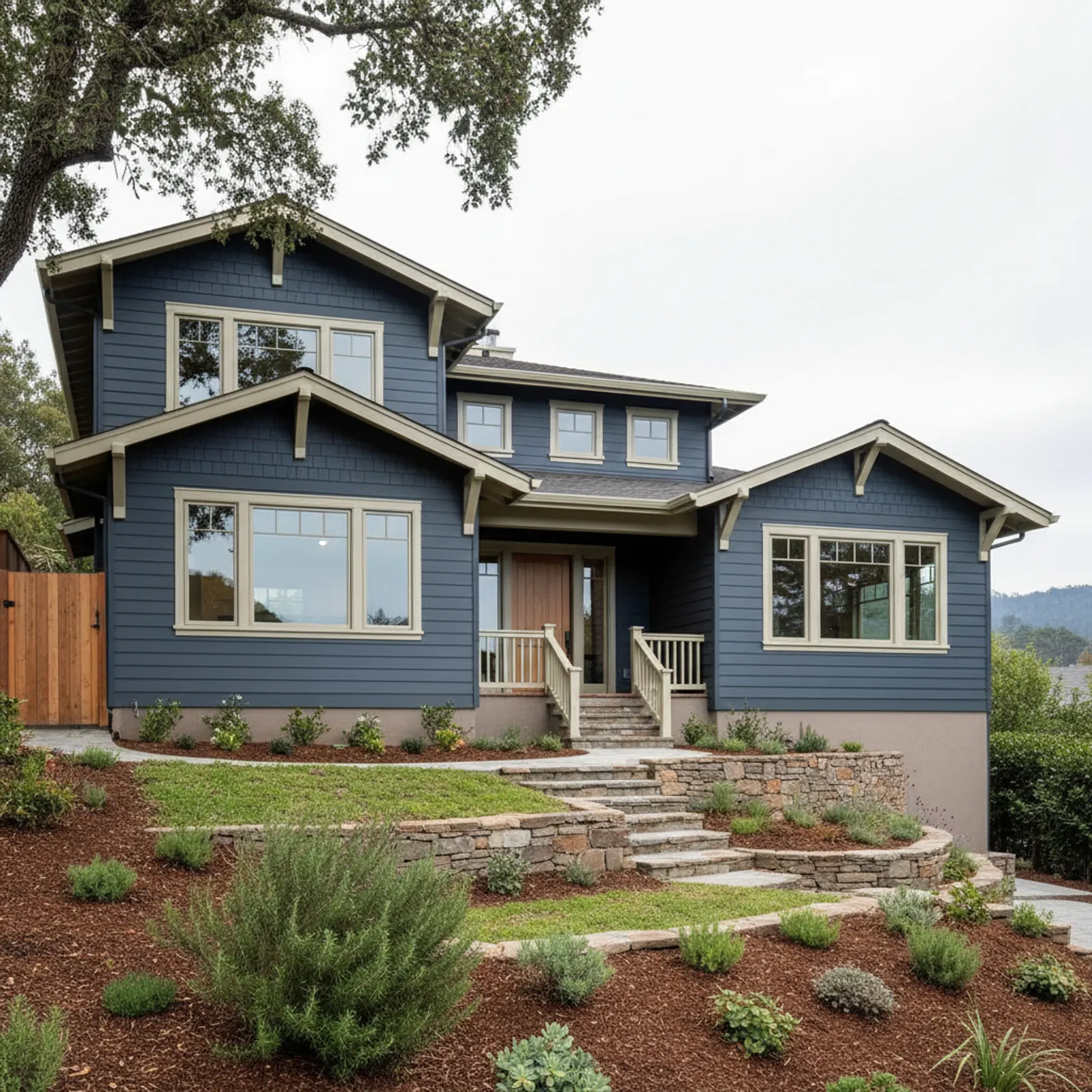
Siding in San Anselmo
A San Anselmo re-side genuinely splits between high wooded-ridge wildfire and a creekside flood-damp historic core. The steep Ross Valley and Sleepy Hollow hillsides carry high, access-constrained fire exposure, while the charming San Anselmo Avenue historic district sits low on the creek floor where flooding and persistent damp are the controlling concern — and the period stock demands faithful detailing.
So a San Anselmo project is scoped honestly by parcel: hardened, non-combustible assemblies on the hillsides; rigorous drying-and-flood-aware detailing on the creekside historic core.
Wooded ridges: genuine high fire
San Anselmo's Ross Valley and Sleepy Hollow hillside homes sit in wooded, steep, evacuation-constrained terrain with real high exposure. There we specify Class A non-combustible cladding and harden eaves, soffits, vents, decks, and ground transitions.
Creekside downtown: flood-damp and heritage
The historic San Anselmo Avenue district sits low on the creek and takes recurring flood and persistent damp; we run a robust, drying-capable plane with elevated-clearance, flood-aware detailing, and replicate period profiles faithfully on the old stock.
Hillside access and the Sleepy Hollow re-side
Re-siding a Sleepy Hollow or upper Ross Valley home is shaped less by the wall itself than by how crews reach it. These hillside lots climb off narrow, twisting roads with limited frontage, short driveways, and steep grade changes, so staging siding bundles, scaffold, and a dumpster takes planning that a flat downtown lot never demands. We often stage material in lifts, run scaffold off the downhill elevation, and protect the wooded slope below from falling tear-off debris. That access reality also drives sequencing: we strip and dry-in one elevation at a time rather than opening the whole envelope, because a sudden North Bay storm rolling over the valley can wet an exposed wall fast. Fiber-cement and other non-combustible cladding arrives heavier than the old wood it replaces, which matters when everything is hand-carried up a hillside path. Pricing and timeline on these San Anselmo jobs reflect that labor, not just square footage, and we walk the approach with you before quoting so the access plan is settled up front rather than discovered mid-tear-off.
Detailing fiber-cement so Ross Valley damp cannot sit
San Anselmo's persistent North Bay moisture is the quiet failure mode behind most siding we replace here. Fog drainage settles into the wooded valley overnight, walls stay damp well into the morning, and shaded north and downhill elevations on these hillside homes dry slowly all season. Cladding that never gets a chance to release moisture is what rots sheathing and grows mold behind the wall. So on a San Anselmo re-side we treat the assembly as a drainage system, not just a surface. That means a continuous water-resistive barrier, a vented rainscreen gap behind fiber-cement so air can move and the back of the board can dry, kickout flashing where rooflines dump onto walls, and generous clearance at the base so siding is not wicking off damp soil or planting beds. Penetrations, trim returns, and window heads get flashed in shingle-lapped sequence rather than caulk-dependent joints. The fire-hardening many of these hillside parcels need and this moisture detailing are not in conflict; we specify a single non-combustible, properly drained assembly that answers both at once.
Why this matters in San Anselmo
- Specified for North Bay conditions
- non-combustible fiber cement as the recommended system
- Correctly detailed weather-resistive barrier and flashing
- Installed by a crew with 20 years combined experience
Recommended systems for San Anselmo
- non-combustible fiber cement
- drainage-plane detailing
- fire-hardened detailing
Fiber Cement Siding for San Anselmo homes
The full fiber cement siding approach — materials, weather-resistive detailing, and the manufacturer standards we install to — is covered on the main service page, then specified for San Anselmo's conditions on this one.
Our San Anselmo process
- Step 1
Consultation
We listen to your goals and assess your home on site — exposure, substrate, and architecture.
- Step 2
Design & Proposal
A clear written proposal with the right system specified for your climate and a transparent scope.
- Step 3
Expert Installation
Trained crews install to manufacturer best practices with careful weather-management detailing.
- Step 4
Walkthrough & Support
A final walkthrough, full cleanup, and a clear written record of the scope completed — work we stand behind.
FAQ
Siding in San Anselmo — FAQ
Yes — San Anselmo pairs genuine high wooded-ridge fire with a creekside flood-damp historic core; Larkspur's hillside is elevated (not high) shade-damp, and San Rafael's split is hillside-vs-flat without the creek-flood factor.
On the Ross Valley / Sleepy Hollow wooded hillsides, strongly — high, access-constrained exposure. The creekside flats and downtown are lower-exposure, flood-and-damp led. We assess by address.
Recurring creek flooding and persistent valley-floor damp drive trapped moisture; a robust, flood-aware drying-capable assembly fixes the root cause.
Yes — faithful period profiles and trim are central to how we approach the historic creekside district.
Yes — steep wooded terrain with constrained access; non-combustible hardened exteriors are the baseline there, not optional.
Keep Exploring
More for San Anselmo homeowners
More in San Anselmo
Other exterior services in San Anselmo
Nearby Service Areas
Siding near San Anselmo
Helpful Exterior Guides