
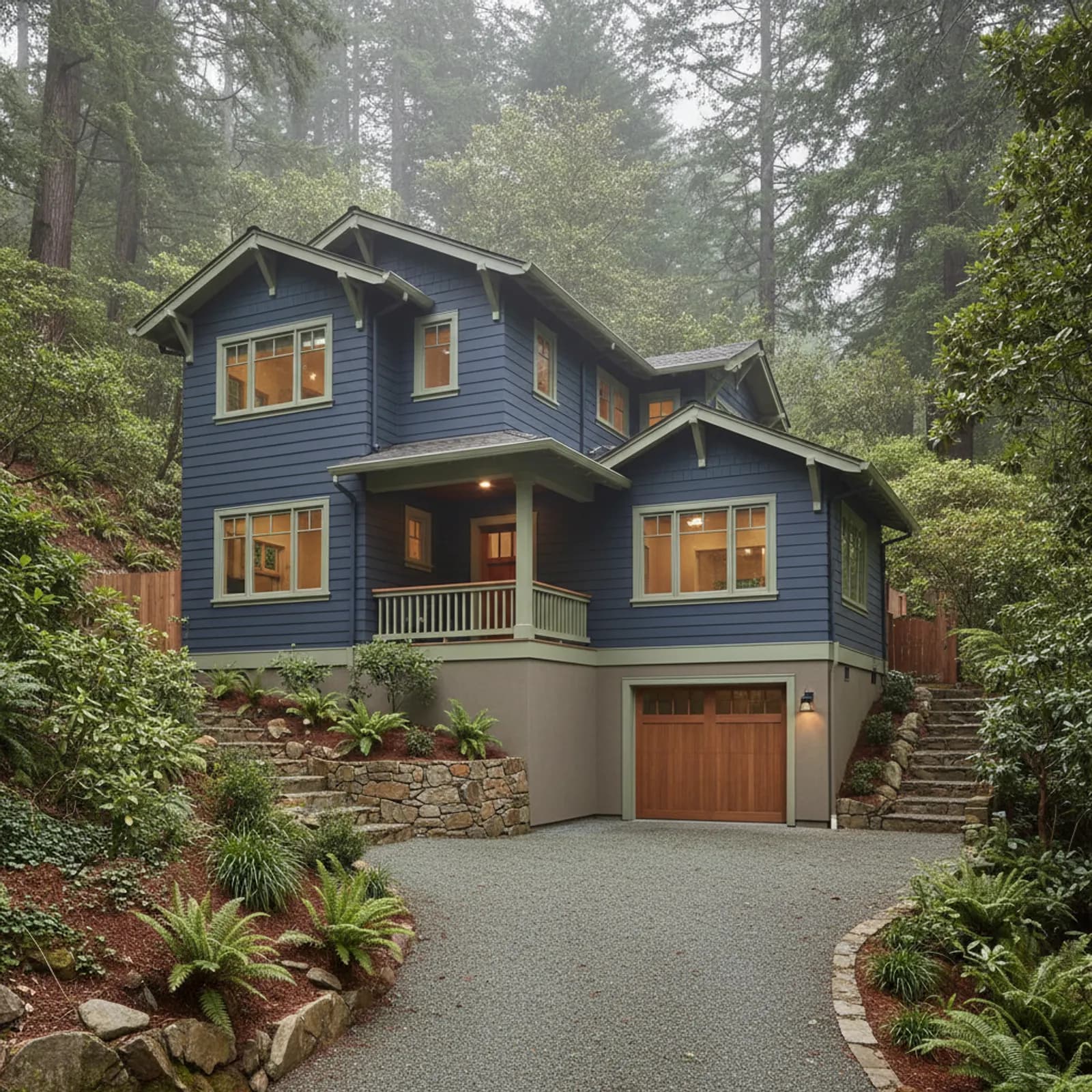
Siding in Mill Valley
A Mill Valley re-side is one of the more technically demanding projects we take on. Homes here are tucked into steep, redwood-shaded hillsides beneath Mount Tamalpais — historic brown-shingle and craftsman cottages, mid-century hillside homes, and architecturally significant modern builds — in a setting that is simultaneously high wildfire-exposure and persistently damp under canopy.
So Mill Valley re-sides are scoped around two hard constraints at once: a wooded-hillside ember threat and a microclimate where surfaces rarely fully dry — resolved in one architecturally exacting envelope.
Steep, shaded, design-led — three constraints together
Mill Valley lots are steep and access-constrained, the architecture is scrutinized, and the canopy keeps walls damp. We plan access and staging explicitly, detail for drainage and drying, and harden against embers — all while holding the reveal consistency and trim proportion these homes are judged on.
Replacing combustible shingle in a fire-and-fog setting
Much of Mill Valley's older stock wears wood or shingle that is both combustible and moisture-aged. Re-cladding in non-combustible material over a drying-capable assembly delivers the hardening and the moisture-durability upgrade together — the highest-value move on these hillside homes.
Getting material onto a Mount Tam hillside lot
Half the difficulty of re-siding in Mill Valley is solved before a single course goes up: getting crews, scaffold, and siding bundles onto a lot that drops away from a narrow lane. Many homes off Cascade, Throckmorton, and the streets climbing toward Mount Tamalpais have no driveway frontage to speak of, so material gets hand-carried down switchback stairs or staged off a neighbor's pullout. We walk the approach early and plan lift points, scaffold tie-ins on uneven grade, and where the bundles will sit so they stay dry under canopy. The wooded character that defines the town also limits how much we can clear, and Mill Valley reviews tree work and grading closely. Building those constraints into the schedule keeps a re-side from stalling halfway up the slope, and it protects the mature redwoods and oaks that give these properties their value. On a tight hillside parcel, disciplined staging is not a convenience; it is what makes the job buildable at all without damaging the setting.
Detailing a wall that almost never dries out
Under Mill Valley's redwood-and-fog canopy, exterior walls hold dampness far longer than a sunnier Marin exposure would, and that single fact drives most of our siding spec here. Fog drip, shade, and slow evaporation mean any moisture that gets behind the cladding has little chance to escape, so we build the assembly to drain and breathe rather than trap. That means a continuous water-resistive barrier, a rainscreen gap that lets the back of the siding dry, and meticulous flashing at every window head, deck ledger, and the spots where a hillside home steps down the slope. Bottom courses and ground-adjacent trim, which sit closest to damp soil and leaf litter, get particular attention against rot and fungal staining. On the historic brown-shingle and craftsman cottages common in town, we match profiles and reveals so the upgraded, moisture-managed wall still reads as original. The goal is an envelope that survives a microclimate where surfaces stay wet much of the year, without sacrificing the architectural detail Mill Valley owners expect.
Why this matters in Mill Valley
- Specified for North Bay conditions
- premium non-combustible fiber cement as the recommended system
- Correctly detailed weather-resistive barrier and flashing
- Installed by a crew with 20 years combined experience
Recommended systems for Mill Valley
- premium non-combustible fiber cement
- rigorous drainage-plane detailing
- fire-hardened hillside detailing
Fiber Cement Siding for Mill Valley homes
The full fiber cement siding approach — materials, weather-resistive detailing, and the manufacturer standards we install to — is covered on the main service page, then specified for Mill Valley's conditions on this one.
Our Mill Valley process
- Step 1
Consultation
We listen to your goals and assess your home on site — exposure, substrate, and architecture.
- Step 2
Design & Proposal
A clear written proposal with the right system specified for your climate and a transparent scope.
- Step 3
Expert Installation
Trained crews install to manufacturer best practices with careful weather-management detailing.
- Step 4
Walkthrough & Support
A final walkthrough, full cleanup, and a clear written record of the scope completed — work we stand behind.
FAQ
Siding in Mill Valley — FAQ
Steep access-constrained lots, high design scrutiny, real wildfire exposure, and a persistently damp redwood microclimate — all at once. It's an architectural and technical project, not a cosmetic refresh.
Yes — period-sensitive profiles in non-combustible fiber cement preserve character while adding fire and moisture resilience.
Yes — access and staging on steep, shaded lots are real scope factors we plan and estimate explicitly up front.
Yes — the redwood-canopy microclimate keeps surfaces damp much of the year, so drying-capable detailing is essential alongside the fire strategy.
Keep Exploring
More for Mill Valley homeowners
More in Mill Valley
Other exterior services in Mill Valley
Helpful Exterior Guides