Fire-Resistant Siding in Mill Valley
This is a primary service in Mill Valley. The town's defining feature — steep, densely wooded hillsides beneath Mount Tam — also makes it genuinely high wildfire-exposure. Fire-resistant siding here is a central exterior decision, not a low-regret nicety, and we treat the exterior as a hardened assembly designed into the architecture.
Why Mill Valley's wooded terrain is high exposure
Dense canopy and steep slopes drive heavy ember loading in a wind event. We specify Class A non-combustible cladding and harden the points embers exploit — eaves, soffits, vents, decks, and the ground-to-wall transition — recognizing the terrain's severity.
Hardening without compromising significant architecture
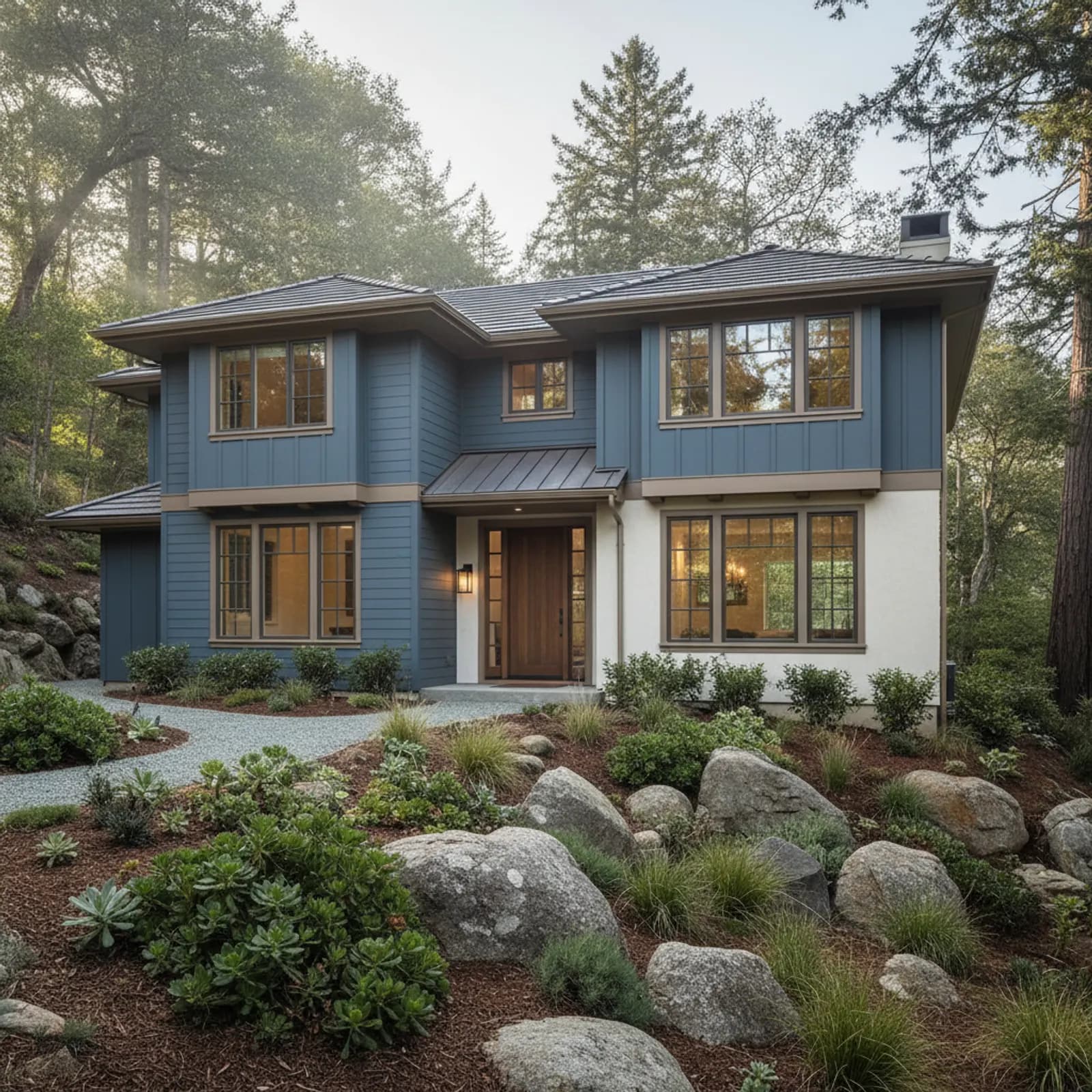
Many Mill Valley homes are design-significant. The craft is integrating a hardened, non-combustible assembly into that architecture so the result is both demonstrably safer and visually uncompromised — documented for insurability conversations.
The fog-and-ember problem behind a Mill Valley wall
Most fire-resistant siding work is written for hot, dry inland towns. Mill Valley is the opposite kind of fire risk: the same redwood canopy and Mount Tamalpais fog that keep walls damp for much of the year also feed the dense fuel that makes an ember event serious. That dual condition shapes the spec. Non-combustible Class A cladding answers the fire side, but it has to be detailed for a climate where surfaces rarely fully dry out, so we pair it with a drainage gap, properly lapped weather-resistive barrier, and corrosion-rated fasteners and flashings that will not bleed or fail in persistent humidity. Fiber-cement and mineral-based panels suit this well because they neither burn nor rot. The mistake we see on hillside homes is treating fire and moisture as separate jobs, then trapping damp behind a sealed face. We design the assembly to shed water and resist embers at the same time, because in this microclimate one without the other shortens the life of the whole wall.
Steep-lot access and defensible-space coordination
Fire-resistant siding on a Mill Valley hillside is as much a logistics problem as a material one. Homes tucked off narrow lanes below Mount Tam often have no flat staging area, limited truck access, and walls that can only be reached from scaffold tiered down a slope. We plan material delivery, lift points, and fall protection around that terrain before the first board comes off, which keeps a re-side from stalling halfway up a grade. The hillside setting also ties the cladding into the wider hardening picture. Class A walls do little if combustible fencing, decking, or heavy plantings sit against them, so we coordinate the siding scope with the ground-to-wall zone and defensible-space clearances the way fire-prone Marin neighborhoods increasingly expect. It is the same exposure logic at work in nearby Sausalito and San Anselmo, where wooded lots meet dense building. Sequencing the siding alongside that perimeter work, rather than after it, is what turns a hardened wall into a hardened home on a difficult lot.
Why this matters in Mill Valley
- Specified for North Bay conditions
- premium non-combustible fiber cement as the recommended system
- Correctly detailed weather-resistive barrier and flashing
- Installed by a crew with 20 years combined experience
Recommended systems for Mill Valley
- premium non-combustible fiber cement
- rigorous drainage-plane detailing
- fire-hardened hillside detailing
Fire-Resistant Siding for Mill Valley homes
The full fire-resistant siding approach — materials, weather-resistive detailing, and the manufacturer standards we install to — is covered on the main service page, then specified for Mill Valley's conditions on this one.
Our Mill Valley process
- Step 1
Consultation
We listen to your goals and assess your home on site — exposure, substrate, and architecture.
- Step 2
Design & Proposal
A clear written proposal with the right system specified for your climate and a transparent scope.
- Step 3
Expert Installation
Trained crews install to manufacturer best practices with careful weather-management detailing.
- Step 4
Walkthrough & Support
A final walkthrough, full cleanup, and a clear written record of the scope completed — work we stand behind.
FAQ
Fire-Resistant Siding in Mill Valley — FAQ
High — steep, densely wooded hillsides beneath Mount Tamalpais drive real ember exposure. Non-combustible, hardened exteriors are the baseline here, not optional.
Class A non-combustible cladding plus hardened eaves, soffits, vents, decks, and ground transitions — designed together and integrated into the home's architecture.
Yes — that integration is central to our Mill Valley work: hardened, non-combustible assemblies designed into the architecture, not bolted on.
It can support insurability in wooded Marin terrain; we document materials and assemblies, though insurers set their own criteria.
Keep Exploring
More for Mill Valley homeowners
More in Mill Valley
Other exterior services in Mill Valley
Nearby Service Areas
Fire-Resistant Siding near Mill Valley
Helpful Exterior Guides