
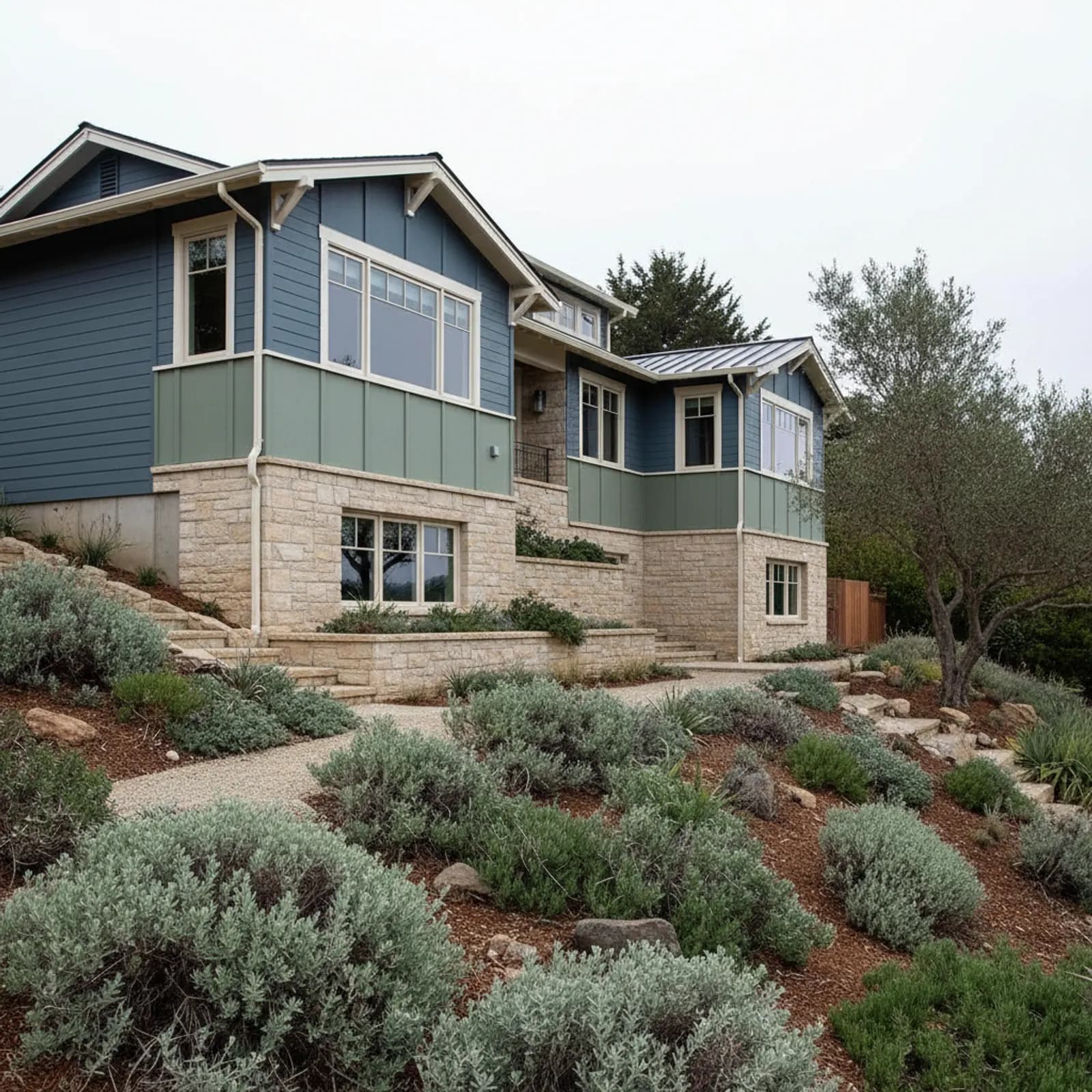
Fire-Resistant Siding in San Rafael
Honest answer: San Rafael is split. Its wooded hillside neighborhoods carry genuinely elevated wildfire exposure where fire-resistant siding is a primary decision; its flat downtown, Canal, and mid-century areas are lower-exposure where it's a low-regret default. We won't apply one story to the whole city.
Elevated hillsides, not extreme — stated honestly
San Rafael's hillside exposure is elevated and real, warranting Class A non-combustible cladding with hardened eaves, vents, and ground transitions — but it is generally less extreme than deep-canopy Mill Valley or foothill-forest towns. We characterize each parcel accurately rather than overstating.
Free on the flats, the reason on the ridges
San Rafael's three-job split decides this: downtown/Canal-flat and Gerstle Park heritage homes get Class A as a free rider on the moisture-durable fiber cement they'd choose anyway, while Sun Valley/Peacock Gap ridge parcels are the real-reason case with hardened detailing. We state which San Rafael a home is in.
Why a marine-damp North Bay assembly changes a fire-rated re-side
Choosing non-combustible cladding is only half the engineering problem in San Rafael, because the same hillsides that face ember exposure sit in a North Bay marine environment that keeps wall assemblies wet for much of the year. Fiber cement and other Class A surfaces resist fire, but they are not the moisture control layer, and a fire-resistant re-side that ignores the bay's persistent damp simply trades a wildfire risk for a rot-and-mold one. So the work behind the visible board matters as much as the board: a continuous water-resistive barrier, properly lapped flashing at every penetration, and a drained, back-ventilated rain-screen cavity that lets the wall dry inland-side after fog and winter storms. Near the bayside flats and the lower Gerstle Park slopes, where moisture exposure is highest, that drying detail is non-negotiable. The goal on a San Rafael home is a single assembly that does two jobs at once, sheds embers on the outside and manages marine moisture behind it, rather than a fire upgrade that quietly shortens the wall's life.
Downtown's older stock and the access it dictates
The historic homes near downtown San Rafael and the wooded lots in the Dominican area complicate a fire-resistant re-side in ways a tract street never would. Older houses often carry original wood siding, layered repaints, and deep eave returns that were never built for non-combustible cladding, so the scope is rarely a clean tear-and-replace; it includes rebuilding eave soffits, retrofitting ember-resistant vents, and reworking trim profiles so the new Class A surface still reads as the home it has always been. Steep hillside parcels add the second constraint of access. Narrow shared drives and grade changes around Sun Valley mean staging, scaffold, and material handling get planned before a single board comes off, and that planning, not the siding itself, often sets the timeline. We walk each lot rather than quote from a map, because the cladding choice on a 1920s downtown bungalow and a hillside Dominican home that share the same fire goal will not share the same detailing or the same day count.
Why this matters in San Rafael
- Specified for North Bay conditions
- non-combustible fiber cement as the recommended system
- Correctly detailed weather-resistive barrier and flashing
- Installed by a crew with 20 years combined experience
Recommended systems for San Rafael
- non-combustible fiber cement
- rigorous drainage-plane detailing
- fire-aware hillside detailing
Fire-Resistant Siding for San Rafael homes
The full fire-resistant siding approach — materials, weather-resistive detailing, and the manufacturer standards we install to — is covered on the main service page, then specified for San Rafael's conditions on this one.
Our San Rafael process
- Step 1
Consultation
We listen to your goals and assess your home on site — exposure, substrate, and architecture.
- Step 2
Design & Proposal
A clear written proposal with the right system specified for your climate and a transparent scope.
- Step 3
Expert Installation
Trained crews install to manufacturer best practices with careful weather-management detailing.
- Step 4
Walkthrough & Support
A final walkthrough, full cleanup, and a clear written record of the scope completed — work we stand behind.
FAQ
Fire-Resistant Siding in San Rafael — FAQ
Elevated and real on the wooded hillsides — Class A non-combustible hardened detailing is warranted there — but lower on the flat downtown and Canal areas. It depends on the parcel.
Generally less and far less uniform — Mill Valley is deep-canopy extremity; San Rafael's hillside exposure is elevated but typically not as severe, and its flats are low-exposure.
It's a low-regret default there rather than a necessity — and it comes free with the non-combustible fiber cement we recommend for moisture anyway.
It can support insurability on elevated-exposure parcels; we document materials and assemblies, though insurers set their own criteria.
Keep Exploring
More for San Rafael homeowners
More in San Rafael
Other exterior services in San Rafael
Nearby Service Areas
Fire-Resistant Siding near San Rafael
Helpful Exterior Guides