
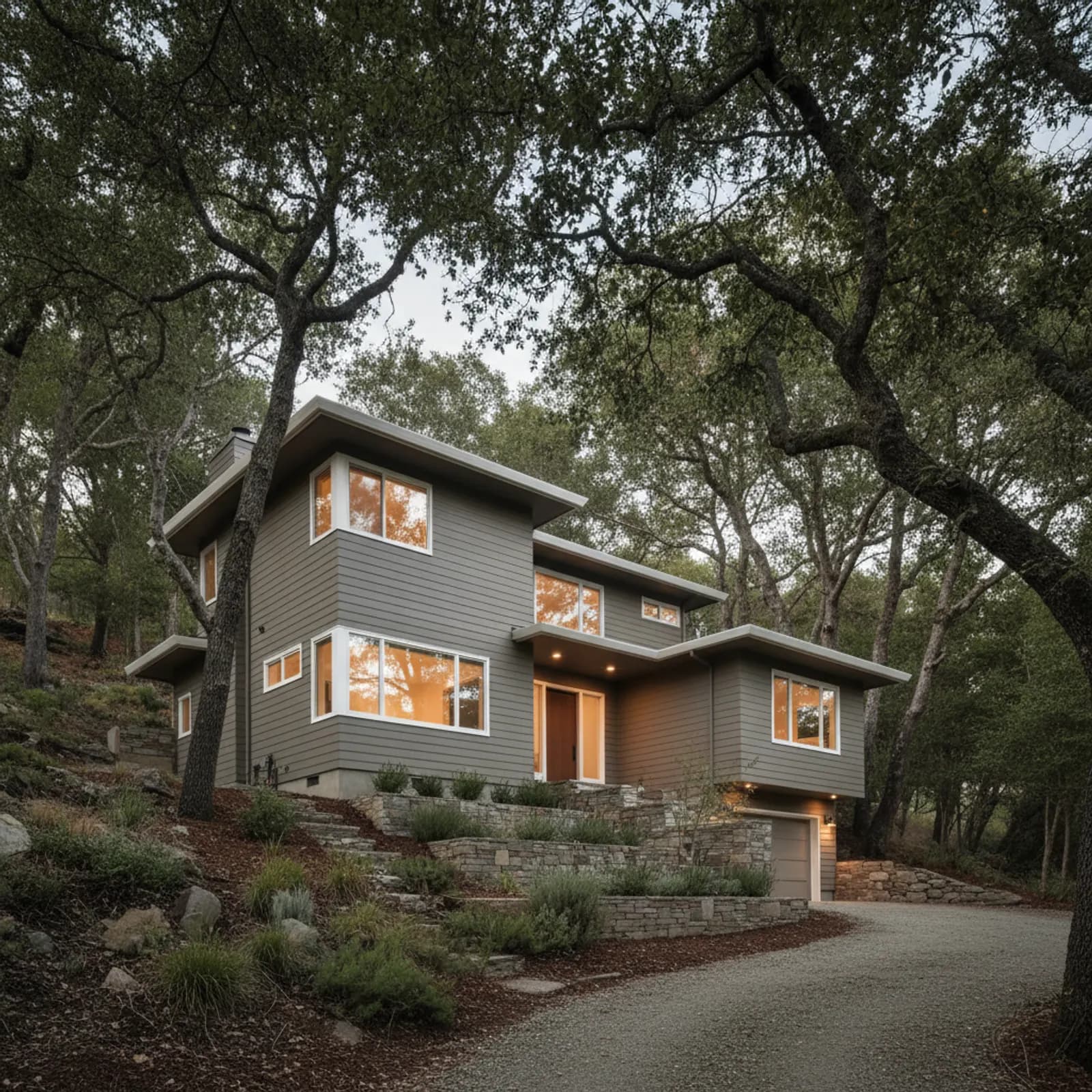
Exterior renovation in San Rafael
San Rafael is the largest city in Marin County and its civic and commercial center, with a housing stock that climbs from a historic downtown and bayside flats up into wooded hillsides. That topography is the whole story for exteriors here: hillside neighborhoods like Gerstle Park, Sun Valley, and the Dominican area carry real wildfire exposure, while the entire city lives in a North Bay marine environment that keeps assemblies damp. A San Rafael re-side has to manage moisture and resist embers at once, and the balance between those two demands shifts as you move from the flats up the slope.
Why San Rafael homeowners re-side
Many San Rafael re-side projects start with moisture: weathered wood or shingle siding that has cupped, checked, or developed rot in the persistent damp, often discovered behind a chronically peeling paint cycle. On the wooded hillsides, the second driver is fire exposure and the combustible cladding that still wears on a large share of older homes. We treat a San Rafael exterior as a single system that has to release moisture and resist ignition together, not as two separate fixes.
Considering an exterior project in San Rafael?
San Rafael housing and architecture
San Rafael's stock blends historic downtown and Gerstle Park homes with strong architectural character, extensive mid-century hillside and valley neighborhoods, and bayside and Canal-area housing. The older character homes reward period-sensitive narrow profiles and careful trim; the mid-century and hillside homes are often detail-intensive on difficult, steep lots with complex elevations. A defining trait across much of the older stock is combustible wood or shingle siding, which in this wooded, fog-damp setting is the priority replacement on both moisture and fire grounds. The right profile and trim choice tracks the home's era, but the substrate and drainage strategy is where most of the engineering happens.
San Rafael's marine-and-hillside climate
San Rafael is cool and fog-influenced through much of the year, with persistent marine moisture that makes drying capacity a genuine performance factor rather than an afterthought. Walls that can't release the water they take on fail early here, regardless of how good the finish looks. Layered on top of that are the warm, dry late-summer and fall windows that drive hillside fire risk, when offshore winds can push embers through the wooded slopes. The controlling reality is that the exterior must both shed and release moisture and resist ember intrusion, and those two requirements have to be designed together.
Hardening a San Rafael hillside home
For San Rafael's wooded hillside parcels we specify Class A non-combustible fiber cement and harden eaves, vents, and the ground-to-wall transition, recognizing that steep, vegetated terrain raises ember loading in a wind event. The hardening is integrated with the drainage detailing rather than competing with it, so the same assembly handles both fire and moisture. Bayside and Canal-area flats carry lower fire exposure but still benefit from non-combustible cladding at no cost to the moisture strategy, which is why we rarely treat fire and moisture as a tradeoff here.
Recommended materials for San Rafael
Non-combustible fiber cement over a rigorously detailed, drying-capable drainage plane is the core recommendation for San Rafael, because it addresses the wooded hillside fire exposure and the persistent North Bay moisture in a single system. The drainage plane and flashing detail matter as much as the cladding itself in this marine climate, so we hold those details to a high standard regardless of the finish chosen. On wooded hillside parcels we generally advise against combustible cladding given the exposure, and fiber cement carries no durability or appearance penalty in exchange.
What an exterior project costs in San Rafael
San Rafael pricing turns on home size and stories, hillside access and lot difficulty, and trim complexity, which runs high on the older character homes. The biggest variable is often substrate and rot condition once cladding is removed, since the damp marine setting tends to hide water damage that only appears at demolition. Add the combined moisture- and fire-management scope, plus window integration, and the right number varies widely from a bayside flat to a steep wooded lot. We provide a written, scoped estimate after an on-site assessment.
Hillside access and staging realities
Steep San Rafael lots are a real scope factor, not a footnote. Hillside neighborhoods often mean narrow approaches, limited staging room, and elevations that require careful access planning to reach safely and efficiently. We walk the lot before quoting so access, scaffolding, and material handling are accounted for explicitly, rather than discovered mid-project and passed along as a surprise.
Downtown and Gerstle Park character homes
The historic downtown and Gerstle Park area homes carry strong architectural character that a re-side should preserve, not flatten. Period-appropriate profiles and trim executed in non-combustible fiber cement keep the home reading true to its era while quietly solving the moisture and fire problem underneath. These projects are trim-intensive and detail-driven, and they reward a contractor who treats the original proportions as a constraint to respect.
Hardening and the Marin insurance context
In wooded Marin terrain, home hardening has become part of how a property is evaluated, including by insurers, though insurers set their own criteria and we don't speak for them. What we can do is document the materials and assemblies used so the hardening is on record for those conversations. We won't overstate what a re-side guarantees on insurability, but a documented non-combustible, well-detailed exterior is a defensible piece of the picture on a hillside parcel.
MMWD, San Rafael Fire Department, and Marin County seat permits
Working exteriors in San Rafael coordinates with a few local authorities. Electric and gas both come from PG&E, and San Rafael is in high-PSPS territory, where Public Safety Power Shutoffs during red-flag events can affect scheduling. Water is supplied by the Marin Municipal Water District (MMWD), a customer-owned public agency serving central Marin. Fire response is the San Rafael Fire Department, which as the county seat's department carries a substantial regional role and, alongside Marin County Fire and CAL FIRE, runs defensible-space inspection on wooded parcels. On the permit side, the City of San Rafael's Community Development Department handles building permits, and Downtown San Rafael, the Gerstle Park district, and other named neighborhoods with historic-preservation character can trigger design-review considerations on visible exterior work. We flag utility, permit, and heritage items at the estimate stage rather than at the wall.
HZ10 and the 2025 FHSZ remap in San Rafael
San Rafael is in James Hardie's HZ10 climate zone despite the fog — HZ10 covers the West's mild coastal-adjacent areas — and HZ10 is the correct spec for a San Rafael home; installing HZ5 is a documented warranty misapplication. On the fire side, the flat downtown, Canal, and bayside neighborhoods sit in Low FHSZ territory or unmapped under California's 2025 LRA Fire Hazard Severity Zone map, while the wooded hillside neighborhoods — Sun Valley, Dominican, the Terra Linda ridges, and parcels backing to Marin Open Space — carry Moderate to Very High designations. On designated hillside parcels the 2025 California Wildland-Urban Interface Code governs the exterior wall. The code frame changed on January 1, 2026, when Chapter 7A moved into the standalone WUI Code. We check the parcel against the current designation at scoping.
Our process in San Rafael
- Step 1
Consultation
We listen to your goals and assess your home on site — exposure, substrate, and architecture.
- Step 2
Design & Proposal
A clear written proposal with the right system specified for your climate and a transparent scope.
- Step 3
Expert Installation
Trained crews install to manufacturer best practices with careful weather-management detailing.
- Step 4
Walkthrough & Support
A final walkthrough, full cleanup, and a clear written record of the scope completed — work we stand behind.
San Rafael rewards an exterior built for both fog-driven moisture and wooded hillside fire, with the balance tuned to where the home actually sits on the slope. We scope every San Rafael project on site so the drainage and fire detailing match the real lot, and your written estimate governs the work.
FAQ
San Rafael — Common Questions
Yes — wooded hillside neighborhoods like Gerstle Park, Sun Valley, and the Dominican area carry real wildfire exposure warranting non-combustible cladding and hardened detailing.
Very much — the North Bay marine environment keeps assemblies damp, so drying-capable drainage-plane detailing is a genuine performance requirement.
Non-combustible fiber cement over a rigorously detailed drainage plane — it meets the fire and moisture demands together.
Yes — period-appropriate profiles and trim in non-combustible fiber cement preserve character while solving the moisture and fire problem.
Yes — hillside access and lot difficulty are real scope factors here and are planned and estimated explicitly.
On wooded hillside parcels we generally advise against it; fiber cement carries no durability penalty and adds moisture and fire resilience.
Home hardening can support insurability in wooded Marin terrain. We document the materials and assemblies used, though insurers set their own criteria.
A correctly detailed, well-drained fiber cement system commonly performs 30+ years here while materially reducing ignition and moisture-failure risk.
Explore
Exterior Services
Helpful Exterior Guides