
Fire-Resistant Siding in Pacific Grove
Direct answer: developed open-coast Pacific Grove is a low-wildfire town — salt and marine moisture, not fire, are the controlling factors. Fire-resistant siding here is a low-regret choice, not a need, and we won't manufacture urgency for a Pacific Grove address.
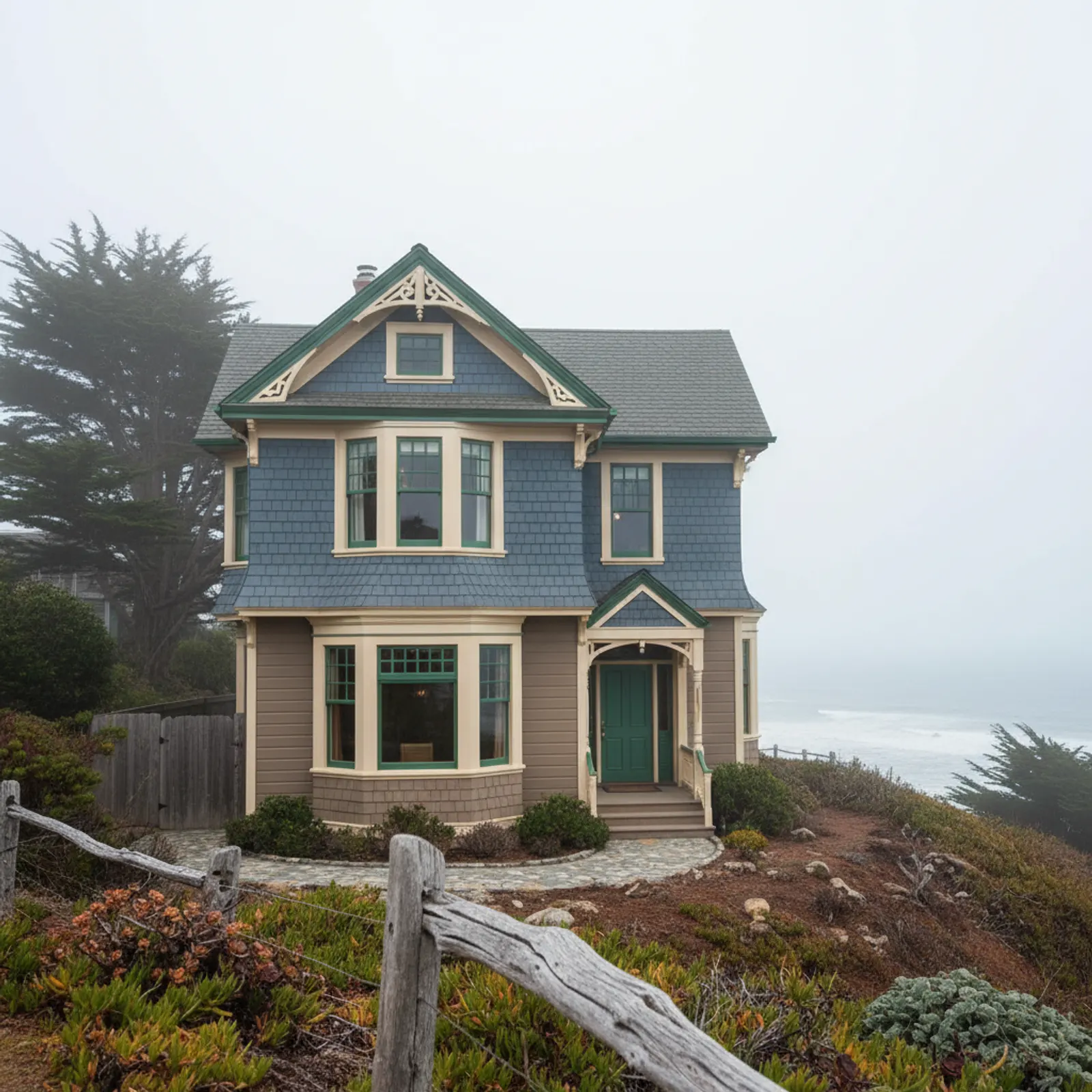
Pacific Grove's Victorian and gingerbread stock predates modern WUI concerns entirely; preservation expectations along Ocean View Boulevard, Lighthouse Avenue, and the historic-district grid drive the real exterior decision-making here. Class A non-combustibility is welcome but secondary to authentic profile and color execution.
Pacific Grove's exposure reality
Pacific Grove's cottage and coastal stock carries low wildfire exposure — developed open-coast terrain with no significant wildland interface. We tell owners plainly that open-Pacific salt and moisture are their real concerns.
Incidental to the Victorian/open-Pacific spec
Pacific Grove's real work is replicating intricate Victorian trim and surviving the most severe open-Pacific salt on the peninsula — that's why fiber cement is chosen. Class A non-combustibility is a free consequence; on a developed open-coast town with no wildland interface it's a margin, never a manufactured concern.
Matching fire-resistant siding to the historic-district grid
The blocks around Lighthouse Avenue and the dense Victorian grid that climbs back from Ocean View Boulevard are where the real challenge sits. These cottages carry narrow lap profiles, decorative gingerbread trim, scalloped shingle courses, and tight reveal lines that the city's preservation expectations treat as defining features. When a Pacific Grove homeowner asks about fire-resistant siding, the question is never whether a Class A non-combustible board can be installed, but whether it can be milled, exposed, and detailed to read as authentic clapboard or fishscale shingle from the sidewalk. Fiber cement and mineral-based products can do this, but only with custom exposure widths, hand-built corner and water-table details, and trim that respects the original shadow lines. We plan these jobs around the cottage's existing rhythm first and the fire rating second, because a board that protects the structure but flattens a century-old facade fails the only test that matters on these streets. That sequencing is what separates a sympathetic re-clad here from a generic install.
Why salt-air durability outranks the fire spec on the peninsula
Pacific Grove sits at the exposed northern tip of the peninsula, where wind drives ocean salt and fog moisture straight onto homes day after day, especially the rows perched just above the rocky shore. For a fire-resistant siding project here, that marine load is the factor that actually determines how long the work lasts. Non-combustible boards earn their place partly because mineral and fiber-cement materials shrug off salt corrosion and constant damp far better than the old-growth wood they often replace, which on these cottages has frequently rotted at the base courses, behind downspouts, and along north-facing walls that never fully dry. We spec stainless or hot-dip fasteners, generous flashing at every horizontal break, and a drainage gap behind the cladding so wind-driven moisture has a path out rather than a pocket to sit in. Compared with inland Monterey or the sheltered canyons of Carmel, Pacific Grove's direct-Pacific exposure forces tighter detailing. The fire rating is a welcome bonus; surviving the salt is the engineering problem we are really solving.
Why this matters in Pacific Grove
- Specified for Monterey Peninsula conditions
- non-combustible fiber cement as the recommended system
- Correctly detailed weather-resistive barrier and flashing
- Installed by a crew with 20 years combined experience
Recommended systems for Pacific Grove
- non-combustible fiber cement
- corrosion-resistant fastening
- period-sensitive trim
Fire-Resistant Siding for Pacific Grove homes
The full fire-resistant siding approach — materials, weather-resistive detailing, and the manufacturer standards we install to — is covered on the main service page, then specified for Pacific Grove's conditions on this one.
Our Pacific Grove process
- Step 1
Consultation
We listen to your goals and assess your home on site — exposure, substrate, and architecture.
- Step 2
Design & Proposal
A clear written proposal with the right system specified for your climate and a transparent scope.
- Step 3
Expert Installation
Trained crews install to manufacturer best practices with careful weather-management detailing.
- Step 4
Walkthrough & Support
A final walkthrough, full cleanup, and a clear written record of the scope completed — work we stand behind.
FAQ
Fire-Resistant Siding in Pacific Grove — FAQ
Pacific Grove is low-exposure open coast and salt/moisture-driven, so it's a low-regret upgrade rather than a necessity. We won't overstate fire risk here.
Low — developed open-coast terrain with no significant wildland interface. Salt and marine moisture are the controlling factors.
No — the fiber cement we recommend for salt-and-moisture durability is already non-combustible, so Class A performance is included.
Corrosion-rated metal and a drying-capable plane, plus period-faithful detailing — the salt-and-moisture failures that actually affect cottage homes here.
Keep Exploring
More for Pacific Grove homeowners
More in Pacific Grove
Other exterior services in Pacific Grove
Nearby Service Areas
Fire-Resistant Siding near Pacific Grove
Back to
Monterey County & Pacific Grove
Helpful Exterior Guides