
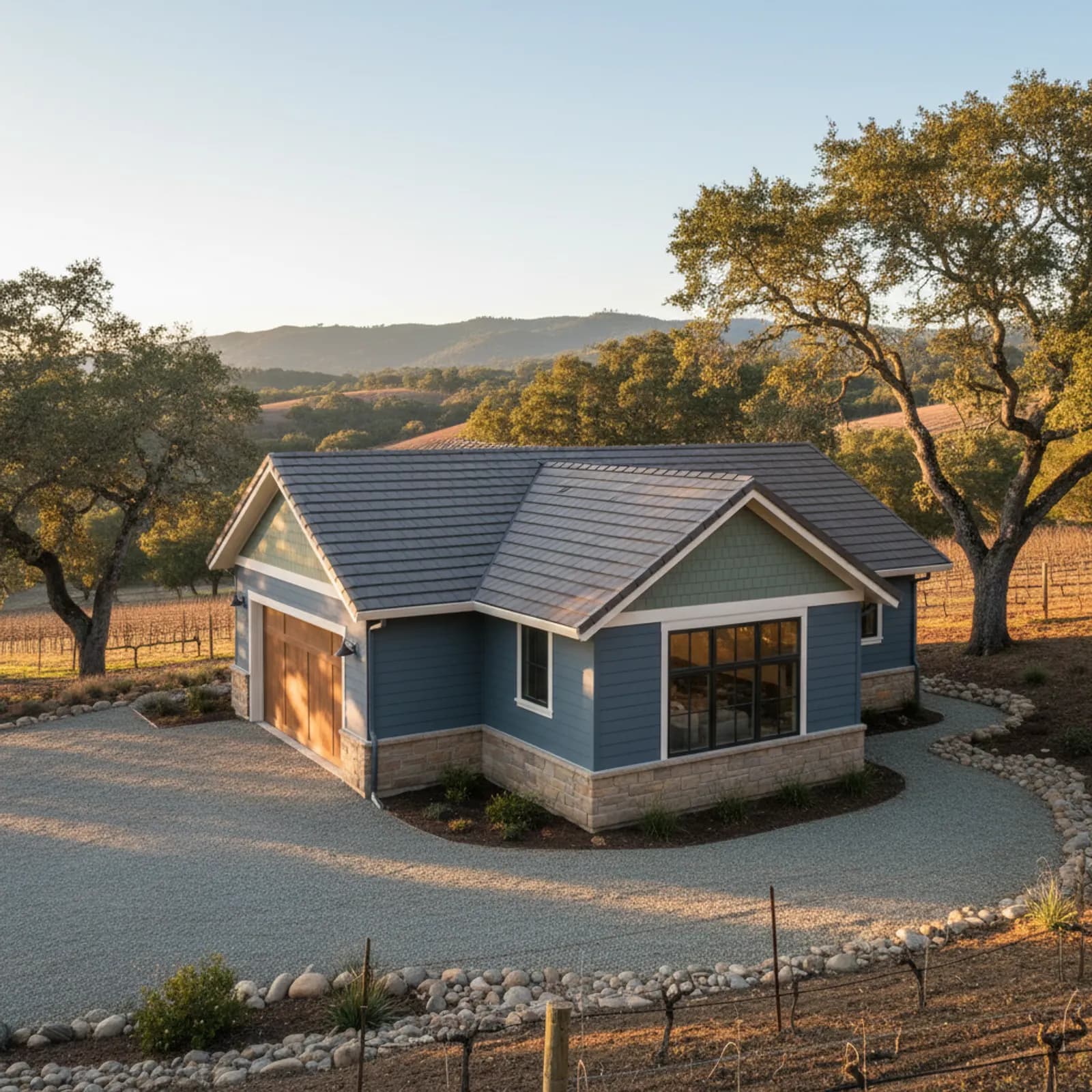
Fire-Resistant Siding in Yountville
Honest answer: Yountville's wildfire exposure is genuinely elevated wine-country — worth hardening for — but, on the mid-valley floor, meaningfully less severe than foothill-edge St. Helena or repeatedly-evacuated Calistoga. Fire-resistant siding here is sensible and recommended, scoped honestly to that elevated (not high) reality.
Elevated, accurately characterized
Yountville's village and vineyard-estate parcels carry elevated wine-country exposure that warrants Class A non-combustible cladding and hardened eaves, vents, and ground transitions — appropriately scoped, not the maximal upper-valley build.
Matched to elevated — and no more
Yountville's exposure is elevated, not high — so the honest answer is proportionate hardened detailing on the premium fiber cement its refined streetscape chooses anyway, never the maximal upper-valley build. Class A is included at no cost; the discipline here is restraint, not over-spec on a tiny culinary village.
Finish standards that survive a Class A swap
Replacing cladding on a Yountville cottage or polished in-town residence is as much a finish problem as a fire problem. The town's restaurant-row blocks and refined residential streets are held to a level of trim detail where a blunt fiber-cement install reads as a downgrade, so the fire-resistant work has to disappear into the architecture. That means specifying smooth or finely textured non-combustible panels that mimic the original wood profiles, mitered returns at corners rather than bulky factory trim, and reveal lines that match the existing window and door casings. On historic-cottage facades the board widths and shadow lines were chosen decades ago, and a Class A replacement that ignores them looks wrong from the street. We mock up profile and color before committing a full elevation, and we keep penetrations, hose-bib boxes, and electrical trim tight and painted to match. The result hardens the wall against ember ignition while preserving the low-key, high-finish look Yountville buyers and neighbors expect from a wine-country home.
Vineyard-edge estates and the napa, st-helena gradient
Yountville sits between Napa to the south and St. Helena to the north, and where a home falls on that line changes the hardening spec. Estate parcels on the vineyard edge, with rows and dry brush running right up to the foundation, behave more like the foothill exposure you see toward St. Helena and need the fuller package: non-combustible cladding carried down to a clean noncombustible base, ember-resistant vents, and boxed eaves. In-town residences closer to the valley floor, surrounded by paved streets and irrigated landscaping like much of Napa proper, carry less direct ember loading and can be scoped accordingly without overbuilding. The practical detail on vineyard-edge work is the ground-to-wall transition, since irrigation and graded rows often push soil and mulch against the siding. We hold a hard noncombustible gap there and detail the bottom course so embers landing in bed mulch cannot find a combustible edge. Matching the spec to the actual parcel, not a blanket county number, is how we keep these estates protected without inflating the build.
Why this matters in Yountville
- Specified for Wine Country conditions
- premium non-combustible fiber cement as the recommended system
- Correctly detailed weather-resistive barrier and flashing
- Installed by a crew with 20 years combined experience
Recommended systems for Yountville
- premium non-combustible fiber cement
- custom trim packages
- fire-aware detailing
Fire-Resistant Siding for Yountville homes
The full fire-resistant siding approach — materials, weather-resistive detailing, and the manufacturer standards we install to — is covered on the main service page, then specified for Yountville's conditions on this one.
Our Yountville process
- Step 1
Consultation
We listen to your goals and assess your home on site — exposure, substrate, and architecture.
- Step 2
Design & Proposal
A clear written proposal with the right system specified for your climate and a transparent scope.
- Step 3
Expert Installation
Trained crews install to manufacturer best practices with careful weather-management detailing.
- Step 4
Walkthrough & Support
A final walkthrough, full cleanup, and a clear written record of the scope completed — work we stand behind.
FAQ
Fire-Resistant Siding in Yountville — FAQ
Elevated wine-country exposure — genuinely worth hardening for — but on the mid-valley floor it's meaningfully less severe than foothill-edge St. Helena or repeatedly-evacuated Calistoga.
It's recommended and sensible given the elevated exposure — and it comes with the non-combustible fiber cement we recommend anyway — but scoped honestly, not to upper-valley extremes.
No — the premium fiber cement we recommend for design and durability is already non-combustible, so Class A performance is included.
It can support insurability in elevated wine-country exposure; we document materials and assemblies, though insurers set their own criteria.
Keep Exploring
More for Yountville homeowners
More in Yountville
Other exterior services in Yountville
Nearby Service Areas
Fire-Resistant Siding near Yountville
Helpful Exterior Guides