
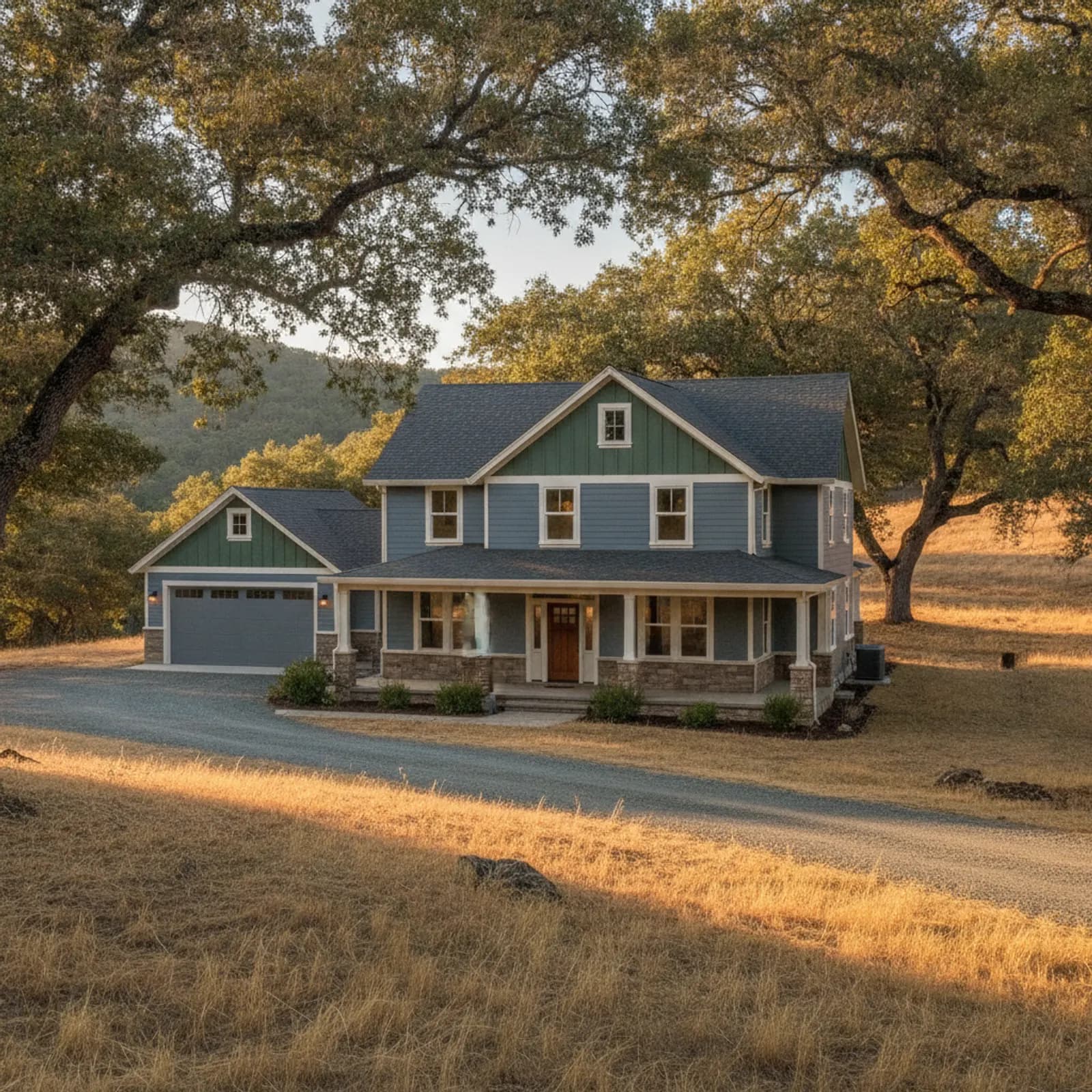
James Hardie Siding in Chicago Park
Chicago Park isn't a town so much as a wooded agricultural district between Grass Valley and Colfax — settled in the 1880s by families who came west from Chicago to plant fruit, laid out as a colony of twenty- and forty-acre tracts whose Bartlett pears once fetched twice the price of Central Valley fruit. The orchards mostly gave way to forest and rural homesteads after pear blight came through, and today it's acreage homes tucked into pine, cedar, and the remnants of old orchard land. A James Hardie job here is a re-clad on a home standing alone in the trees, often at the end of a long private drive with no neighbor in sight.
Board economics on a remote homestead
The case for James Hardie sharpens on a Chicago Park parcel. When a house sits on acreage behind a gated gravel drive off a rural lane, every future maintenance visit — painters, scaffold, lifts — is a trip up from the valley and a real recurring bill. HardiePlank with baked ColorPlus finish takes most of that cycle off the table: the color is cured into the board rather than brushed on, so it holds far longer than a field coat through the foothill seasons. On an isolated homestead, spending once on an exterior that doesn't need repainting is usually the cheaper path over the life of the wall than committing to a repaint schedule that's a logistical chore every time it comes due.
HZ10 board for the ridge's wet-dry swing
Chicago Park sits around 2,700 feet in the Nevada County foothills, within James Hardie's HZ10 climate zone — the formulation built for hot, dry, high-UV summers rather than freeze country. But the setting adds moisture the number alone doesn't capture: heavy tree shade and wetter winters keep north walls damp, then dry summers pull the wall back out, and wood siding rides that swing until joints open and end grain rots. Fiber cement is dimensionally stable through the same cycle and won't rot at the cut ends, which is the failure that shortens wood siding on a shaded, tree-covered lot. We spec the HZ10 board, seal the cut edges as we go, and detail the water-shedding so the assembly handles both the summer UV and the winter damp.
Profiles that fit orchard-country homes
The homes scattered through Chicago Park are custom rural places — farmhouses, cabins, ranch elevations, and the odd converted orchard building — not repeated subdivision plans, so the James Hardie spec is chosen per house. HardiePlank in a wider lap suits a farmhouse or ranch, HardiePanel with HardieTrim battens reproduces a board-and-batten barn look for the outbuildings common on these old tracts, and HardieShingle can carry a cabin gable. Earthier ColorPlus tones tend to sit better against pine and orchard remnants than a bright suburban white. We help match the profile, reveal, and color to a home meant to belong on its acreage, keeping the country character while dropping the maintenance and combustibility of the old wood.
Access and staging on old orchard acreage
Delivering heavy fiber cement to a Chicago Park homestead means working the access, not just the house. The old colony tracts are reached by long private drives and rural lanes with limited turnaround, and a delivery truck often can't get close to a back elevation set among the trees. We plan the material drop and cut station on the estimate visit — staging smaller loads nearer the house where the drive won't take a full truck — and keep the saw work and washdown clear of the wells and septic these parcels run on. We protect the mature trees and any old orchard plantings we're working around. Traveling up from our Sacramento-region base, we treat the access walk and the defensible-space perimeter as one visit, because on forest-embedded acreage the logistics and the fire exposure are the same problem.
Why this matters in Chicago Park
- Specified for Sierra Foothills conditions
- Class A non-combustible fiber cement as the recommended system
- Correctly detailed weather-resistive barrier and flashing
- Installed by a crew with 20 years combined experience
Recommended systems for Chicago Park
- Class A non-combustible fiber cement
- James Hardie
- fire-aware detailing
James Hardie Siding for Chicago Park homes
The full james hardie siding approach — materials, weather-resistive detailing, and the manufacturer standards we install to — is covered on the main service page, then specified for Chicago Park's conditions on this one.
Our Chicago Park process
- Step 1
Consultation
We listen to your goals and assess your home on site — exposure, substrate, and architecture.
- Step 2
Design & Proposal
A clear written proposal with the right system specified for your climate and a transparent scope.
- Step 3
Expert Installation
Trained crews install to manufacturer best practices with careful weather-management detailing.
- Step 4
Walkthrough & Support
A final walkthrough, full cleanup, and a clear written record of the scope completed — work we stand behind.
FAQ
James Hardie Siding in Chicago Park — FAQ
Usually yes — the ColorPlus finish ends the repaint cycle that's especially costly when painters have to drive up and scaffold an isolated acreage home, and the board handles the ridge's heat, UV, and winter damp far better than wood over the life of the wall.
HZ10 — around 2,700 feet the Nevada County foothills still fall in Hardie's hot-dry zone, though the tree shade and wetter winters make the board's dimensional stability and sealed cut edges especially valuable here.
Yes — wider HardiePlank fits a farmhouse or ranch, HardiePanel with battens reproduces a board-and-batten barn look, and HardieShingle carries a cabin gable. We match the profile and an earthier ColorPlus tone to the home and its wooded setting.
It's a planning item, not a dealbreaker. Hardie ships heavy, so we scope the drop, staging, and cut station to your access on the estimate visit and keep everything clear of the well and septic on the parcel.
Keep Exploring
More for Chicago Park homeowners
More in Chicago Park
Other exterior services in Chicago Park
Nearby Service Areas
James Hardie Siding near Chicago Park
Helpful Exterior Guides