
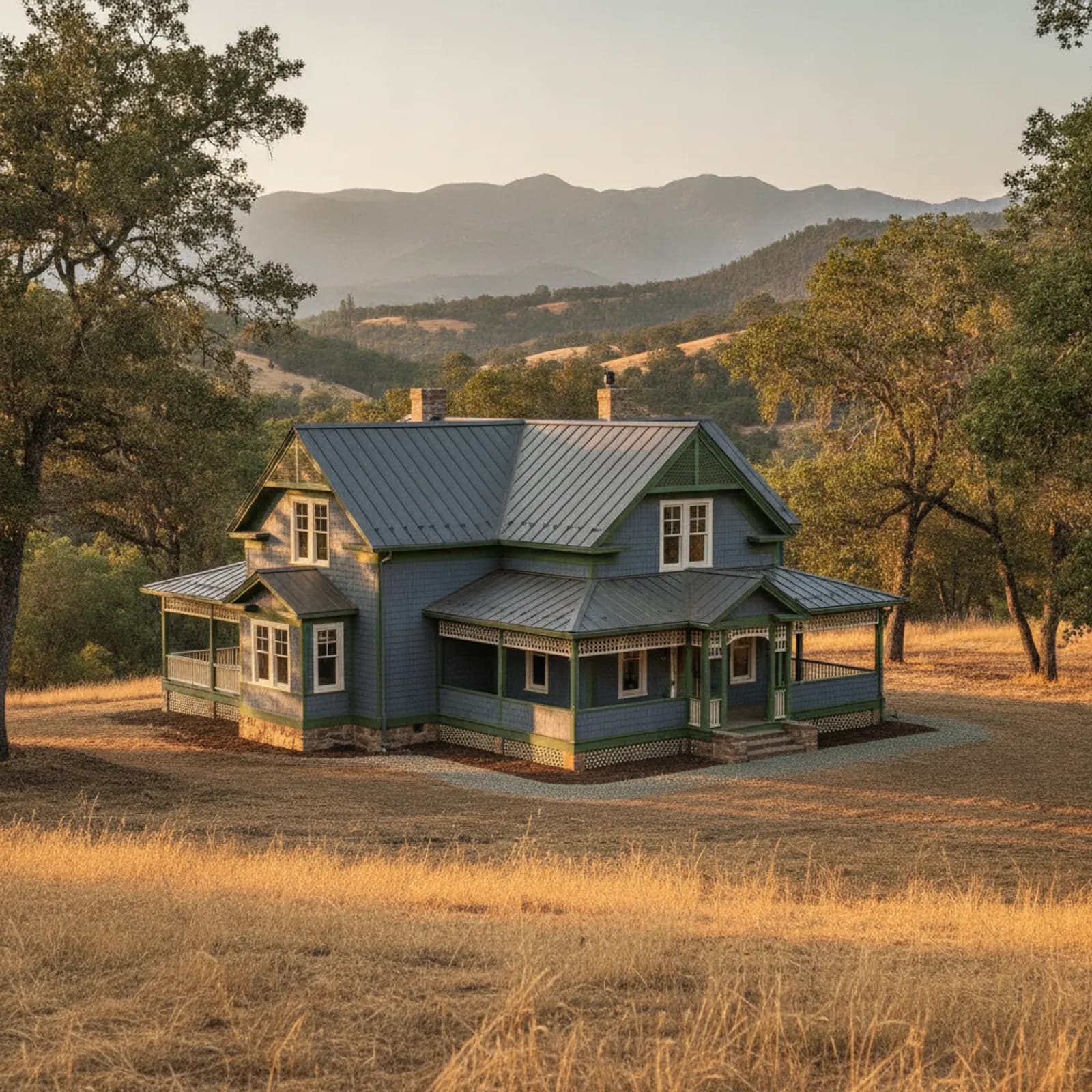
Fire-Resistant Siding in Chicago Park
Fire-resistant siding is a central decision in Chicago Park, not a nicety. This is forest-embedded acreage between Grass Valley and Colfax — old orchard-colony tracts that have grown back into pine and cedar, where homes sit alone among continuous fuel with long private access and a real ridge draw. The district falls squarely in the Nevada County wildland-urban interface, and on a homestead this deep in the trees the exterior of the house is one of the few parts of the fire equation the owner can actually harden.
Fuel in the yard, not over a ridge
On a Chicago Park parcel the trees aren't a distant tree line — they're the setting, with conifers and old orchard growth standing within feet of the walls and crowns reaching over the roof. That closes the distance an ember storm has to travel and puts direct radiant heat, and sometimes flame contact, onto the wall itself. Class A non-combustible cladding is the baseline we specify, but on forest-embedded acreage the eave, soffit, and vent detailing carries as much of the protection as the field board, because the fuel is close enough to attack the assembly head-on. We scope each elevation to how near the actual trees are, not to a generic foothill template that assumes drifting embers alone.
Building to the WUI-code standard
The 2025 California Wildland-Urban Interface Code is the exterior-wildfire construction standard for the WUI fire-severity zones Chicago Park sits in, and it's the benchmark we build a re-side to even on an older home the code doesn't strictly force to comply. In practice that's non-combustible or ignition-resistant cladding — fiber cement meets the exterior-wall requirement — installed with ember-resistant vents, enclosed eaves, and detailing that removes the gaps a firebrand finds. Fiber cement is non-combustible under ASTM E84 and carries a Class A flame-spread rating, which makes it a genuinely strong wall material, but it is not 'fireproof' and we won't call it that. The re-side is one layer of a hardened home built to a real standard, paired with the defensible space this acreage demands.
Duff, the litter line, and the ground transition
Homes in a forest district like Chicago Park are most often lost to embers finding a weak point while the fire is still working up the ridge, not to a single wall of flame. The vulnerable spots repeat every season: pine needles and cedar duff packed against the foundation, litter caught in the eave returns, gaps behind old trim, deck-to-wall joints buried in debris. Replacing wood siding with Class A board only pays off if we close those paths in the same pass. We detail a non-combustible ground-to-wall transition so nothing wicks flame up from the duff line, screen the vents, and box the eaves where embers otherwise lodge and light the fascia. On acreage where clearing duff is a constant chore, the transitions at the base of the wall are where a hardened re-side is won or lost.
Documenting the hardening for a hard market
Insurers pricing the Nevada County foothills treat forest-embedded acreage like Chicago Park as high exposure, and more of them now ask what a home has actually done before they'll write or renew it. When we harden a home here we document the non-combustible cladding and the eave, vent, deck, and ground-transition work that went with it, so you can hand your agent a record of real work instead of a vague claim. We're honest about what that record does: it can support your case and your agent's file, but the carrier sets its own criteria and we don't promise a rate outcome or guarantee insurability. What we stand behind is that the exterior was hardened to a genuine standard and written down clearly enough to be useful.
Why this matters in Chicago Park
- Specified for Sierra Foothills conditions
- Class A non-combustible fiber cement as the recommended system
- Correctly detailed weather-resistive barrier and flashing
- Installed by a crew with 20 years combined experience
Recommended systems for Chicago Park
- Class A non-combustible fiber cement
- James Hardie
- fire-aware detailing
Fire-Resistant Siding for Chicago Park homes
The full fire-resistant siding approach — materials, weather-resistive detailing, and the manufacturer standards we install to — is covered on the main service page, then specified for Chicago Park's conditions on this one.
Our Chicago Park process
- Step 1
Consultation
We listen to your goals and assess your home on site — exposure, substrate, and architecture.
- Step 2
Design & Proposal
A clear written proposal with the right system specified for your climate and a transparent scope.
- Step 3
Expert Installation
Trained crews install to manufacturer best practices with careful weather-management detailing.
- Step 4
Walkthrough & Support
A final walkthrough, full cleanup, and a clear written record of the scope completed — work we stand behind.
FAQ
Fire-Resistant Siding in Chicago Park — FAQ
High — forest-embedded acreage between Grass Valley and Colfax, where regrown orchard land and conifer stand feet from the walls on a ridge that draws fire upslope. Non-combustible, hardened exteriors are the baseline here, not an upgrade.
No — it's non-combustible under ASTM E84 with a Class A flame-spread rating, a strong wall material, but nothing on a house is fireproof. It's one layer of a hardened envelope alongside vents, eaves, decks, and defensible space.
It's California's exterior-wildfire construction standard for the WUI zones Chicago Park sits in. It targets new work, but we build a re-side to that benchmark anyway — non-combustible cladding plus ember-resistant vents, enclosed eaves, and closed ember paths.
It can support your case — we document the cladding and hardening for your file — but carriers set their own criteria. We don't guarantee a rate or insurability; we make sure the work meets a real standard and is recorded clearly.
Keep Exploring
More for Chicago Park homeowners
More in Chicago Park
Other exterior services in Chicago Park
Nearby Service Areas
Fire-Resistant Siding near Chicago Park
Helpful Exterior Guides