
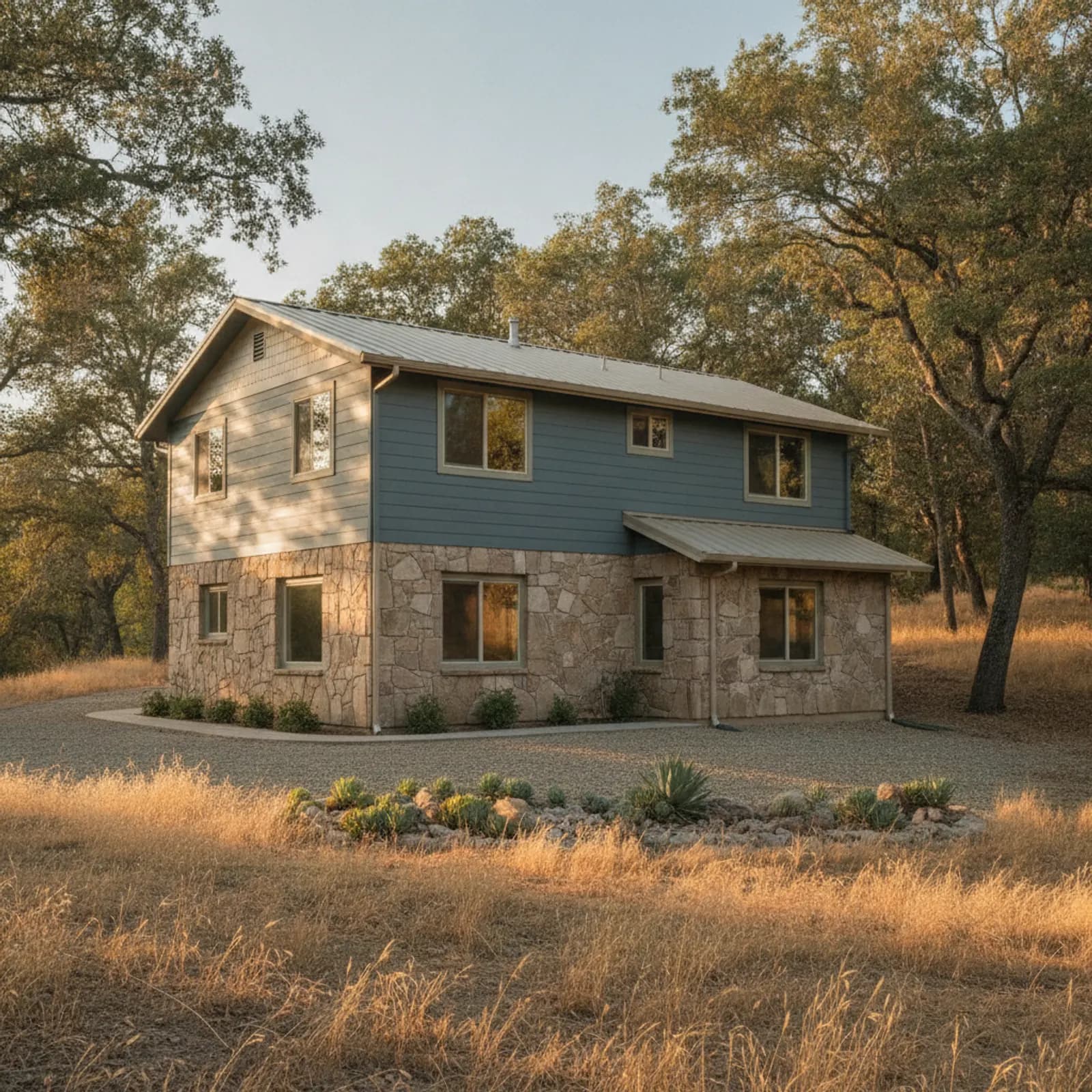
Fire-Resistant Siding in Cedar Ridge
Cedar Ridge is genuine wildland-urban interface in continuous incense-cedar and ponderosa canopy, and the mechanism here is timber fire rather than the grass fire of the open foothill communities.
That changes the priority order in a way worth stating, because most hardening advice is written generically and the two are not the same problem.
The wall face is genuinely in play here
On open grassland we tell owners plainly that cladding ranks below vents and ground transitions, because ember cast is the mechanism. In dense conifer that changes: canopy fire can deliver sustained radiant exposure directly to the wall, and a combustible elevation in that situation is a genuine liability rather than a secondary one. Non-combustible cladding therefore earns a higher position in the Cedar Ridge priority list. The openings still matter enormously — vents remain a primary ember path and eaves still collect them — but the ordering is meaningfully different from open-ground advice.
Continuous canopy and the fuel against the building
Incense cedar and ponderosa drop constantly, so needle litter accumulates in gutters, roof valleys, deck framing, and against foundations year-round rather than seasonally. On a parcel with continuous overhead canopy that is a persistent condition rather than an occasional one. Clearing it is recurring work, and CAL FIRE reports that properties in compliance with defensible space requirements are five times more likely to survive a wildfire. On a Cedar Ridge property that compliance is harder to sustain than on open ground precisely because the litter never stops arriving.
Cedar and board-and-batten, and why they get replaced
The 1970s-through-1990s stock here is substantially clad in cedar, board-and-batten, or T1-11 — combustible material sitting in continuous timber fuel with canopy overhead. On this specific parcel type that combination is about as unfavourable as residential exterior conditions get in the foothills, which is why re-cladding in non-combustible material is a genuinely high-value upgrade rather than a nice-to-have. The character can be kept; fiber cement reproduces board-and-batten and shingle profiles convincingly.
Honest limits, as everywhere
We will not tell you that a hardened Cedar Ridge home is safe from wildfire or that hardening guarantees survival. Homes built to a high standard have been lost and poorly built ones have survived, because outcomes depend on fire behaviour, weather, fuel loading, terrain, and available suppression far more than on any building decision. What hardening does is improve the odds and remove the failure modes within your control — and under continuous canopy, the ones outside your control are a larger share than on open ground.
Why this matters in Cedar Ridge
- Specified for Sierra Foothills conditions
- Class A non-combustible fiber cement as the recommended system
- Correctly detailed weather-resistive barrier and flashing
- Installed by a crew with 20 years combined experience
Recommended systems for Cedar Ridge
- Class A non-combustible fiber cement
- James Hardie
- fire-aware detailing
Fire-Resistant Siding for Cedar Ridge homes
The full fire-resistant siding approach — materials, weather-resistive detailing, and the manufacturer standards we install to — is covered on the main service page, then specified for Cedar Ridge's conditions on this one.
Our Cedar Ridge process
- Step 1
Consultation
We listen to your goals and assess your home on site — exposure, substrate, and architecture.
- Step 2
Design & Proposal
A clear written proposal with the right system specified for your climate and a transparent scope.
- Step 3
Expert Installation
Trained crews install to manufacturer best practices with careful weather-management detailing.
- Step 4
Walkthrough & Support
A final walkthrough, full cleanup, and a clear written record of the scope completed — work we stand behind.
FAQ
Fire-Resistant Siding in Cedar Ridge — FAQ
Because the mechanism differs. On open grassland ember cast is the threat and cladding ranks below vents and ground transitions. In dense conifer, canopy fire can deliver sustained radiant exposure directly to the wall, so a combustible elevation becomes a genuine liability rather than a secondary one.
A persistent one rather than a seasonal one, because incense cedar and ponderosa drop constantly under continuous canopy. It accumulates in gutters, valleys, deck framing, and against foundations year-round, which makes defensible-space compliance harder to sustain here than on open ground.
On this parcel type it is one of the higher-value upgrades available to an existing structure. Combustible cladding sitting in continuous timber fuel with canopy overhead is about as unfavourable as residential exterior conditions get in the foothills, and the character can be preserved in a non-combustible material.
It improves the odds and removes the failure modes you control. It does not guarantee anything — well-built homes have been lost and poorly built ones survived, because fire behaviour, weather, fuel, terrain, and suppression matter more. Under continuous canopy the factors outside your control are a larger share than on open ground.
Keep Exploring
More for Cedar Ridge homeowners
More in Cedar Ridge
Other exterior services in Cedar Ridge
Nearby Service Areas
Fire-Resistant Siding near Cedar Ridge
Helpful Exterior Guides