Fiber Cement Siding in Cedar Ridge
Cedar Ridge sits in dense incense-cedar and ponderosa canopy southeast of Grass Valley at roughly 2,400 feet, and its fire mechanism is timber rather than grass. That distinction matters, because timber fire delivers sustained radiant load rather than the fast ember-driven pass of open grassland.
The wall face matters more here than it does on the open foothill parcels, and the canopy is doing two things at once.
Timber fire behaves differently from grass fire
In dense conifer, fire can move into the canopy and deliver sustained radiant exposure to a structure rather than passing quickly the way a grass front does. That changes the emphasis: the wall face genuinely matters, because it may be exposed to prolonged heat rather than brief ember cast. Non-combustible cladding therefore does more work on a Cedar Ridge parcel than it does at Pilot Hill or Cool. The openings still matter — vents and eaves remain critical — but the ranking is different, and specifying a Cedar Ridge property as though it were open-ground grassland gets the emphasis wrong.
Canopy cuts the UV and slows the drying
Dense incense-cedar and ponderosa cover means Cedar Ridge homes get considerably less direct sun than the open foothill parcels, which is genuinely helpful for finish life — the UV load is lower and coatings last longer. The trade is moisture: shaded elevations dry slowly, needle litter accumulates in gutters and against walls, and organic debris holds water against the building. So the finish is under less attack here and the drainage detailing is under more, which is close to the reverse of the open-parcel picture.
Cedar and board-and-batten stock, replaced for a reason
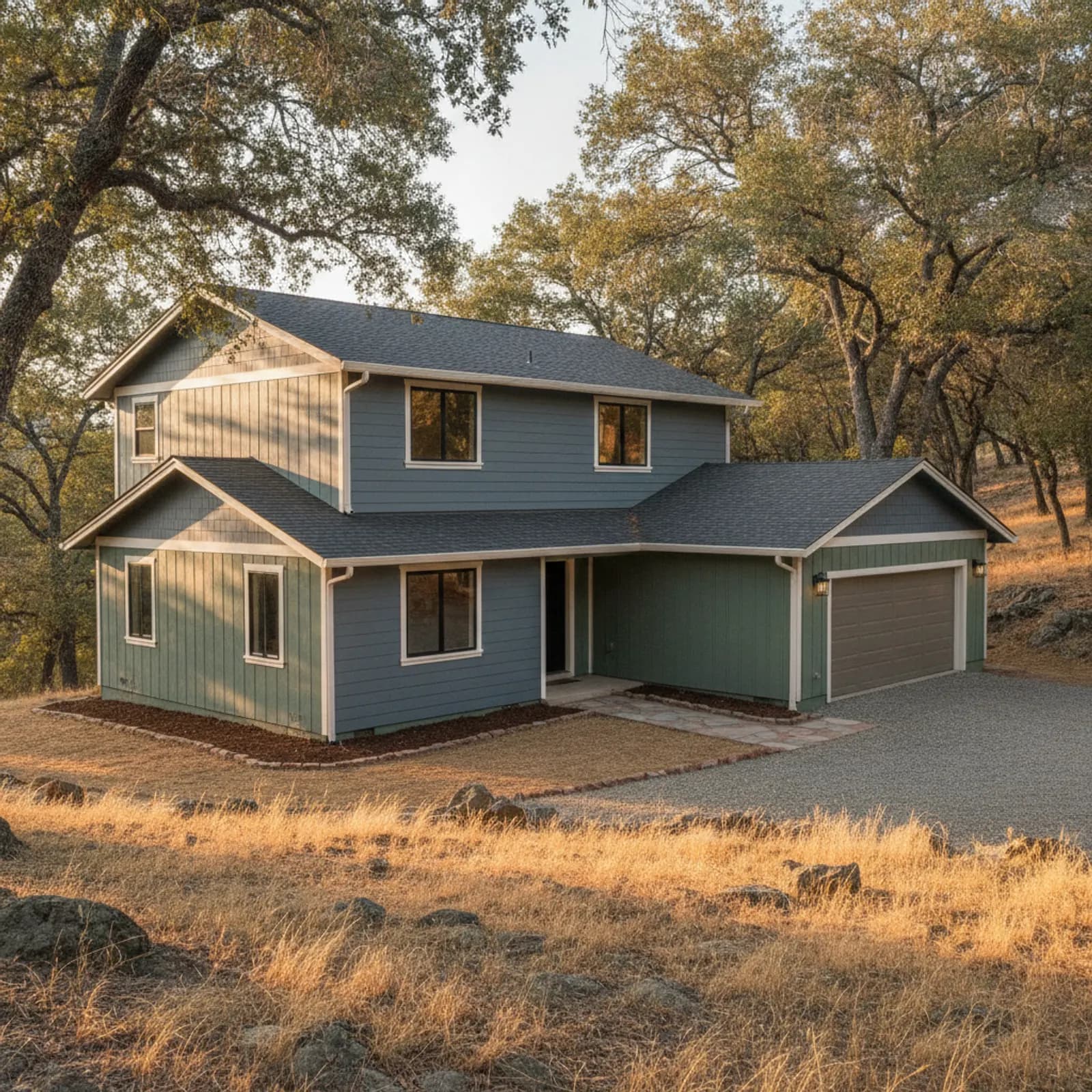
A great deal of Cedar Ridge housing is 1970s-through-1990s custom foothill building clad in cedar, board-and-batten, or T1-11 — combustible material in continuous timber fuel. That is the single most consequential thing about the local stock. Replacing it with a non-combustible wall is one of the highest-value hardening upgrades available to an existing structure here, and unlike the open-grassland markets it genuinely is at or near the top of the list rather than below the openings. The vernacular can be preserved: fiber cement reproduces board-and-batten and shingle profiles convincingly.
Needle litter is a year-round mechanism
Incense cedar and ponderosa drop continuously, and on a Cedar Ridge parcel that means gutters, roof valleys, deck framing, and the ground against the foundation collect combustible material constantly rather than seasonally. It also holds moisture against the building, which is the drainage side of the same problem. Ground clearance at the base of the wall matters more here than in a drier open setting, and a maintenance conversation about litter is worth having alongside the construction one because it addresses both mechanisms at once.
Why this matters in Cedar Ridge
- Specified for Sierra Foothills conditions
- Class A non-combustible fiber cement as the recommended system
- Correctly detailed weather-resistive barrier and flashing
- Installed by a crew with 20 years combined experience
Recommended systems for Cedar Ridge
- Class A non-combustible fiber cement
- James Hardie
- fire-aware detailing
Fiber Cement Siding for Cedar Ridge homes
The full fiber cement siding approach — materials, weather-resistive detailing, and the manufacturer standards we install to — is covered on the main service page, then specified for Cedar Ridge's conditions on this one.
Our Cedar Ridge process
- Step 1
Consultation
We listen to your goals and assess your home on site — exposure, substrate, and architecture.
- Step 2
Design & Proposal
A clear written proposal with the right system specified for your climate and a transparent scope.
- Step 3
Expert Installation
Trained crews install to manufacturer best practices with careful weather-management detailing.
- Step 4
Walkthrough & Support
A final walkthrough, full cleanup, and a clear written record of the scope completed — work we stand behind.
FAQ
Fiber Cement Siding in Cedar Ridge — FAQ
Yes, and the difference is substantive. Dense conifer means timber fire with sustained radiant exposure rather than the fast ember-driven pass of open grassland. The wall face genuinely matters here in a way it does not at Cool or Pilot Hill, so non-combustible cladding ranks higher in the priority order.
Both. It cuts the UV load substantially, so finishes last longer than on open parcels. The trade is moisture — shaded elevations dry slowly, needle litter holds water against the building, and drainage detailing carries more weight. It is close to the reverse of the open-parcel picture.
On a Cedar Ridge parcel it is one of the highest-value hardening upgrades available to an existing structure — combustible cladding in continuous timber fuel is the most consequential thing about the local stock. Unlike the open-grassland markets, here it genuinely is at or near the top of the list.
More than most owners expect, and in two ways at once. It is combustible material accumulating continuously in gutters, valleys, deck framing, and against the foundation, and it holds moisture against the building. Ground clearance matters more here than in a drier open setting for that reason.
Keep Exploring
More for Cedar Ridge homeowners
More in Cedar Ridge
Other exterior services in Cedar Ridge
Nearby Service Areas
Fiber Cement Siding near Cedar Ridge
Helpful Exterior Guides