
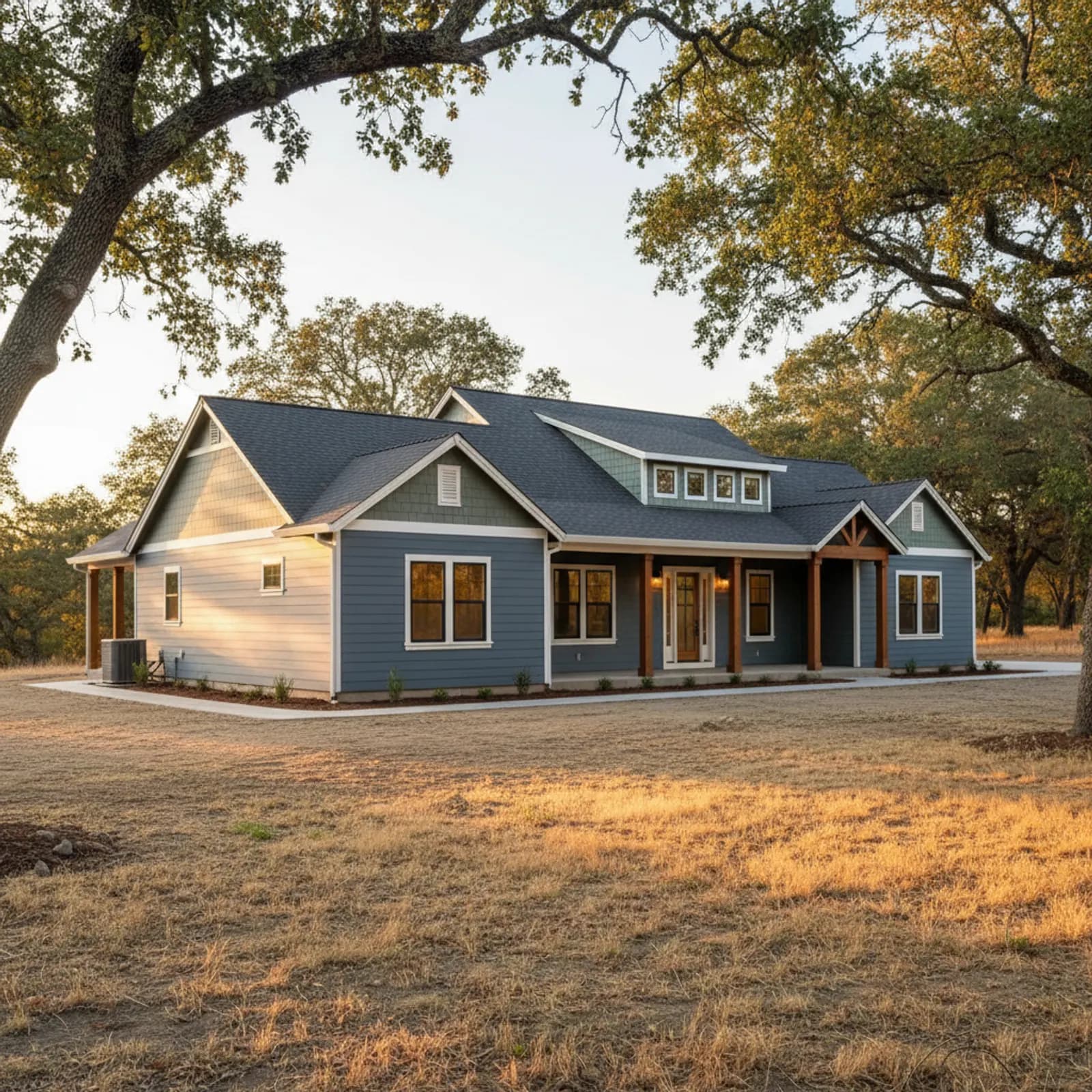
Fiber Cement Siding in Loomis
Fiber cement is the core Loomis recommendation because it is dimensionally stable through dry, hot foothill summers, holds factory finish under intense UV, and is Class A non-combustible for the elevated exposure on oak-woodland and grass-acreage parcels.
Heat-and-UV durable for the bulk
Loomis's hot, high-UV foothill summers degrade original cladding; fiber cement resists thermal movement and holds a baked finish for decades on small-town-core and rural-acreage homes alike.
Non-combustible on oak-woodland acreage
On Loomis's wooded and grass-acreage parcels, fiber cement's non-combustibility is the decisive property, paired with hardened detailing; in the older core it's the heat-durable, low-maintenance choice.
Think the whole equestrian parcel
Loomis is rural-residential acreage where a home shares the lot with barns and stables. A fiber-cement re-clad that hardens only the house while a combustible outbuilding sits within ignition range is half a solution — we scope the Class A cladding and ground/eave detailing across the parcel's relevant structures.
Ember-zone detailing and the defensible-space conversation
Because Loomis sits in genuine wildland-urban interface country rather than a tidy suburban tract, the fiber cement specification here is driven as much by ember intrusion as by the board itself. A Class A non-combustible field is only as good as the edges and openings around it, so on these oak-woodland and grass-acreage homes the detailing matters: closing off eave and soffit gaps, tight metal flashing at transitions, ember-resistant venting, and careful treatment where the cladding meets decks, foundations, and the inevitable outbuildings on a working parcel. Fire-aware exterior choices also intersect with the defensible-space expectations homeowners in this part of Placer County already live with, so re-cladding is often the moment to rethink the first few feet around the structure too. We can't speak to any single parcel's permit path, since requirements vary by lot, slope, and access road, but on rural acreage between Auburn and Roseville it's worth confirming local hardening and inspection conditions before scoping a fiber cement project rather than discovering them mid-build.
Two very different Loomis jobs under one material
Loomis isn't one housing type, and fiber cement work splits accordingly. In the older town center the homes are smaller, set closer together, and often carry decades of original wood cladding with weathered trim profiles and tight side-yard access. There the job is largely a careful tear-off and re-clad that respects the existing scale, matching reveal widths and trim depth so a heat-and-UV-stable board reads correctly on a modest small-town facade. Out on the acreage and equestrian parcels toward Granite Bay and Rocklin, the work changes character entirely: sprawling custom elevations, long gable runs, deep overhangs, and outbuildings that owners frequently want clad to the same standard as the main residence. Staging material and moving equipment across an oak-shaded property is its own planning problem, quite different from maneuvering around a compact in-town lot. Estimating, panel layout, and crew sequencing all flex between those two realities. Naming which Loomis you're building in up front keeps the bid honest and the finish appropriate to the home rather than forcing one playbook onto both.
Why this matters in Loomis
- Specified for Foothill / Rural-Residential conditions
- Class A non-combustible fiber cement as the recommended system
- Correctly detailed weather-resistive barrier and flashing
- Installed by a crew with 20 years combined experience
Recommended systems for Loomis
- Class A non-combustible fiber cement
- fire-aware eave and vent detailing
- durable factory finishes
- robust flashing
Fiber Cement Siding for Loomis homes
The full fiber cement siding approach — materials, weather-resistive detailing, and the manufacturer standards we install to — is covered on the main service page, then specified for Loomis's conditions on this one.
Our Loomis process
- Step 1
Consultation
We listen to your goals and assess your home on site — exposure, substrate, and architecture.
- Step 2
Design & Proposal
A clear written proposal with the right system specified for your climate and a transparent scope.
- Step 3
Expert Installation
Trained crews install to manufacturer best practices with careful weather-management detailing.
- Step 4
Walkthrough & Support
A final walkthrough, full cleanup, and a clear written record of the scope completed — work we stand behind.
FAQ
Fiber Cement Siding in Loomis — FAQ
Yes — dimensionally stable through hot thermal cycling and holding a baked finish far longer than original cladding under intense foothill UV.
Yes — its Class A non-combustibility is decisive on the elevated-exposure wooded/grass acreage, paired with hardened detailing, with no finish penalty.
Far less than field paint — factory finishes are engineered for foothill UV; the substrate keeps performing well beyond any refresh.
Fiber cement — engineered wood is combustible in the elevated oak-woodland terrain; there's no durability gain to offset the fire risk there.
Keep Exploring
More for Loomis homeowners
More in Loomis
Other exterior services in Loomis
Nearby Service Areas
Fiber Cement Siding near Loomis
Helpful Exterior Guides