
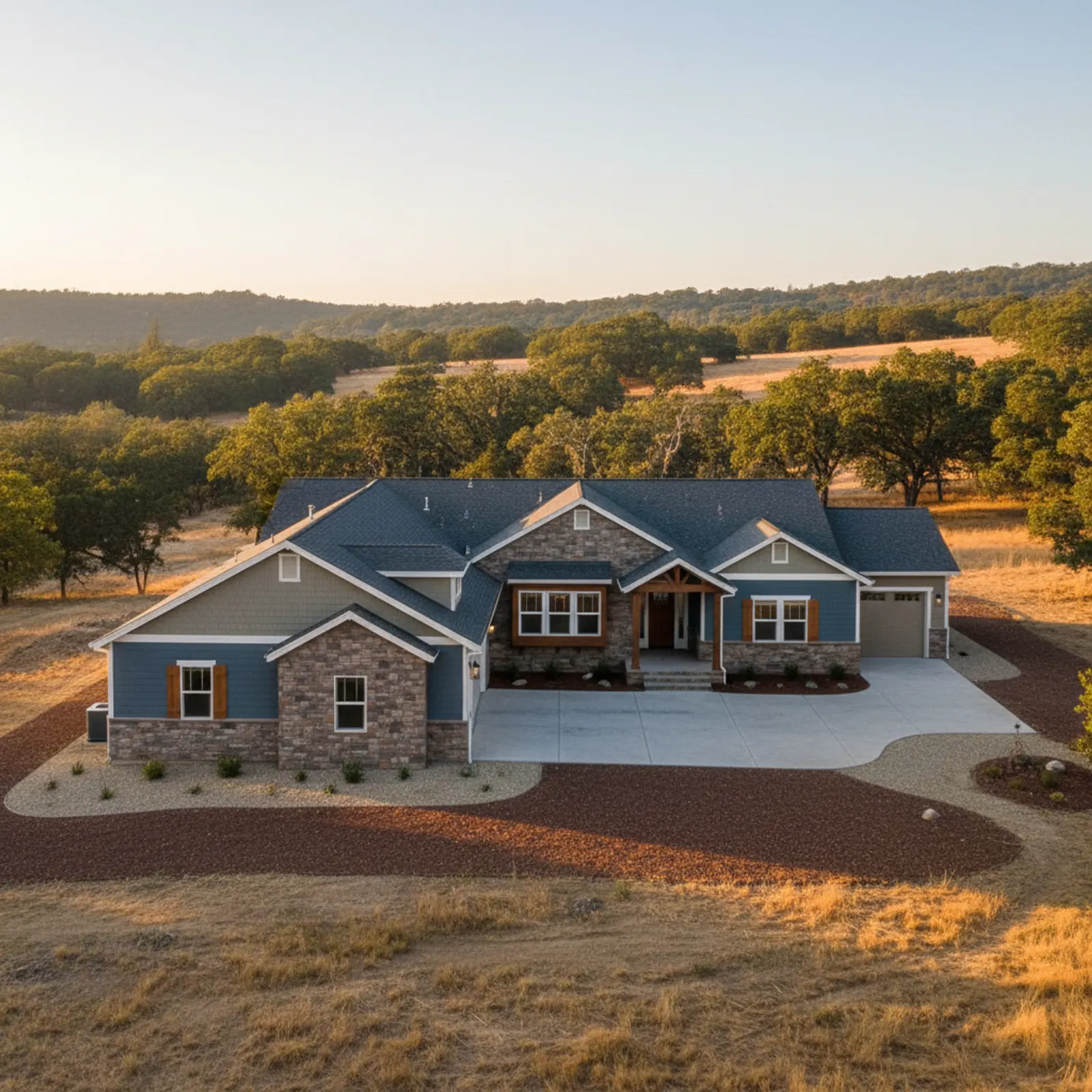
Fire-Resistant Siding in Loomis
Honest answer: Loomis is split. The older small-town core is lower-exposure where fire-resistant siding is a low-regret default; the oak-woodland custom homes and rural/equestrian grass-acreage carry genuinely elevated foothill exposure where it is a real decision.
Town core lower, oak-woodland acreage elevated
Loomis's older small-town core sits in lower-exposure ground; the oak-woodland and grass-acreage parcels carry elevated, real exposure and warrant Class A non-combustible cladding with hardened eaves, vents, and ground transitions.
Free in the core, the whole point on acreage
Loomis's older small-town core gets Class A as an incidental benefit of the heat-durable fiber cement it would choose anyway. The oak-woodland and rural/equestrian grass-acreage is the opposite — there non-combustible cladding plus hardened eaves, vents, and ground transitions, scoped across outbuildings, is the actual reason for the project.
Defensible-space siding details for equestrian and acreage parcels
On Loomis's equestrian and grass-acreage properties, the siding choice is only half the job; how the cladding meets the rest of the parcel decides whether it actually performs. Tall seasonal grasses, hay storage, and outbuildings sitting close to a main residence create ember and radiant-heat paths that a wall assembly has to anticipate. We extend non-combustible fiber cement or comparable Class A cladding down to a clean, gap-free ground transition so windblown embers have nowhere to lodge against the base of the wall. Where a deck, breezeway, or barn-side wing abuts living space, we treat that junction as the weak link it is, closing the under-eave and rim joist gaps that embers exploit. The goal on these larger oak-woodland lots is a wall plane that gives up no easy ignition point even when the surrounding pasture is dry. Pairing the cladding spec with ember-resistant vents and a swept-clean perimeter turns the exterior into part of the defensible space rather than a fuel source standing inside it.
Working around oak canopy and long rural driveways
Much of Loomis's custom housing stock sits deliberately tucked under mature oak canopy at the end of long private drives, and that setting shapes how a fire-resistant siding job actually runs. Heavy tree cover keeps walls shaded and damp longer after foothill storms, so even on a property where moisture risk is otherwise low we sequence the tear-off and re-clad to avoid leaving sheathing exposed under dripping limbs. Narrow, winding driveways and gated acreage access also limit how close a delivery truck or lift can get to the house, which affects staging for heavy fiber cement panels and the cut-and-fit pace on tall gable walls. We plan material drops and protect landscaping accordingly rather than assuming curbside access. Overhanging branches that brush the eaves get noted too, since they undercut the hardened exterior we are installing by feeding embers straight to the roofline. Accounting for the canopy, the drive, and the way these homes are sited keeps the work clean and the finished wall assembly performing as intended in real fire country.
Why this matters in Loomis
- Specified for Foothill / Rural-Residential conditions
- Class A non-combustible fiber cement as the recommended system
- Correctly detailed weather-resistive barrier and flashing
- Installed by a crew with 20 years combined experience
Recommended systems for Loomis
- Class A non-combustible fiber cement
- fire-aware eave and vent detailing
- durable factory finishes
- robust flashing
Fire-Resistant Siding for Loomis homes
The full fire-resistant siding approach — materials, weather-resistive detailing, and the manufacturer standards we install to — is covered on the main service page, then specified for Loomis's conditions on this one.
Our Loomis process
- Step 1
Consultation
We listen to your goals and assess your home on site — exposure, substrate, and architecture.
- Step 2
Design & Proposal
A clear written proposal with the right system specified for your climate and a transparent scope.
- Step 3
Expert Installation
Trained crews install to manufacturer best practices with careful weather-management detailing.
- Step 4
Walkthrough & Support
A final walkthrough, full cleanup, and a clear written record of the scope completed — work we stand behind.
FAQ
Fire-Resistant Siding in Loomis — FAQ
It depends on the parcel — the older small-town core is lower-exposure (low-regret only), while oak-woodland and rural grass-acreage carry genuinely elevated exposure warranting hardened non-combustible detailing.
Elevated and real on the oak-woodland and grass-acreage parcels; lower in the older small-town core. Not the higher exposure of deeper foothill towns.
No — the fiber cement we recommend for Loomis's heat durability is already non-combustible, so Class A performance is included.
On elevated-exposure oak-woodland/grass parcels it can support insurability; we document materials and assemblies, though insurers set their own criteria. In the older core the effect is usually negligible.
Keep Exploring
More for Loomis homeowners
More in Loomis
Other exterior services in Loomis
Nearby Service Areas
Fire-Resistant Siding near Loomis
Helpful Exterior Guides