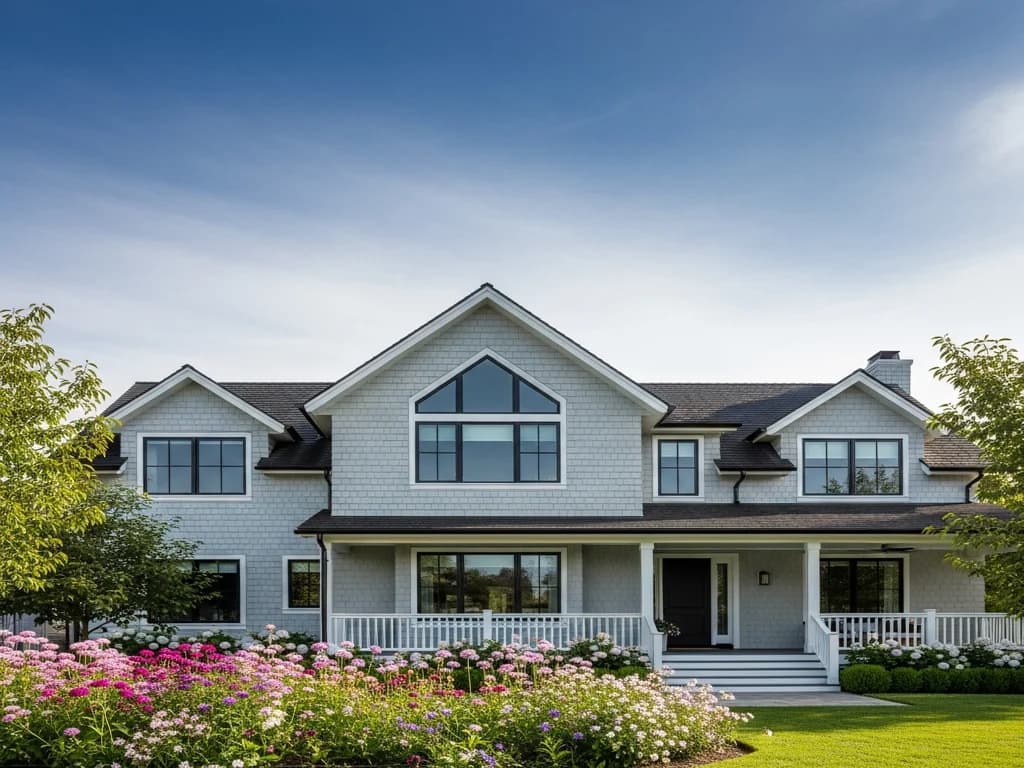
Siding in Cloverdale
A Cloverdale re-side is a northernmost-Sonoma job: the small wine-country town anchoring the upper Alexander Valley where Highway 101 and the Russian River cut through to the Mendocino line. The housing splits three ways — a compact historic downtown grid, postwar and newer subdivision tracts spreading east and west, and rural vineyard-edge homes on the surrounding oak-and-grass hillsides. Two stressors govern the work: genuine WUI wildfire exposure in the Kincade Fire region, and the hard inland-valley heat that runs hotter here than coastal Sonoma.
We scope a Cloverdale re-side around both at once — non-combustible cladding for the fire reality and a heat-stable assembly for the long, baking summers — rather than a cosmetic re-clad that ignores either.
Three housing types, one valley exposure
Cloverdale is not one architectural story. Downtown holds older bungalows and early-century cottages near Cloverdale Boulevard; the subdivisions off Asti Road and the east side carry stucco-and-T1-11 tract stock; and the rural parcels backing vineyards and open hillside sit in the most exposed terrain. A re-side here reads the address first — period lap and trim downtown, efficient full-wall replacement on tract homes, and the heaviest fire detailing on the vineyard-edge slopes — because what protects a rural ridge home is overkill on a sheltered in-town lot, and what suits downtown leaves a hillside exposed.
Inland heat is the daily load here
Cloverdale summers run hot — this end of the Alexander Valley bakes well past the coastal Sonoma towns, with long stretches in the high 90s and triple digits. That heat is the cladding's everyday adversary: it cooks south and west elevations, drives thermal movement through fasteners and butt joints, and bleaches field-applied paint fast. We favor dimensionally stable fiber cement with factory finishes engineered for high UV, detail the expansion gaps that wood-look products tend to neglect here, and back the wall with a rainscreen so the assembly sheds the day's heat rather than trapping it against the sheathing.
Vineyard-edge access and the harvest calendar
Many Cloverdale re-sides sit on rural parcels off River Road, Asti, and the hillside lanes climbing out of the valley floor, where the work is as much a staging problem as a cladding one. Crews work around active vineyard rows, irrigation lines, narrow private drives, and harvest-season traffic that can tie up turnaround for delivery and lift trucks. We walk the approach early to confirm scaffold placement and material drops on sloped, gravel-drive parcels, sequence the noisy tear-off phases away from any bottling or crush windows, and protect the rows and drip lines an owner has spent years establishing. A multi-elevation hillside home often needs cladding swapped on faces a standard truck route never reaches.
Why the Kincade region rewrites a Cloverdale spec
Cloverdale sits inside the same northern-Sonoma fire terrain the 2019 Kincade Fire ran through, and that history changes what a responsible re-side recommends here. On the rural and vineyard-edge parcels backing open grass and oak woodland, the cladding decision is inseparable from the WUI ember threat, so we steer away from the combustible wood-look products an owner might pick on looks alone and toward Class A non-combustible assemblies. That means fiber-cement or mineral cladding detailed with the closed eaves, ember-rated vents, and hardened ground transitions that actually stop ember intrusion — not just a Class A face over gaps where fire really gets in. We pair that hardening with the clean, valley-appropriate finish the home should have, so the result is defensible without reading as a bunker.
Why this matters in Cloverdale
- Specified for Wine Country / North Bay conditions
- Class A non-combustible fiber cement as the recommended system
- Correctly detailed weather-resistive barrier and flashing
- Installed by a crew with 20 years combined experience
Recommended systems for Cloverdale
- Class A non-combustible fiber cement
- fire-hardened eave and vent detailing
- drainage-plane detailing for the wet season
- durable factory finishes
Fiber Cement Siding for Cloverdale homes
The full fiber cement siding approach — materials, weather-resistive detailing, and the manufacturer standards we install to — is covered on the main service page, then specified for Cloverdale's conditions on this one.
Our Cloverdale process
- Step 1
Consultation
We listen to your goals and assess your home on site — exposure, substrate, and architecture.
- Step 2
Design & Proposal
A clear written proposal with the right system specified for your climate and a transparent scope.
- Step 3
Expert Installation
Trained crews install to manufacturer best practices with careful weather-management detailing.
- Step 4
Walkthrough & Support
A final walkthrough, full cleanup, and a clear written record of the scope completed — work we stand behind.
FAQ
Siding in Cloverdale — FAQ
On rural, hillside, and vineyard-edge parcels, yes — Cloverdale sits in genuine northern-Sonoma WUI terrain that the Kincade Fire ran through. In-town downtown lots carry lower but still real ember exposure, so we assess each address honestly.
Cloverdale is the smaller, hotter, northernmost Alexander Valley town — more inland heat, a compact historic downtown rather than a luxury-estate market, and a heavier mix of tract and rural vineyard-edge stock than Healdsburg or master-planned Windsor.
Field-painted wood fades and moves badly in this inland heat. Factory-finished fiber cement with proper expansion detailing and a rainscreen handles the high-UV, triple-digit summers far better over the long run.
Yes — we replicate the original lap exposure and trim profiles while upgrading to non-combustible materials, so the home keeps its period character near Cloverdale Boulevard.
Through a written proposal after an on-site assessment; the fire-hardening scope and access on rural parcels vary widely from an in-town downtown lot.
Keep Exploring
More for Cloverdale homeowners
More in Cloverdale
Other exterior services in Cloverdale
Helpful Exterior Guides