
8 min read · Guide
Let's say the honest thing first: if your California home has sound brick veneer, the usual answer is to keep it. Brick is one of the most durable exterior finishes there is, it's noncombustible, and it doesn't ask much of you. So this isn't a guide about talking anyone out of their brick — a wholesale brick-to-fiber-cement re-clad is genuinely rare, and we won't push it. What this guide covers is the handful of real situations where the conversation comes up: brick veneer that's actually failing (spalling, cracking, or trapped behind paint), partial-brick homes where a wainscot or accent no longer matches the plan, and the very common question, 'can I just put Hardie over my brick?' We'll walk each one straight, including where brick should simply be repaired and left alone.
Brick veneer is a reservoir cladding — and it usually stays
Brick veneer on a modern home isn't structural; it's a rain-screen skin standing off the framing, with a drainage cavity and a weather-resistive barrier behind it doing the real water management. Building Science Corporation describes brick as a 'reservoir cladding' — it soaks up rainwater and later releases it as vapor — which is exactly why that cavity and drainage plane behind it matter (their RR-0104 report documents what goes wrong when moisture gets trapped instead). When brick is installed and detailed the way the Brick Industry Association's Technical Notes lay out, it lasts for generations with almost no maintenance, and it's inherently noncombustible. None of that is a problem you need to solve by replacing it. In most cases the right move is to leave sound brick alone, or to repair and repoint it — not to re-clad. We say that plainly because it's true.
When brick genuinely calls for attention — spalling, painted, or failing
There are real conditions where brick veneer stops serving the wall. **Spalling** — where the face of the brick flakes, pops, or crumbles — usually means water is getting in and freeze-thaw or trapped moisture is breaking the brick apart from the inside; it points to a drainage or flashing problem behind the veneer, not just cosmetic wear. **Painted brick** is its own trap: paint seals a reservoir cladding that was designed to breathe, so moisture that used to dry outward gets held in, and once brick has been painted it's very hard to reverse. **Cracking and displacement** can signal failed ties, missing weep openings, or movement. In these cases the honest fix depends on severity: isolated spalling and failed mortar are often repaired and repointed with brick left in place; widespread failure, or brick over a wall assembly that's rotting behind it, is where removing the veneer and re-cladding — fiber cement being one durable, noncombustible option — starts to make sense. This is a scope-on-site call, not a blanket verdict.
Partial-brick homes: matching a wainscot or accent to full fiber cement
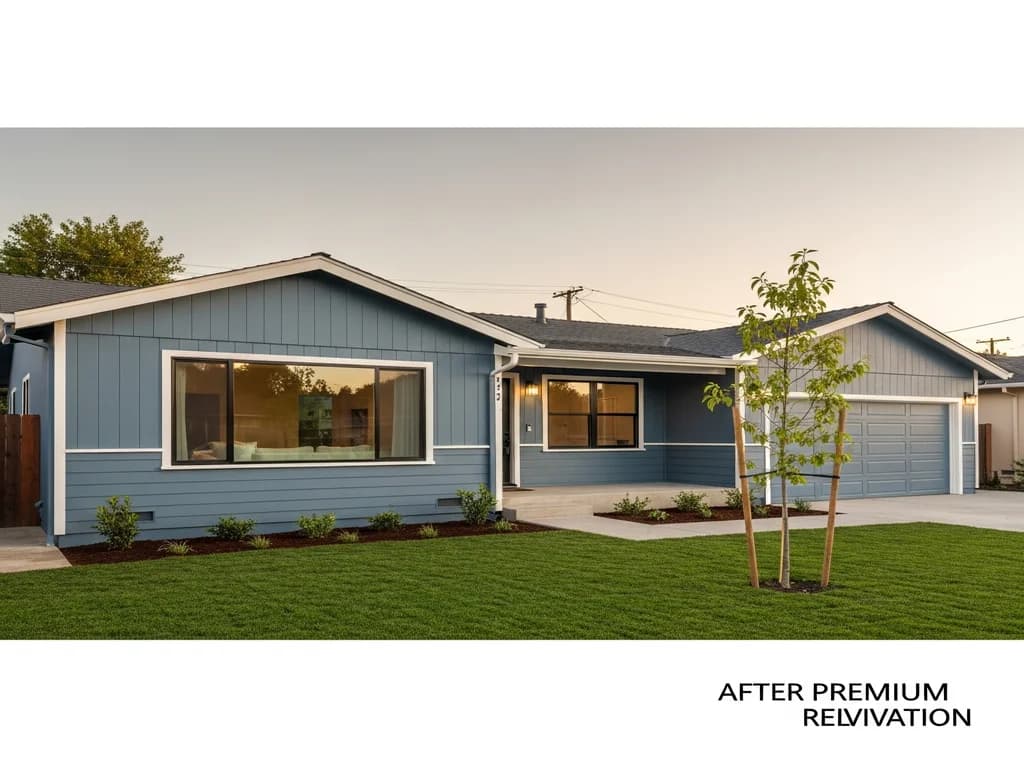
The most common brick-and-fiber-cement project we actually see has nothing to do with failing brick. It's the partial-brick home — brick wainscot across the bottom third, or a brick accent around the entry, with dated siding above — where the homeowner wants one clean, uniform look. Here the decision is a design one, and there are two honest paths. You can keep the brick as a deliberate accent and run fiber cement as the field siding above and around it, which respects the brick and often looks intentional and layered. Or, if the brick reads as the dated element and you want a single material wrapping the house, you re-clad fully. Neither is 'right' — it depends on the architecture and what you're after. What we won't do is tell you the brick has to go for a look you could achieve by pairing with it. When brick does come off for a uniform re-clad, it's the moment to inspect and rebuild the weather barrier behind it.
'Can I put Hardie over my brick?' — the drainage-plane reality
This is the question we get most, and it deserves a real answer rather than a quick 'sure.' You cannot just fur out and nail fiber cement straight over a brick face and expect it to behave. Fiber cement, like any cladding, needs a continuous water-resistive barrier and a way for incidental water to drain and dry — Building Science Corporation's work on drainage planes and on veneer cavities (BSI-086, BSD-105) is clear that the layer behind the cladding is what controls water, and brick's own irregular, absorptive face is not that layer. Cladding over brick without proper detailing traps moisture between two skins and invites exactly the rot you're trying to avoid. It can be done correctly — but 'correctly' means furring to create a drainage gap, establishing a proper flashed WRB, and detailing every window, door, and penetration, and at that point you're doing most of the work of a re-clad anyway. Honestly, in most cases removing the brick (or siding above it) and starting the wall assembly clean is the more durable path. We'll tell you which your wall actually needs after we look at it.
Repointing and cleaning: the care path for brick that's staying
Mortar joints are the sacrificial part of a brick wall — they're designed to wear so the brick doesn't — and a good share of the 'failing brick' we're shown is really failing mortar. Repointing (raking out deteriorated joints and packing in fresh mortar) is routine masonry work, with one caveat worth knowing before you hire it: the new mortar must be compatible with the old. Mortar harder than the surrounding brick forces movement and moisture through the brick faces instead of the joints, and the brick loses that fight over time. Cleaning follows a similar rule: gentle wins. Low-pressure washing and soft brushing handle most grime, while sandblasting or aggressive pressure washing strip the fired outer skin off the brick and leave its softer core exposed to weather. Skip film-forming sealers too — a coating that stops outward drying invites the same trouble house paint does. Maintained this way, a brick accent can outlast several rounds of the siding beside it.
The addition dilemma: new walls next to old brick
Additions put brick owners in a spot the original builder never faced: the new wing needs an exterior, and brick made today won't match brick fired decades ago — clay lots, mortar color, and years of weathering all announce themselves at the line where old meets new. Chasing a match usually lands on a near-miss, and a near-miss looks worse than no attempt at all. The stronger design moves are deliberate ones. Contrast on purpose: clad the addition in fiber cement in a complementary color and let the original brick volume anchor the composition. Or carry a line rather than a material: pick up the brick's datum — the top of a wainscot, a sill height — with a trim band or material change on the addition, so the two elevations converse without pretending to be the same wall. Either approach beats a mismatched brick order, and both leave the original masonry doing what it does best.
If the veneer does come off: a one-time shot at the wall behind it
On the rare projects where removal is genuinely warranted, there's an upside worth planning rather than discovering: the wall is open, and it will likely never be open again. That's the moment to give an older wall what it was never built with — air-seal the sheathing plane, repair any framing the failed veneer wetted, and weigh continuous exterior insulation under the new barrier before fiber cement goes on. None of that work is visible once the job closes up, which is exactly why it gets skipped when nobody prices it up front. It also thickens the wall, so window and door extension jambs, trim depths, and the tie-in to any brick that remains all need resolving before demolition rather than after. A re-clad scoped this way costs more than a bare swap and delivers a better wall — ask for both numbers and decide with eyes open.
Key takeaways
- Sound brick veneer usually stays — it's durable and noncombustible, and repair/repointing beats replacement in most cases.
- Brick is a reservoir cladding; spalling or painted brick signals trapped-moisture or drainage problems, not just cosmetics.
- The common brick-and-fiber-cement project is a partial-brick home going uniform — and pairing (keeping brick as an accent) is often the honest answer.
- You can't nail fiber cement straight over a brick face; it needs a furred drainage gap, a flashed weather-resistive barrier, and full detailing.
- Whether to repair, pair, or re-clad is a scope-on-site call — there's no blanket verdict for or against keeping brick.
FAQ
Quick Answers
Usually no. Sound brick veneer is durable and noncombustible, and there's rarely a good reason to remove it wholesale — repair and repointing keep most brick going for decades. Re-cladding in fiber cement only starts to make sense when the brick is widely spalling or failing, when it's been painted and is trapping moisture, when the wall behind it is compromised, or when a partial-brick home is going to a single uniform material by choice. We scope that on site rather than assuming the brick has to go.
Not directly over the brick face. Fiber cement needs a continuous, correctly flashed water-resistive barrier and a way for water to drain and dry behind it, and a brick face isn't that layer. Doing it right means furring out to create a drainage gap, establishing a proper WRB, and detailing every opening — at which point you're doing most of the work of a full re-clad. In many cases removing the brick and starting the wall assembly clean is the more durable approach.
Spalling — where the brick face flakes or pops off — is almost always a moisture problem: water is getting into the brick and freeze-thaw cycles or trapped moisture are breaking it apart from within, often because of a drainage, flashing, or weep-opening issue behind the veneer. It usually means the wall assembly needs attention, not just the brick surface. Isolated spalling is often repaired in place; widespread spalling with a failing assembly behind it is where re-cladding gets considered.
Gently, and test a small hidden patch first. Low-pressure water and a soft brush deal with most dirt and organic growth. What to avoid is anything abrasive — sandblasting and high-pressure washing remove the hard fired surface, exposing the softer interior to accelerated weathering. Avoid film-forming sealers for the same breathing-related reasons that make paint a problem on this material.
Trying usually disappoints — new brick against decades-old brick reads as a near-miss at the seam. The better outcomes are intentional: side the addition in fiber cement as a deliberate contrast and let the original brick anchor the house, or align a trim band or wainscot height with the brick's existing lines so the elevations relate without imitating each other.
Sources
Authoritative references
- Brick Industry Association — Technical Notes on Brick Construction (design & detailing bulletins)
- Building Science Corporation — RR-0104: Solar-Driven Moisture in Brick Veneer (brick as a reservoir cladding)
- Building Science Corporation — BSI-086: Vitruvius Does Veneers (airspace & drainage behind masonry veneer)
- Building Science Corporation — BSD-105: Understanding Drainage Planes (water-resistive barriers behind cladding & veneer)
External links to government, code, and manufacturer sources. Sierra Siding is not affiliated with these organizations; references are provided for verification.