
6 min read · Cost
James Hardie siding cost in Carmichael is shaped less by board footage than by the age and variety of the housing stock. This is established Sacramento County territory, with mid-century ranch tracts off Fair Oaks Boulevard, larger custom homes on the American River bluffs, and a deep mature-tree canopy that complicates access. Most homes still wear original hardboard or stucco well past its service life, so substrate condition and trim detail, not square footage alone, set the spread.
What actually moves a Carmichael Hardie price
Four drivers do most of the work on a Carmichael estimate. Substrate condition is the biggest swing, because aged hardboard and T1-11 on postwar and 1960s-1980s homes routinely reveal rot, brittle sheathing, or failed flashing once it comes off. Wall area and story count set the baseline. Trim complexity climbs sharply between a plain ranch gable and a custom bluff home with masonry accents and layered casings. Finally, access through mature landscaping and narrow side yards adds staging and protection time. An honest bid separates these so you see what your specific home, not a blended average, actually costs. We confirm a realistic substrate allowance on site rather than guessing it into a flat per-foot rate.
Mid-century ranch tracts versus bluff custom homes
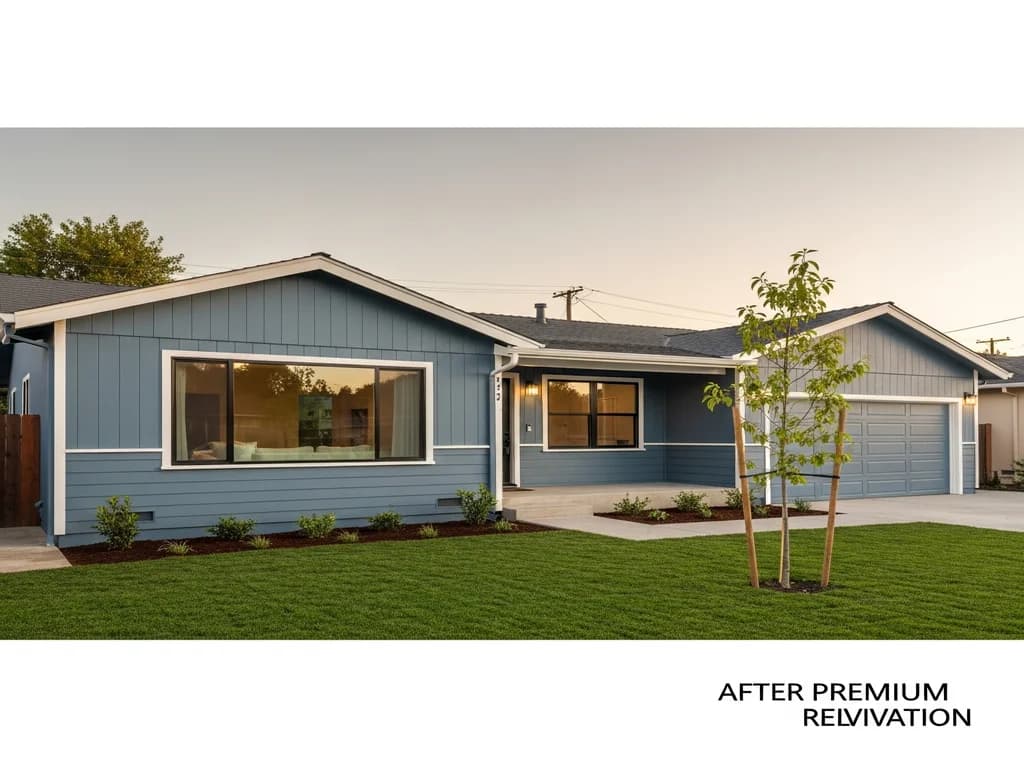
Carmichael's scope splits along two housing types that price very differently. The ranch tracts through the Arden-Arcade belt tend to be long single-story runs with wide eaves, which actually keeps Hardie lap install efficient, though deep overhangs and tree canopy add cut-in detailing around fascia and soffits. The larger custom homes near the American River bluffs are a different animal: taller two-story elevations, complex rooflines, and architectural trim that owners in this higher-value market expect matched precisely. That pushes the bid toward more HardieTrim board, panel-and-batten or shingle accents, and added labor for staging on sloped lots. Two homes of similar square footage can land far apart, which is exactly why per-elevation itemization keeps the comparison honest. Our James Hardie fiber cement siding page explains how the profiles map to each style.
Substrate variability is the rule, not the exception
On aged Carmichael stock, finding damage at tear-off is normal, so the smart money plans for it rather than hoping against it. Original hardboard absorbs moisture at its edges and swells, T1-11 checks and delaminates, and decades of layered paint can hide soft sill plates and brittle sheathing underneath. A bid that carries no substrate-repair allowance, or an unrealistically thin one, is the most common way a cheap Carmichael quote turns into a change-order surprise. We document what we open up with photos so the added scope is transparent, not a blank check. Where damage is structural we will say so plainly. The goal is a wall you only re-side once, which means fixing what is behind the cladding, not just covering it. Pairing the re-side with exterior painting on trim and accents is often the efficient sequence.
How Sacramento Valley heat shapes the spec
Carmichael sits squarely in the valley-heat band, where long stretches of triple-digit days and strong UV are the dominant exposure, not snow or salt air. That climate rewards specific choices that move cost. Factory-applied ColorPlus finishes hold up far better than field paint under relentless sun, so the upgrade usually pays for itself in deferred repaints and adds to the material line. Heat-driven expansion and contraction make correct gapping, fastening, and joint detailing non-negotiable, because cutting that corner shows up as buckling within a couple of seasons. You can read more on the finish technology directly from James Hardie ColorPlus. Moisture risk is only moderate, but river-adjacent homes and tree-shaded north walls still warrant a proper weather-resistive barrier behind the new cladding.
Less HOA constraint than newer subdivisions
Unlike the master-planned Placer and Folsom communities, much of Carmichael grew up without uniform architectural-review boards, and many neighborhoods carry no HOA at all. For a re-side that translates into real design flexibility: you are usually freer to choose profile, color, and trim program based on what fits the home rather than a covenant palette. That freedom does not lower the cost so much as redirect it toward choices that genuinely match the architecture, whether that is a clean ranch lap or a richer trim package on a bluff custom. Some pockets do have HOAs, so we confirm requirements before finalizing a palette. The practical upshot is that Carmichael owners often get more say over the finished look than their counterparts in newer, more tightly governed subdivisions nearby.
How to compare Carmichael bids fairly
Because the stock varies so much, the cheapest top-line number is rarely the honest one here. Check that the substrate-repair allowance is realistic for a home of your age, since under-budgeted substrate is the single most common bid problem on aged Carmichael cladding. Confirm the finish program names ColorPlus rather than vague field paint. On custom or two-story homes, look for a per-elevation breakdown instead of one blended rate that buries the complex walls. Verify the installer's license and Hardie experience before you weigh price, because correct fastening and clearances are what make the product perform as designed; you can check a contractor at CSLB. A clear, itemized estimate that documents the home you actually own beats a low number that assumes the easiest possible job.
What drives a Carmichael Hardie price
| Cost driver | Effect |
|---|---|
| Aged hardboard substrate | Variable; common scope add |
| Tract single/two-story labor | Standard valley baseline |
| Less HOA constraint | Design flexibility |
| Mature landscaping access | Modest factor |
| ColorPlus finish program | Long-cost win |
James Hardie scope bands in the Carmichael area (for planning)
| Scope | Per sq ft of wall | Typical project total |
|---|---|---|
| Single-story HardiePlank, ColorPlus | $13–$20 | $28,000–$58,000 |
| Two-story / complex trim | $17–$24+ | $48,000–$84,000+ |
| Significant substrate repair included | $16–$24 | $40,000–$72,000+ |
Typical Hardie planning range for the Sacramento Valley — a general California market range, not a Sierra Siding quote. Substrate repair on aged Carmichael stock is itemized when extensive. Final number is set on-site — your written estimate is what governs.
Key takeaways
- Aged hardboard and T1-11 mean substrate damage at tear-off is the rule, not the exception
- Ranch tracts install efficiently; bluff custom homes add trim and access cost
- Valley heat favors ColorPlus finishes and disciplined gapping over fire hardening
- Less HOA constraint than newer Placer or Folsom subdivisions means more design freedom
- Per-elevation itemization keeps custom and two-story bids honest
- A realistic substrate-repair allowance is the most important line to verify
FAQ
Quick Answers
Because the stock ranges from simple ranch tracts to detailed bluff custom homes, and because substrate condition under aged cladding varies widely. Per-elevation itemization explains the spread.
Yes. Older stock with aged hardboard or T1-11 typically shows damage at tear-off, so a realistic repair allowance belongs in any honest bid.
Less so than newer Placer subdivisions. Some neighborhoods have HOAs and many do not, which usually gives you more freedom over profile and color.
Generally no. This developed valley corridor is low wildfire risk, so you typically are not paying the ember-resistant premium the foothills require.
In the valley-heat band it usually is, because factory finish resists fade and chalking under relentless sun far better than field paint and defers repainting.
On site, by square footage, stories, substrate condition, and trim complexity. The written estimate is what governs once we have mapped the actual home.
Sources
Authoritative references
- James Hardie — official product & installation resources
- Contractors State License Board (CSLB) — verify a California contractor
- Zonda — 2025 Cost vs. Value Report (exterior remodel ROI)
External links to government, code, and manufacturer sources. Sierra Siding is not affiliated with these organizations; references are provided for verification.