
7 min read · Design
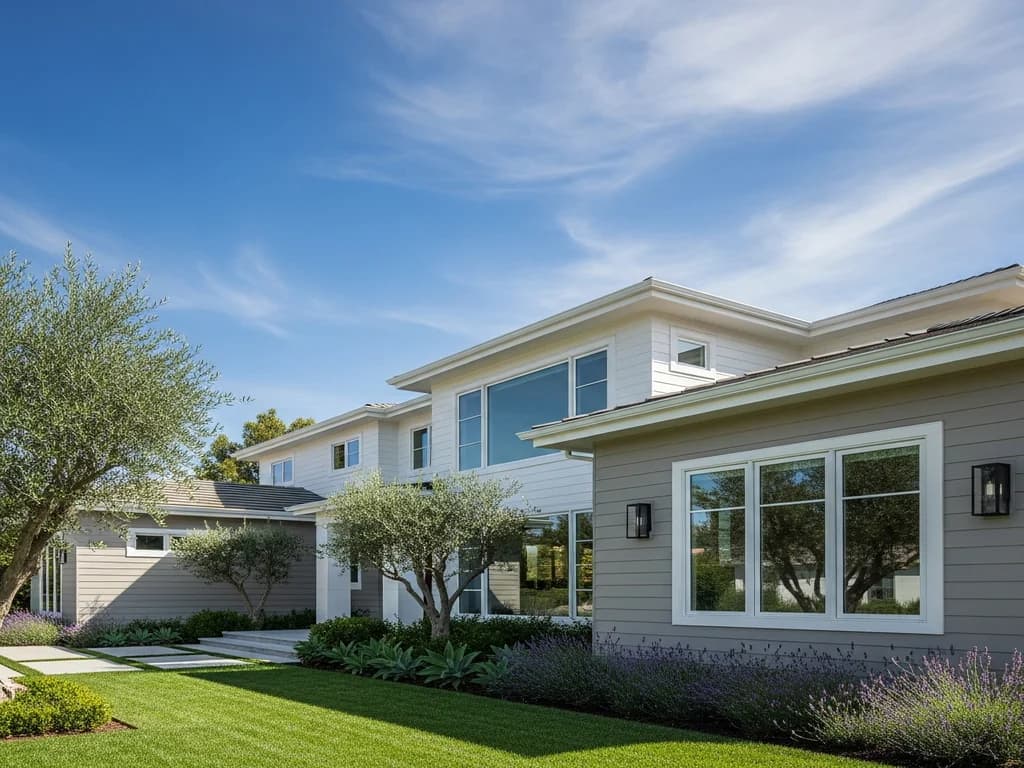
Modern farmhouse is the most-installed exterior direction on California new construction and re-side projects right now, and also the most-imitated. Done well it reads timeless and architectural; done generically it joins the tract-uniform sea of white bodies with black trim. The difference lives in the board-and-batten gesture, mixed-profile discipline, palette choice, and trim proportion. Here is how to do it well across California.
The board-and-batten body: the signature gesture
Vertical board-and-batten cladding is the defining modern farmhouse element. Hardie executes it with HardiePanel plus battens, typically 1.5-inch Hardie Trim at 16-to-24-inch spacing, where the vertical lines emphasize roofline geometry and the batten projection adds shadow play and dimension. Our dedicated board-and-batten exterior ideas guide covers spacing and profile in depth, but the headline is simple: attempting modern farmhouse without any board-and-batten almost always reads as farmhouse-adjacent rather than confidently modern farmhouse. The vertical profile is what signals the style to the eye before color or trim register, so it is the gesture worth getting right first. Even a single board-and-batten gable over a lap body announces the direction more clearly than any palette choice alone, which is why we treat the profile decision as the foundation of the whole composition rather than an afterthought.
Mixed-profile strategy: where lap belongs
Pure board-and-batten across every elevation reads heavy and one-note. The most successful California modern farmhouse mixes board-and-batten on the primary visible elevations, front-facing and one side, with lap on the subordinate faces. The mixed approach saves cost because lap installs faster, and it reads more intentional than relentless vertical. HardiePlank in 5-to-7-inch exposures complements the board-and-batten well and grounds the composition. The discipline is in the transition: change profiles at a logical corner, never mid-wall, so the move reads as design rather than a budget seam. This is the balance we recommend on most projects because it carries the look while keeping labor controlled.
The winning palettes
Three palettes consistently succeed. Classic high-contrast pairs an Arctic White ColorPlus body with black trim and black windows, which photographs spectacularly but is now widespread on tract two-stories, so weigh whether you want to stand out. Cool sophisticated pairs Iron Gray body with Arctic White trim and black accents, slightly less ubiquitous and strong on north-facing primary elevations where a dark body holds detail in shaded light. Soft warm pairs Boothbay Blue with warm white trim for farmhouse with cottage warmth. All three are available as factory-finished James Hardie ColorPlus colors, which hold up better under California UV than thin field coats that chalk on sun-baked elevations.
Black window frames: the non-negotiable punctuation
Modern farmhouse without black windows reads as something else, regular farmhouse or transitional. The black frames provide the architectural punctuation that makes the high-contrast composition work, anchoring the eye and defining the openings against the body. Frame material matters in California: choose fiberglass for sun resistance, because vinyl in black can warp on south- and west-facing elevations where surface temperatures climb. If you are pairing black windows with a fiber cement siding re-side, coordinate the frame finish and the trim color as a single decision rather than three separate ones, so the punctuation reads deliberate. This single upgrade often delivers the most visual return per dollar on a modernization, especially on an older tract home where swapping dated white aluminum frames for black is the clearest signal that the exterior has been intentionally updated rather than merely repainted.
Trim, detail, and the elements that elevate
Modern farmhouse trim is more substantial than minimalist modern, with 4-to-5-inch corner boards, prominent fascia, and defined window casings, but lighter than period craftsman, without heavy returns or busy proportions. Wrong proportions read as a mistake, so the balance is the craft. Beyond trim, a handful of elements prevent a home from reading generic: a single-pitch or gable porch over the entry, a board-and-batten accent on one gable face, dark metal touches such as sconces, an awning, or address numbers, and a warm wood door playing against the monochrome body. Each adds character. A quality exterior painting or factory finish on these details keeps them crisp rather than chalky.
When modern farmhouse does not work, and where we fit
Genuine craftsman, Spanish revival, mid-century modern, and contemporary minimalist architecture all fight modern farmhouse rather than support it; forcing the look onto the wrong bones reads as costume. Match palette and profile to the architecture instead of imposing a trend on a home that resists it, and be honest with yourself that the style, while strong now, will likely feel dated in ten to fifteen years, so favor elements that age toward classic. We do modern farmhouse extensively across California: ColorPlus body in the chosen palette, board-and-batten on primary elevations with lap on the rest, an integrated trim system, and coordinated window-frame spec, with every project reviewed on a sample board in real sunlight at multiple times of day before commitment.
Three winning California modern farmhouse palettes
| Palette | Body | Trim | Windows | Accent |
|---|---|---|---|---|
| Classic high-contrast | Arctic White | Black | Black | Warm wood door |
| Cool sophisticated | Iron Gray | Arctic White | Black | Warm wood door |
| Soft warm | Boothbay Blue | Arctic White | Black | Warm wood door |
Key takeaways
- Board-and-batten on primary elevations plus lap on subordinate faces is the right balance
- Three winning palettes: Arctic White with black, Iron Gray with warm white, Boothbay Blue with warm white
- Black window frames are non-negotiable, and fiberglass beats vinyl under California UV
- Trim should be substantial but not as heavy as period craftsman; wrong proportions read as a mistake
- Modern farmhouse on the wrong architecture reads as costume, so match palette to the bones
- The style will likely date in 10 to 15 years; choose elements that age toward classic
FAQ
Quick Answers
Typically somewhat more on California Hardie installs, because the panel-and-batten combination adds labor over straight lap. On mixed projects, primary elevations vertical and subordinate elevations lap, the total stays close to all-lap pricing while the visual impact stays high.
Yes, with a Tahoe-appropriate variation that adds warm wood accents to the vocabulary. An Iron Gray body with a warm wood entry and black metal accents reads as mountain modern farmhouse.
Honestly, probably within 10 to 15 years, since it has saturated tract construction. If you plan to stay long-term, choose elements that age toward classic, like Arctic White, Iron Gray, or Boothbay Blue, rather than locking to the trend.
Yes. Hardie's panel-and-batten system supports both modern and traditional farmhouse direction in non-combustible material, and the product line is engineered for the look.
Black vinyl can warp on south- and west-facing California elevations where surface temperatures climb. Fiberglass holds dimensional stability under that UV and heat, so it is the durable choice for dark frames.
Mix profiles intentionally, get trim proportions right, choose a palette that suits your home and neighborhood, and add a few elevating details like an entry porch, one accent gable, dark metal accents, and a warm wood door.
Sources
Authoritative references
External links to government, code, and manufacturer sources. Sierra Siding is not affiliated with these organizations; references are provided for verification.