6 min read · Cost
A partial re-side replaces one or two elevations instead of the whole envelope, and in the right circumstances it is a defensible choice across California's varied climates. It costs more per square foot than whole-home work but less in total, and the math swings hard on which elevations have actually failed. The honest framework below walks through when partial scope earns its keep and when it quietly sets you up for a second project in a few years.
When partial re-side makes sense
Three scenarios genuinely favor partial work. First, one elevation has failed substantially while the others remain serviceable — common where a single sun-baked western wall in the Sacramento or San Joaquin Valley degrades years ahead of shaded faces. Second, a tight budget makes full re-side impossible, but the worst elevation poses a real moisture or pest entry point that cannot wait. Third, an architectural change — an addition, a garage conversion, a deliberate accent wall — confines new cladding to one face. Outside these, a full re-side usually wins the long-run math. Our siding-repair team scopes which path actually fits your home.
Why partial re-side costs more per square foot
Mobilization, permitting, scaffolding, dumpster delivery, and project management are largely fixed costs, and on a partial job they spread across far less wall area. The material delivery still hits the same supplier minimum, and setup and teardown consume the same crew days whether you re-skin one wall or four. On a roughly 25% partial scope, the per-foot rate often runs 30-50% above equivalent whole-home work. This is also why the cost gap between one elevation and two adjacent elevations is usually smaller than homeowners expect — once the equipment and crew are staged, adding scope earns a better rate. Ask any bidder what share of the number is fixed overhead versus actual siding.
Aesthetic mismatch — the honest concern
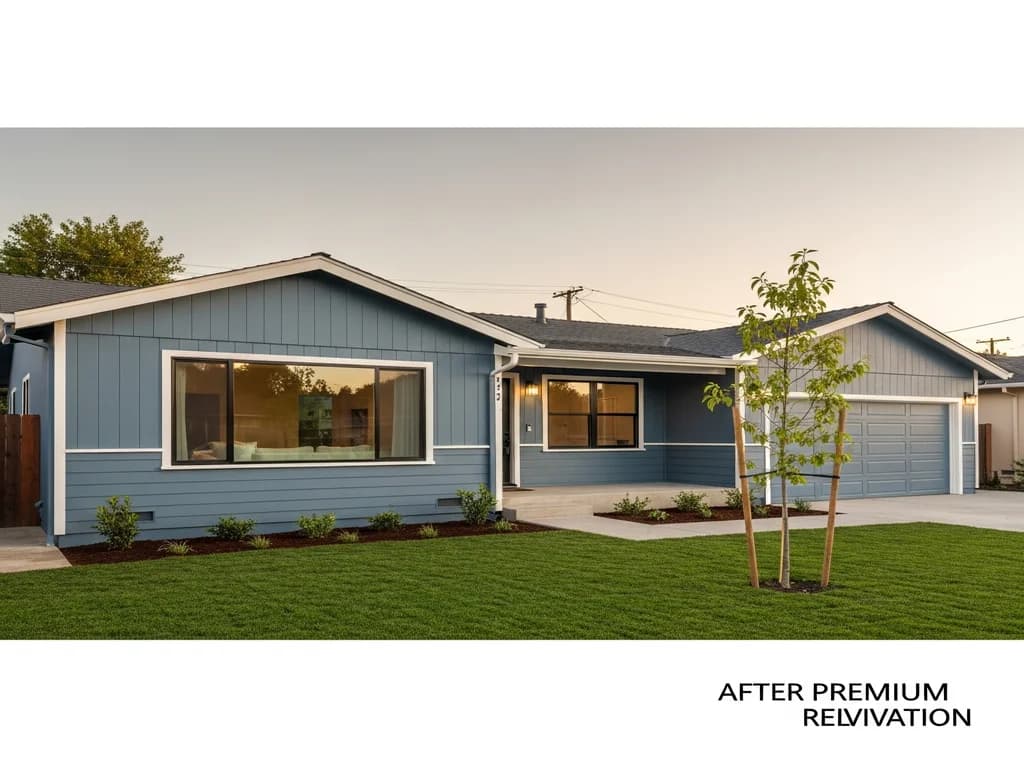
Partial re-side creates a visible boundary between new and weathered cladding, and California sun makes this worse, not better. New ColorPlus boards beside years-old ColorPlus on existing walls typically read as a real color difference; over two to three seasons the new finish ages partway toward the old, but it never converges exactly. Coastal and foothill homes that have faced fog cycling or intense foothill UV often shift in ways a fresh run cannot match without repainting. On a clearly delineated rear or side elevation the mismatch is tolerable; on a prominent front face it can be hard to accept. We set those expectations before you commit, not after.
Regional drivers across California climates
Where your home sits changes which elevations fail first and what the replacement assembly must include. In the hot interior valley, the western and southern walls absorb the most UV and thermal cycling, so those are the usual partial candidates. On the coast and in the wine country, the weather-facing and shaded north walls hold moisture and grow the most rot, often demanding deeper substrate work. In the foothill and Tahoe wildland-urban interface, any elevation you replace on a designated parcel must meet ignition-resistant construction standards, which can mean a partial wall is built to a higher spec than the original three. Review CAL FIRE's home hardening guidance if your parcel sits in a fire-prone zone.
Cost framework by scope
Pricing tracks the scope bands in our cost tables, not a flat rate. A single elevation — usually a rear or one side — carries the highest per-foot premium because all the fixed overhead lands on the smallest area. Two elevations spread that overhead a little wider and improve the per-foot rate. Three elevations almost always approach whole-home pricing: at that point the per-foot premium of partial work has nearly caught up to the efficient per-foot rate of a full re-side, and you are usually better off finishing the envelope. The decision point is rarely the cladding price itself; it is how much fixed mobilization you are paying twice. Our siding cost guide lays out the full-project context.
When partial doesn't make sense
If the failure pattern is multi-elevation — several walls showing end-of-life hardboard, widespread paint failure, or substrate damage that crosses corners — partial scope is a stop-gap that typically gets replaced within five to seven years. It also breaks down when aesthetic consistency carries the architecture, as on Spanish revival or modern-farmhouse homes where the eye expects one material wrapping the whole house. And it complicates warranty and insurance completeness, since the elevations you leave alone stay on aging cladding outside the new system's coverage. In those cases the cheaper-looking partial number is the more expensive decision over a decade.
How we scope partial work
Our process starts with an on-site assessment of which elevations are genuinely serviceable versus failed, including probing for hidden substrate damage that storm or moisture exposure often reveals only at tear-off. We then have an honest conversation about aesthetic mismatch expectations specific to your finish and exposure. You receive an itemized partial scope set side-by-side against a full re-side number so you can see the per-foot premium plainly. As a licensed California contractor — verify any bidder's standing at the CSLB — we are direct about which path delivers more value, but the final call is yours.
Partial vs. whole-home re-side trade-offs
| Factor | Partial favors | Whole-home favors |
|---|---|---|
| Cost per sq ft | Partial costs more per foot | Whole-home more efficient per foot |
| Cost total | Partial lower total | Whole-home higher total |
| Aesthetic consistency | Partial creates mismatch | Whole-home fully consistent |
| Future re-side timing | Partial defers full re-side | Whole-home resets all elevations together |
| Insurance/warranty completeness | Partial leaves other elevations on existing | Whole-home full warranty |
Key takeaways
- Per-square-foot cost runs 30-50% higher on partial because fixed overhead spreads across less area
- Climate dictates which elevations fail first: valley sun, coastal moisture, foothill WUI
- Aesthetic mismatch between new and weathered cladding is real and never matches exactly
- Three-elevation partial usually approaches whole-home cost — finishing often wins
- Multi-elevation failure means partial is a stop-gap, not a solution
- WUI parcels may require the partial wall to meet a higher ignition-resistant spec than the original
FAQ
Quick Answers
Yes, but plan for color and finish matching to be imperfect by the time you complete the rest, since the first phase will have weathered.
Honestly, no. They age toward each other over a few seasons but never converge exactly, especially under intense California sun.
Sometimes. If one elevation is a visible inspection liability, addressing it can recover the cost. Discuss with your agent before committing.
It can. On designated fire-zone parcels the replaced elevation generally must meet ignition-resistant construction standards, which may exceed the original assembly.
Often less of a jump than expected. Once mobilization, permit, and equipment are on site, the second adjacent elevation usually earns a better per-foot rate.
Sources
Authoritative references
- Contractors State License Board (CSLB) — verify a California contractor
- James Hardie — official product & installation resources
External links to government, code, and manufacturer sources. Sierra Siding is not affiliated with these organizations; references are provided for verification.