
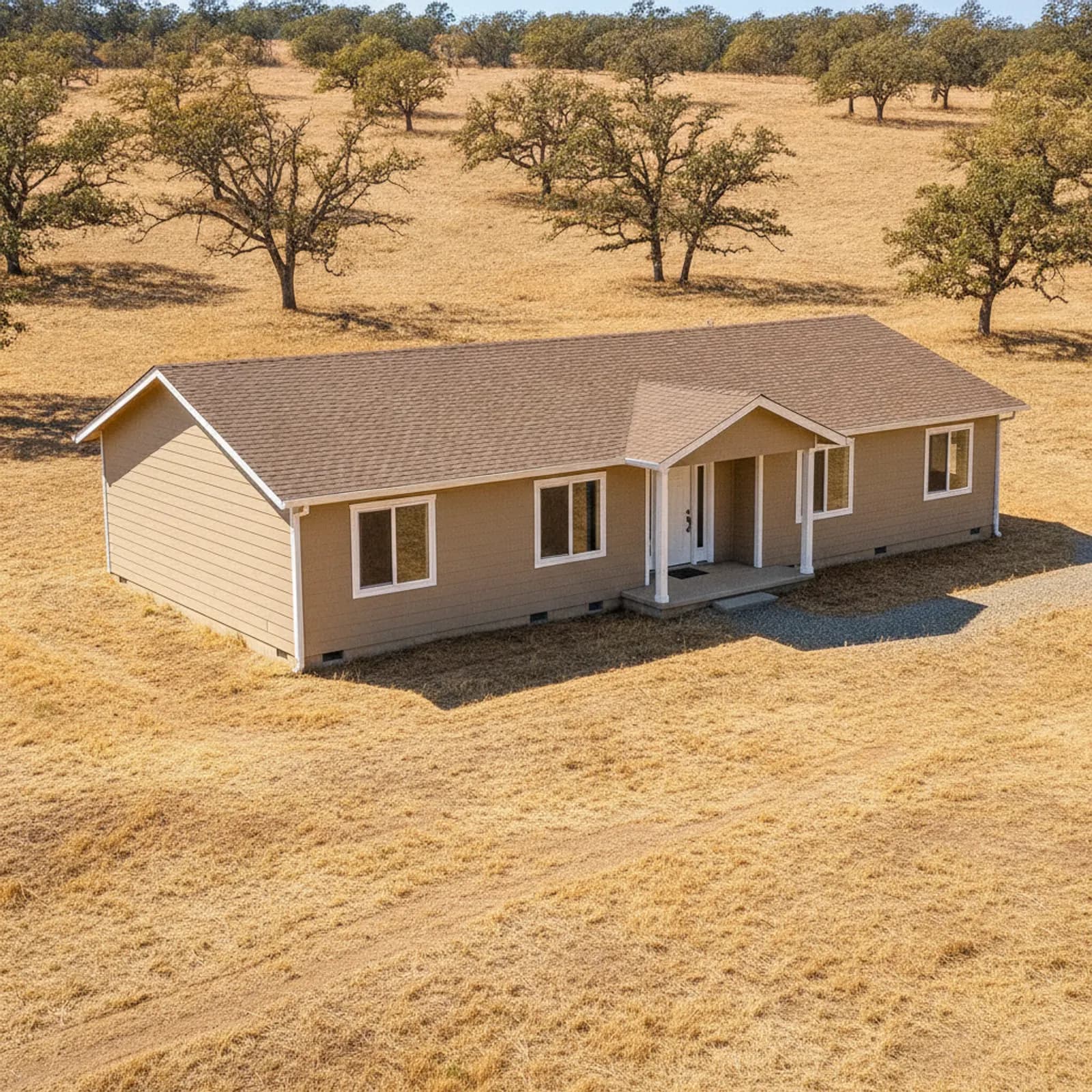
Exterior renovation in Valley Springs
Valley Springs sits at the lower-foothill edge of Calaveras County, a crossroads community where Highways 26 and 12 meet near New Hogan Lake, the gateway between the San Joaquin Valley and the higher Gold Country. Its housing is lower-foothill in character: ranch and rural homes on oak-grass parcels, lake-adjacent properties near New Hogan, older crossroads-town homes, and newer subdivisions on the town's growing edge. Much of that stock wears aging wood, board-and-batten, or economy cladding weathered by hot summers, and nearly all of it sits in dry oak-grass country where grassfire exposure makes wildfire the controlling exterior concern.
Grass-and-oak fire at the valley edge
Valley Springs sits lower and more open than the mid- and upper-foothill towns, so its fire exposure has a distinct character: less dense conifer, more fast-moving grass-and-oak fuel that cures across the long dry summer and carries wind-driven fire readily. The lake-adjacent and rural parcels press that fuel close to homes, while the open, low-canopy setting also means intense summer heat and UV on unshaded walls. A Valley Springs re-side therefore answers a grass-driven fire exposure and a hard heat load together — which makes non-combustible, heat-durable cladding a natural fit here.
Considering an exterior project in Valley Springs?
Valley Springs housing and architecture
Valley Springs's stock is shaped by its lower-foothill, ranch-country setting: rural and ranch homes on oak-grass acreage, lake-adjacent properties near New Hogan, older homes near the historic crossroads, and newer subdivisions filling in the town's edge. These are mostly straightforward, practical elevations rather than ornate or historic homes, which makes them strong candidates for a clean, durable non-combustible re-side and a refreshed trim and color program. The rural and lake-edge parcels warrant fuller grass-and-oak fire detailing, while outbuildings on ranch parcels are often worth hardening alongside the main house. We match a practical, durable profile to the home's era and its exposure.
Valley Springs's lower-foothill climate
Valley Springs runs hot and high-UV through long summers — hotter than the mid- and upper-foothill towns at its lower elevation and open, low-canopy setting — so heat and sun fade and chalk coatings quickly on unshaded south and west walls. Winters are cool and wet with little to no snow. As across the county, both defer to fire: the surrounding oak-grass cures to fast-moving fuel through the dry season, and the open terrain and wind drive the ember-and-grassfire exposure that governs the spec. The cladding is specified for ember-and-wind behavior first, with non-combustible fiber cement also carrying the heavy heat and UV load.
Wildfire hardening in Valley Springs
Valley Springs's dry oak-grass setting carries real grass-and-oak fire exposure, so we specify Class A non-combustible fiber cement and harden the vulnerable details — eaves, vents, decks, and the ground-to-wall transition where wind-driven embers gather — to current California WUI standards. The rural, ranch, and lake-adjacent parcels warrant the fuller treatment, with attention to outbuildings and the immediate defensible zone; the denser in-town lots carry the same non-combustible cladding at no material change. We document the assemblies for defensible-space and insurability conversations, and we're clear that siding is one layer of a whole-property strategy — on a grass-and-oak parcel a home is only as defensible as the fuel and structures around it.
Recommended materials for Valley Springs
Class A non-combustible fiber cement is the core recommendation across Valley Springs: it answers the grass-and-oak fire exposure and, because the setting is hot and open, also delivers the heat and high-UV durability the lower foothills demand — the safest cladding is also the most heat-durable. The same product line carries the ranch homes, the lake-adjacent properties, and the newer edge subdivisions, keeping the spec consistent across a lower-foothill service area. High-UV factory finishes hold color through the intense summers far better than field paint on these largely unshaded elevations, while fuller fire detailing goes on the rural and lake-edge parcels that need it.
What an exterior project costs in Valley Springs
Valley Springs pricing follows the usual drivers — home size and stories, trim and profile complexity, substrate and dry-rot discovery once cladding comes off, window integration, and fire-hardening scope. Two things are particular here: fire detailing is lighter on a central town lot but heavier on a rural, ranch, or lake-adjacent parcel where grass-and-oak fuel presses close and outbuildings factor in, and acreage access can affect staging and logistics. Older crossroads-town homes more often reveal substrate surprises after decades of hard summer heat. We provide a written, scoped estimate after an on-site assessment, because the right number depends heavily on where in Valley Springs the home sits.
Ranch parcels and the grassland edge
Valley Springs's rural and ranch parcels sit in dry oak-grass where grassfire exposure is most acute and where outbuildings, fence-to-wall transitions, and the immediate defensible zone all factor into a sensible exterior strategy. These are the properties where the fuller hardening earns its place, and where longer or rougher access can affect staging. We scope the fuel setting and access during the site walk so the crew sequences the work across the structures that matter on the property.
Lake-adjacent homes near New Hogan
Homes near New Hogan Lake sit in an oak-and-grass recreation setting that carries both the county's fire exposure and a desire for a low-maintenance, durable exterior that holds up to hard sun and second-home or rental use. A non-combustible, heat-stable re-side suits that, and we detail the hardening for the wind-driven grass fuel these lake-edge parcels carry. We keep records of the materials and assemblies used for the defensible-space and insurability conversations that matter on foothill lake property.
Newer edge subdivisions and resale
On Valley Springs's growing edge, newer subdivisions are reaching refresh age in a market where durability and, on the rural fringe, documented fire-aware detailing increasingly factor into how a home is valued. Replacing tired original cladding with a heat-stable, non-combustible, low-maintenance system protects both the structure and its resale standing in a lower-foothill market where much of the surrounding stock still wears its original builder look. We focus on durable, sensible choices that hold their look for decades.
Calaveras County, CCWD, and Calaveras Consolidated Fire
Working exteriors in Valley Springs coordinates with a few local authorities. Valley Springs is unincorporated Calaveras County, so building permits come through the Calaveras County Building Department rather than a municipal department. Electric and gas are PG&E. Water on most parcels is either from private wells or from the Calaveras County Water District (CCWD) Valley Springs / New Hogan service area. Fire response is the Calaveras Consolidated Fire Protection District alongside CAL FIRE Tuolumne-Calaveras Unit (TCU) on wildland calls, with the Calaveras County Sheriff coordinating events during red-flag windows.
HZ10 and the New-Hogan-corridor FHSZ reality
Valley Springs is in James Hardie's HZ10 climate zone; installing HZ5 is a documented warranty misapplication. On the fire side, most Valley Springs parcels sit in Moderate FHSZ territory under California's 2025 LRA Fire Hazard Severity Zone map, while rural oak-grass and lake-adjacent parcels running toward the New Hogan and Highway 12 corridor carry High designations where annual grass cures to fast fuel. The 2015 Butte Fire (549 homes destroyed) burned adjacent Calaveras terrain. On wildland-adjacent parcels the 2025 California Wildland-Urban Interface Code governs the exterior wall. Chapter 7A moved into the standalone WUI Code on January 1, 2026.
Our process in Valley Springs
- Step 1
Consultation
We listen to your goals and assess your home on site — exposure, substrate, and architecture.
- Step 2
Design & Proposal
A clear written proposal with the right system specified for your climate and a transparent scope.
- Step 3
Expert Installation
Trained crews install to manufacturer best practices with careful weather-management detailing.
- Step 4
Walkthrough & Support
A final walkthrough, full cleanup, and a clear written record of the scope completed — work we stand behind.
Valley Springs rewards an exterior strategy built for its lower-foothill reality — grass-and-oak fire exposure and a hard summer heat load answered together — from a ranch backing onto open grass to a lake-adjacent home near New Hogan. We scope every Valley Springs project on site so the hardening and heat detailing match the parcel, and your written, itemized estimate governs the work.
FAQ
Valley Springs — Common Questions
Class A non-combustible fiber cement — it answers the grass-and-oak fire exposure and, because Valley Springs runs hot and open, also delivers the heat and high-UV durability the lower foothills demand, with fuller fire detailing on rural and lake-adjacent parcels.
Yes — Valley Springs sits in dry oak-grass country where fast-moving grassfire carries wind-driven embers, and the county's 2015 Butte Fire is a plain reminder. Rural, ranch, and lake-adjacent parcels carry the most exposure; we scale the hardening to each parcel.
On ranch and rural parcels, yes — we talk through hardening outbuildings and the immediate defensible zone, since on a grass-and-oak parcel a home is only as defensible as the fuel and structures next to it.
No — no cladding is fireproof, and we won't claim it is. Fiber cement is noncombustible (Class A when tested per ASTM E84), which makes it a strong choice in grass-and-oak fire country, but it's one layer of a whole-home and defensible-space strategy.
Explore
Exterior Services
Helpful Exterior Guides