
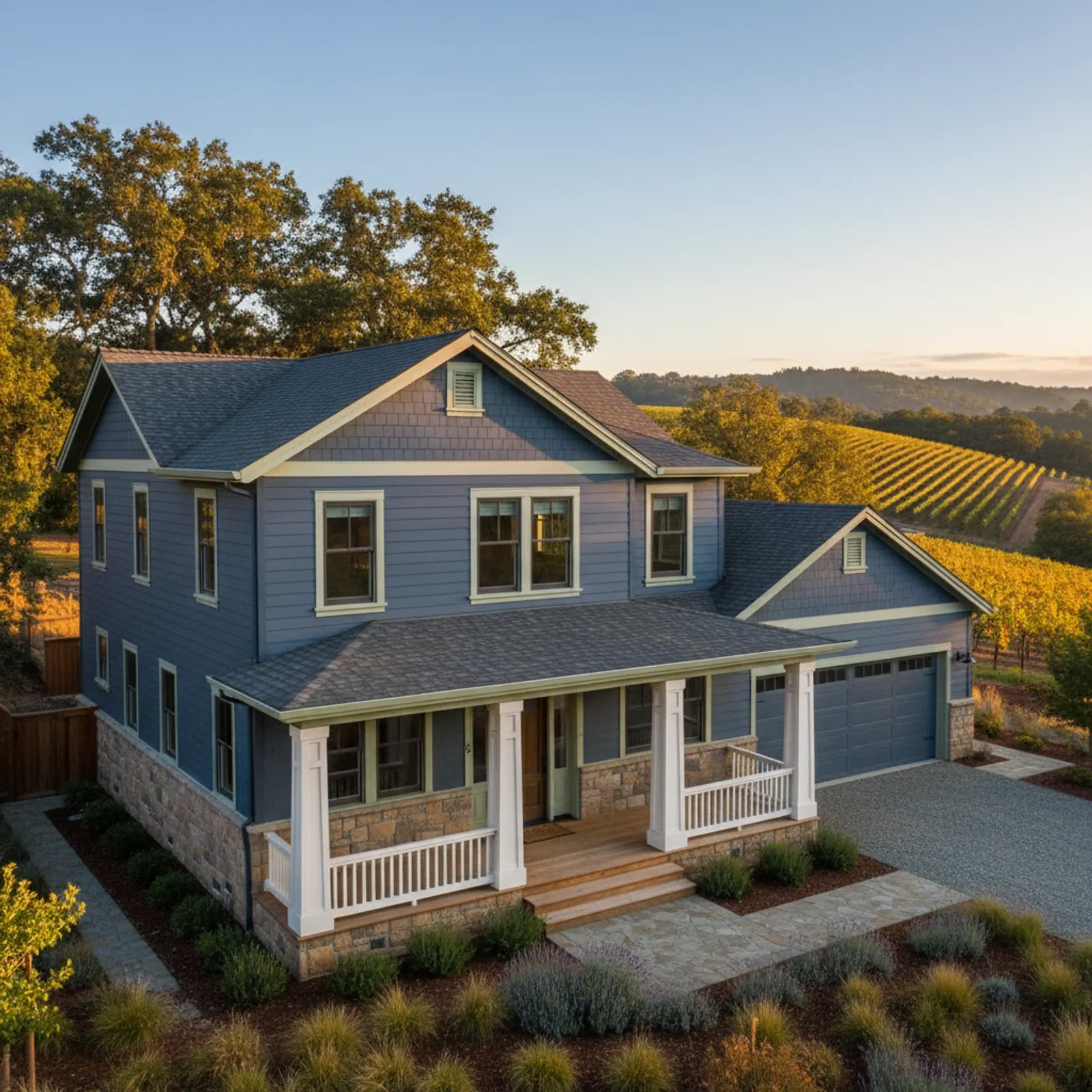
Siding in Calistoga
A Calistoga re-side is shaped by repeated fire-evacuation history and a constrained valley head. At the north tip of Napa Valley, this historic hot-springs resort town has been directly threatened and evacuated multiple times (the 2017 Tubbs/Atlas and 2020 Glass/LNU events), with limited egress and Mt. St. Helena / Palisades fire terrain on three sides. It is also the valley's hottest spot. So a Calistoga project is fire-hardening-first, heat-stable, with resort-town heritage fidelity for the eclectic downtown stock.
We scope it around the genuine, recurring fire reality and the valley's extreme heat — never a cosmetic resort re-clad.
Repeated fire history, constrained egress
Calistoga's hillside estates and rural acreage — and even the town itself — sit in high fire terrain with documented repeat evacuations and narrow valley-head escape routes. We specify Class A non-combustible cladding and harden eaves, soffits, vents, decks, and ground transitions as the baseline.
The valley's hottest heat + resort heritage
Calistoga regularly records the valley's highest summer temperatures, so we use heat-stable, fade-resistant assemblies; on the eclectic historic resort-town homes we replicate period detailing faithfully while still hardening.
Ember-resistant cladding for the upvalley WUI
Because Calistoga sits in a designated wildland-urban interface, a re-side here is really a wall-assembly upgrade governed by California's WUI ignition-resistant standards. The goal is to deny embers a foothold. That pushes us toward noncombustible or ignition-resistant claddings -- fiber cement, mineral-faced panels, or properly rated systems -- detailed as a Class A assembly rather than a single product swapped in isolation. Embers don't strike the field of a wall; they collect at the soffit-to-wall junction, behind trim, and in the gap where siding meets the foundation. So the spec extends to noncombustible weep screeds, tight kickout and Z-flashing, and ember-blocking closures at vents and eave returns. On the hillside estates and rural acreage above town, defensible-space clearance and the cladding work move together, since downhill flame contact and radiant heat are the real threats on a slope. The result is a wall that resists the ember shower a Glass Fire-style event throws at a home, not a finish chosen for looks alone. That is the difference that matters this far up the valley.
Working around historic downtown stock and steep-lot access
Calistoga's housing is a study in contrasts, and each kind reshapes how the siding work actually runs. Along Lincoln Avenue and the older residential blocks near the hot-springs core sit modest early-1900s and craftsman-era homes with narrow side yards, original wood profiles, and details a town that prizes its resort heritage expects to see preserved. Matching reveal, trim depth, and corner treatment on those homes is exacting, and partial repairs often mean blending new courses into weathered originals. Out on the wooded ridges, the picture flips: long private drives, grade changes, and tight switchbacks make staging the limiting factor. Material delivery, scaffold on a slope, and dumpster placement all have to be solved before a single board comes off. Rural acreage parcels add distance from the nearest supply run and limited room to turn equipment. We plan sequencing, access, and protection of mature landscaping up front, because on these lots a misjudged staging plan costs more time than the cladding itself. The same service looks very different downtown versus a ridge estate above it.
Why this matters in Calistoga
- Specified for Wine Country conditions
- non-combustible fiber cement as the recommended system
- Correctly detailed weather-resistive barrier and flashing
- Installed by a crew with 20 years combined experience
Recommended systems for Calistoga
- non-combustible fiber cement
- fire-hardened detailing
- period-sensitive trim
Fiber Cement Siding for Calistoga homes
The full fiber cement siding approach — materials, weather-resistive detailing, and the manufacturer standards we install to — is covered on the main service page, then specified for Calistoga's conditions on this one.
Our Calistoga process
- Step 1
Consultation
We listen to your goals and assess your home on site — exposure, substrate, and architecture.
- Step 2
Design & Proposal
A clear written proposal with the right system specified for your climate and a transparent scope.
- Step 3
Expert Installation
Trained crews install to manufacturer best practices with careful weather-management detailing.
- Step 4
Walkthrough & Support
A final walkthrough, full cleanup, and a clear written record of the scope completed — work we stand behind.
FAQ
Siding in Calistoga — FAQ
Calistoga is the repeatedly-evacuated, egress-constrained resort town at the valley head with the valley's hottest temperatures and more eclectic/modest stock — versus St. Helena's grand-estate-and-Main-Street market. Both are high-fire; Calistoga's history is more acute.
Yes — Calistoga has been evacuated multiple times in recent major fires with constrained egress. Non-combustible cladding with hardened detailing is the baseline, not optional.
It regularly records the valley's highest summer temperatures — we specify heat-stable, fade-resistant assemblies accordingly.
Yes — faithful period detailing on the eclectic downtown stock, with non-combustible upgrades given the genuine fire exposure.
Through a detailed written proposal after on-site assessment; hardening scope, access, and substrate condition vary widely.
Keep Exploring
More for Calistoga homeowners
More in Calistoga
Other exterior services in Calistoga
Helpful Exterior Guides