
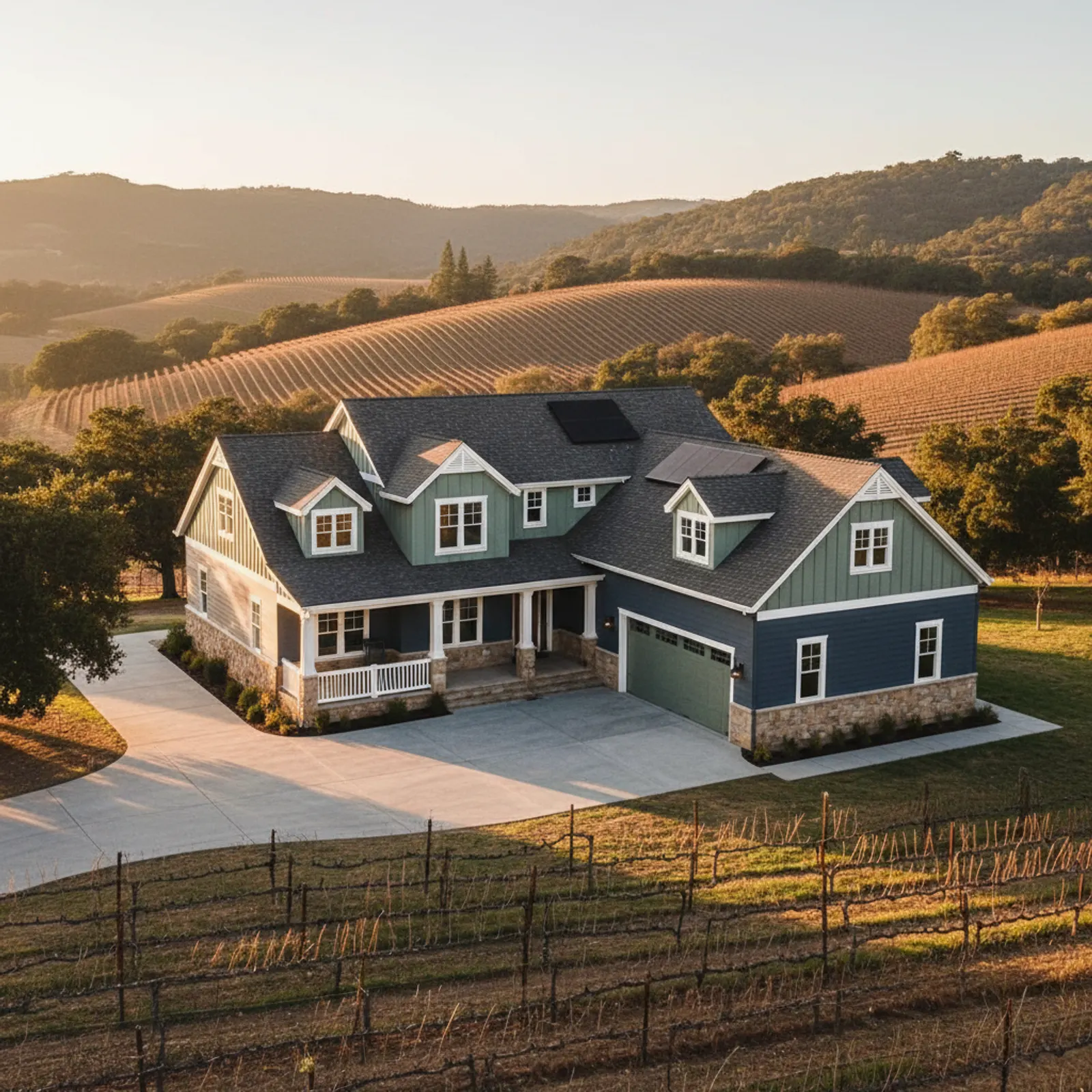
Siding in St. Helena
A St. Helena re-side sits at the high-value heart of upper Napa Valley — premium wine estates, vineyard properties, and a celebrated historic Main Street downtown — in genuinely high wine-country wildfire terrain. The 2020 Glass Fire burned directly into the St. Helena area; this is not theoretical exposure. So a project here integrates three things at once: estate-grade design, faithful historic-downtown detailing, and serious fire hardening, under an elevated-heat valley climate.
We scope it as all three together — never a cosmetic estate re-clad that ignores the fire reality.
High design and real fire, integrated
St. Helena estates and vineyard homes carry complex, high-design elevations; the craft is folding Class A non-combustible cladding and hardened eave, vent, and ground-transition detailing into that architecture so the result is demonstrably safer and visually uncompromised.
Historic Main Street fidelity
St. Helena's protected historic downtown and older town homes demand faithful period profiles and trim; we replicate them exactly while still upgrading to non-combustible assemblies given the genuine valley fire exposure.
Hillside ember zones below the Mayacamas
Many St. Helena homes do not sit on the flat valley floor; they climb the foothills toward the Mayacamas and Vaca ranges, and that placement changes what a siding job has to do. On these slopes a house is squarely in the wildland-urban interface, where wind-driven embers, not a wall of flame, are the most common ignition path. The Glass Fire proved that exposure is real here, so we treat upslope and ridge-facing elevations as the most vulnerable faces. The siding spec follows the terrain: Class A non-combustible cladding such as fiber cement or mineral-based board, tight horizontal joints and butt seams that deny embers a foothold, and a clean, sealed transition where the wall meets the foundation so nothing can pile against the base and smolder. Decks, fences, and landscaping that abut the wall get reviewed as part of the same envelope, because a hardened wall behind a combustible fence is a half-measure. The goal on a hillside lot is a continuous, ignition-resistant skin, not a cosmetic re-clad.
Vineyard-estate access and the upvalley siding sequence
Re-siding a working vineyard property in St. Helena is as much a logistics problem as a craft one. Estate homes sit behind long private drives, mature landscaping, and irrigation lines, and the surrounding rows are a live agricultural operation, so staging, lifts, and material drops have to be planned around vine work and harvest windows rather than dropped wherever convenient. We sequence the job elevation by elevation to keep equipment off planted ground and protect drip systems and stonework during tear-off. Upvalley toward Calistoga and down toward Yountville, the same pattern repeats: high-value homes on generous, hard-to-stage parcels where a careless crew can do real damage to the grounds. Material lead times matter too, because the architectural-grade cladding and matched trim these estates call for are not always stocked locally and benefit from ordering before demolition begins. By confirming access routes, protection plans, and delivery timing up front, a St. Helena siding project moves at the pace the property allows instead of stalling once the old cladding is already off the walls.
Why this matters in St. Helena
- Specified for Wine Country conditions
- premium non-combustible fiber cement as the recommended system
- Correctly detailed weather-resistive barrier and flashing
- Installed by a crew with 20 years combined experience
Recommended systems for St. Helena
- premium non-combustible fiber cement
- custom trim packages
- fire-hardened detailing
Fiber Cement Siding for St. Helena homes
The full fiber cement siding approach — materials, weather-resistive detailing, and the manufacturer standards we install to — is covered on the main service page, then specified for St. Helena's conditions on this one.
Our St. Helena process
- Step 1
Consultation
We listen to your goals and assess your home on site — exposure, substrate, and architecture.
- Step 2
Design & Proposal
A clear written proposal with the right system specified for your climate and a transparent scope.
- Step 3
Expert Installation
Trained crews install to manufacturer best practices with careful weather-management detailing.
- Step 4
Walkthrough & Support
A final walkthrough, full cleanup, and a clear written record of the scope completed — work we stand behind.
FAQ
Siding in St. Helena — FAQ
Yes — upper Napa Valley is genuine high wildfire terrain and the 2020 Glass Fire reached the St. Helena area. Non-combustible cladding with hardened detailing is the baseline, not an option.
St. Helena is smaller, more exclusive, deeper in the valley, and higher-fire (Glass Fire), with a more estate/vineyard-concentrated stock and a protected historic Main Street — versus Napa city's larger mixed urban fabric.
Yes — folding non-combustible cladding and hardened detailing invisibly into significant St. Helena estate architecture is central to how we work the upper valley.
Yes — faithful period profiles and trim, with non-combustible upgrades given the genuine valley fire exposure.
Through a detailed written proposal after on-site assessment; estate hardening scope, design complexity, and substrate condition vary widely.
Keep Exploring
More for St. Helena homeowners
More in St. Helena
Other exterior services in St. Helena
Helpful Exterior Guides