
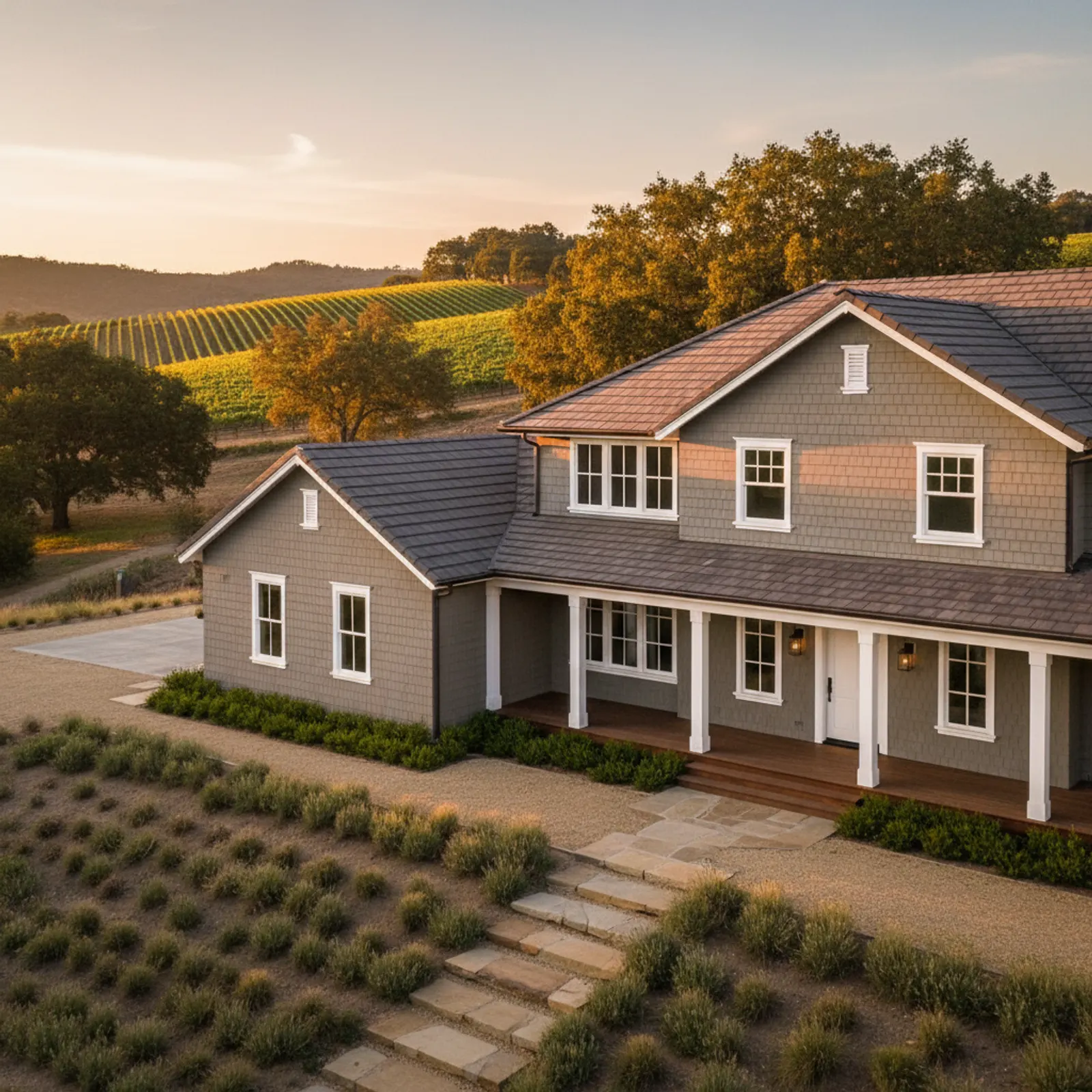
Exterior renovation in St. Helena
St. Helena sits in the heart of the Napa Valley, an affluent small town surrounded by vineyards and the hillsides that climb toward the Mayacamas and Vaca ranges. It is one of the highest-value, most design-conscious housing markets in Northern California, and, after the Glass and LNU fires, one where wildfire exposure is acutely and personally understood. A St. Helena exterior project is expected to be both architecturally impeccable and genuinely hardened, and homeowners here generally will not accept one of those at the expense of the other.
Why St. Helena homeowners re-side
St. Helena re-side decisions are rarely about basic wear alone. They are driven by the desire for a higher architectural standard on a high-value home, by the upvalley heat and UV that tire finishes faster than the southern valley, and increasingly by a deliberate decision to harden after the fire seasons of recent years. On hillside and vineyard-edge estates, the hardening motive often leads. We approach each project as an architecture-and-hardening problem solved together.
Considering an exterior project in St. Helena?
St. Helena housing and architecture
St. Helena's stock runs from historic downtown and Victorian-era homes through established in-town residences to vineyard estates and hillside custom homes. The historic core demands period-sensitive profiles, narrow reveals, and trim that honors the town's protected character; getting those proportions wrong is conspicuous here. The estate and hillside homes are detail-intensive, architect-driven projects where reveal consistency, material transitions, and fire detailing must all be resolved to a very high standard. Across both ends of the stock, the finish quality expectation is high enough that the cladding choice and the trim package have to be considered as one decision.
St. Helena's upvalley climate
Upvalley St. Helena is notably hotter and drier in summer than the southern Napa Valley, with strong UV and a long, severe fire season; winters are mild. The heat and dryness punish finishes on exposed elevations and drive real durability requirements, but the dominant controlling factor on hillside and vineyard-edge parcels is wildfire exposure during the long dry months. The dryness and heat are not separate problems from the fire risk; they are the same upvalley condition expressed two ways, and the specification has to answer both at once.
Hardening a St. Helena estate without losing the architecture
For St. Helena's hillside and vineyard-adjacent homes, exposure made concrete by the Glass and LNU fires, we specify Class A non-combustible fiber cement and harden eaves, vents, and ground-to-wall transitions, integrating the fire strategy into the home's architecture rather than bolting it on. The aim is an exterior that is both safer and architecturally uncompromised, which on a high-design home is the harder and more important version of the job. We document materials and assemblies to support insurability and rebuilding-standard conversations in this market, while recognizing that insurers set their own criteria.
Recommended materials for St. Helena
Premium non-combustible fiber cement with custom trim and profile packages is the core recommendation for St. Helena, because it delivers the architectural finish quality the market expects, the heat durability the upvalley climate requires, and the non-combustibility the fire exposure demands in one system. We deliberately avoid combustible cladding on hillside and vineyard-edge parcels regardless of aesthetic tradition, because the exposure here is too real to trade for appearance. Fiber cement carries no finish penalty in exchange, which is what makes the architecture-and-hardening goal achievable rather than aspirational.
What an exterior project costs in St. Helena
St. Helena projects are typically larger and more detail-intensive than valley production homes: significant square footage, complex multi-material elevations, custom trim, and fire-hardening scope all add up. Estate-lot access and vineyard-edge staging add real logistics, and substrate discovery on older homes is common once cladding comes off. The value concentrates in craftsmanship and integrated hardening detail rather than in any per-foot shortcut, so pricing is established in a detailed written proposal after an on-site assessment rather than as a generic figure.
The historic downtown and protected character
St. Helena's historic core is a defining part of the town's identity, and a re-side there is a sensitivity exercise as much as a construction one. Period-appropriate profiles and trim executed in non-combustible fiber cement preserve the home's character while adding durability and hardening that the original wood never offered. These projects are trim-heavy and proportion-driven, and they call for restraint: the right outcome looks like the home always did, only better protected.
Vineyard-edge and hillside estates
The estate and hillside homes on the vineyard and oak-hill edge are where St. Helena's fire exposure and architectural ambition meet most directly. These are detail-intensive, architect-driven elevations with complex material transitions, and they sit precisely where ember loading is highest in a wind event. Resolving custom trim, multi-material faces, and a fully hardened assembly together is the core of this work, and it is unforgiving of shortcuts on either the design or the fire side.
Insurability and rebuilding-standard context
In a market shaped by recent fire seasons, documented hardening has become part of how a St. Helena home is evaluated, including in insurability and rebuilding-standard conversations. We record the materials and assemblies used so those details are available when they matter, while being honest that insurers apply their own criteria and we don't speak for them. A documented non-combustible, well-detailed exterior is a defensible part of that picture on an exposed upvalley parcel.
Permits, PG&E PSPS, and St. Helena historic-district review
Working exteriors in the small city of St. Helena runs into a few local realities most homeowners don't fully anticipate. Electric and gas both come from PG&E, and upvalley St. Helena sits in one of the hardest-hit corridors in PG&E's PSPS territory — Public Safety Power Shutoffs during diablo-wind and red-flag events routinely affect the town and can shape scheduling on any two- to three-week exterior project through the late-summer and fall fire windows. Water is supplied by the City of St. Helena Water Department, city-owned. Fire response is the St. Helena Fire Department, supported by Napa County Fire and CAL FIRE on wildland calls. On the permit side, the City of St. Helena's Community Development Department handles building permits, and the downtown blocks along Main Street and the adjacent Adams and Spring Street corridors fall within the town's designated historic district — visible exterior work on contributing structures goes to design review, where material, profile, and color can be regulated. Away from the district, a like-for-like re-side is typically routine; substantive assembly changes trigger more review. We flag utility, permit, and heritage items at the estimate stage rather than at the wall.
HZ10, the Glass and LNU fires, and the 2025 FHSZ remap upvalley
St. Helena is one of the wine-country markets where the fire framework is neither abstract nor optional. Two named events shape the current conversation: the 2020 Glass Fire, which burned across the Mayacamas into upvalley Napa County (including Deer Park immediately north of St. Helena), and the 2017 LNU Complex — including the Nuns and Atlas fires — which reached the ridges and valley floor around the town. California's 2025 LRA Fire Hazard Severity Zone map (the first comprehensive revision since 2007) applies to Napa County and, by the city's separate adoption, to St. Helena parcels. The Mayacamas and Vaca hillside parcels — the vineyard-and-estate territory this market centers on — carry Moderate to Very High designations, while the valley-floor town core sits mostly in Low FHSZ or unmapped. On designated parcels the 2025 California Wildland-Urban Interface Code governs the exterior wall; on the flat downtown lots it does not, though non-combustible cladding remains a low-regret upgrade there anyway. The code frame itself changed on January 1, 2026, when Chapter 7A was deleted from the Building Code and moved into the standalone WUI Code. On the material side, St. Helena is in James Hardie's HZ10 climate zone; installing HZ5 is a documented warranty misapplication. We check the parcel at scoping and match the assembly to the current designation.
Our process in St. Helena
- Step 1
Consultation
We listen to your goals and assess your home on site — exposure, substrate, and architecture.
- Step 2
Design & Proposal
A clear written proposal with the right system specified for your climate and a transparent scope.
- Step 3
Expert Installation
Trained crews install to manufacturer best practices with careful weather-management detailing.
- Step 4
Walkthrough & Support
A final walkthrough, full cleanup, and a clear written record of the scope completed — work we stand behind.
St. Helena homeowners should not have to choose between an architecturally exceptional exterior and a hardened one, and on an upvalley estate they cannot afford to. We deliver both, scoping every St. Helena project on site so the architecture and the fire detailing are resolved together, with your written estimate governing the work.
FAQ
St. Helena — Common Questions
On hillside and vineyard-adjacent parcels, yes — exposure made concrete by the Glass and LNU fires. Class A non-combustible cladding with hardened detailing is the baseline there.
That balance is central to our St. Helena work — integrating a non-combustible, hardened assembly into a high-design exterior so the result is both safer and architecturally uncompromised.
Premium non-combustible fiber cement with a custom trim and profile package — architectural finish quality, upvalley heat durability, and fire performance together.
Yes — St. Helena runs hotter, drier, and higher-UV than southern Napa, which drives both finish durability and the severe fire season.
Yes — period-appropriate profiles and trim in non-combustible fiber cement preserve character while adding hardening and durability.
Home hardening can support insurability in this market. We document the materials and assemblies used, though insurers set their own criteria.
On hillside and vineyard-edge parcels we advise against it regardless of aesthetics; non-combustible fiber cement carries no finish or durability penalty here.
A correctly installed fiber cement system commonly performs 30+ years in St. Helena's upvalley climate while materially reducing ignition risk.
Explore
Exterior Services
Helpful Exterior Guides