
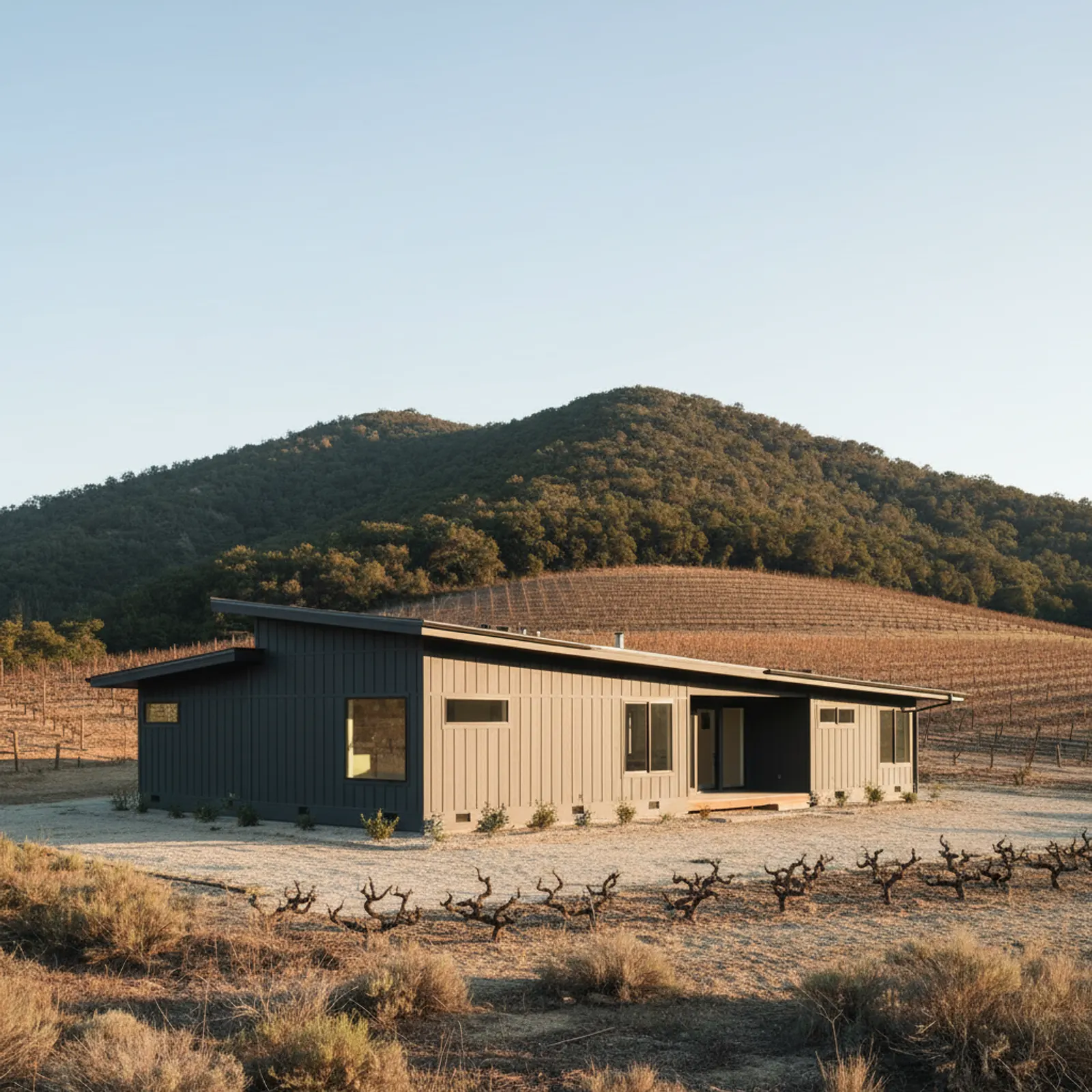
Exterior renovation in Calistoga
Calistoga sits at the far northern tip of the Napa Valley, a small resort town ringed tightly by steep wooded ridges, hot springs, and vineyard land. Of all the Napa Valley communities it is among the most fire-exposed — the 2020 Glass Fire and the 2017 Tubbs Fire both pressed hard against it. For Calistoga homeowners an exterior project is, first and foremost, a hardening project, executed with care for the town's distinctive historic character.
Hardening without erasing the town
The tension every Calistoga re-side has to resolve is real: the exposure demands non-combustible, aggressively detailed assemblies, while the town's charm rests on a historic downtown and older residential streets whose character is part of its value. Those goals are not in conflict when the work is done right. Period-correct profiles and trim are available in non-combustible fiber cement, so a historic home can be genuinely hardened and still read true to the street. We treat both the fire spec and the character as non-negotiable rather than trading one for the other.
Considering an exterior project in Calistoga?
Calistoga housing and architecture
Calistoga's stock blends a charming historic downtown and Victorian and early-California homes, modest older residential streets, resort and cottage properties tied to the hot-springs trade, and hillside and vineyard-edge custom homes on the surrounding slopes. The historic homes demand period-sensitive profiles, proportioned trim, and restraint so a re-side modernizes durability without flattening character. The hillside and ridge homes are where re-cladding combustible wood and shingle delivers the largest hardening gain, because they sit in genuinely high-exposure terrain where the wall material is survival infrastructure, not finish.
Calistoga's upvalley climate
Calistoga is the hottest, driest part of the Napa Valley in summer, with intense UV and a long, severe fire season; winters are mild and wet. The pronounced dry season and the steep wooded ridges that enclose the town combine to make wildfire the controlling exterior factor on most parcels. The same ridges that funnel summer heat into the upvalley also funnel wind during a fire event, which is why ember behavior — not just flame contact — drives the detailing here. Heat and UV are real secondary stressors the finish has to survive.
Hardening a Calistoga home
Given exposure made concrete by the Glass and Tubbs fires, we specify Class A non-combustible fiber cement for Calistoga homes and aggressively harden eaves, soffits, vents, and ground-to-wall transitions, recognizing that ridge- and vineyard-edge parcels see heavy ember loading in a wind event. In ridge-enclosed terrain, embers carried on canyon wind are the most common ignition path, so the vulnerable details around the wall matter as much as the cladding itself. We document materials and assemblies to support insurability and rebuilding-standard conversations, while being clear that insurers set their own criteria. We won't overstate the risk, but in upvalley Calistoga it is genuinely high.
Recommended materials for Calistoga
Non-combustible fiber cement is the recommendation for Calistoga — in period-appropriate profiles for the historic core and durable, straightforward profiles for hillside homes. We advise against combustible cladding here given the high upvalley fire exposure; the choice is not a stylistic preference but a response to the terrain. Fiber cement also handles the intense upvalley heat and UV with no durability trade-off, so the safest material is also the soundest one on every count. The result hardens the home and carries the character the town expects.
What an exterior project costs in Calistoga
Calistoga projects carry the standard drivers plus aggressive fire-hardening scope, period-sensitive trim on historic homes, and frequently steep ridge or rural site access on the hillside parcels. Older downtown-area homes commonly reveal substrate and dry-rot issues at demolition that a clean exterior never hinted at, so we keep that contingency visible. Ridge and vineyard-edge sites add staging, access, and material-handling cost a flat town lot avoids. We assess on site and provide a written, itemized estimate; in Calistoga the hardening scope is the core of the value, not an add-on.
The historic downtown core
Calistoga's compact historic downtown and the older residential streets around it are the town's identity, and re-siding here is as much a preservation exercise as a durability one. These homes sit on tighter lots with mature landscaping, so staging is careful and the design choices lean toward restraint — matching original exposures, casings, and corner detail in non-combustible profiles. The goal is a home that is meaningfully hardened against the upvalley fire exposure while still belonging on its street. A re-side that looks new but reads wrong here works against the property's value.
Hillside and vineyard-edge parcels
The custom homes on the slopes above town and along the vineyard edge are Calistoga's highest-exposure work. Steep, wooded, and often at the end of long rural drives, these parcels see the heaviest ember loading in a wind event and the most demanding site access. Re-cladding combustible wood or shingle in hardened non-combustible fiber cement is the single highest-value step available for a home in this ridge-enclosed terrain. We plan access, staging, and material handling on these sites before work begins, because the logistics are part of the scope.
Insurability and the rebuilding conversation
In a high-exposure market like upvalley Calistoga, the exterior increasingly intersects with insurance and defensible-space requirements. We can't promise a particular insurer's outcome — they set their own criteria — but we build to current standards and document the materials and assemblies we install so the work supports insurability and rebuilding-standard conversations. For owners navigating coverage in fire country, that documentation is often as valuable as the hardening itself, and we provide it as a matter of course.
City of Calistoga permits, city water, and Calistoga's historic downtown
Working exteriors in the small City of Calistoga coordinates with a few local authorities. Electric and gas both come from PG&E, and Calistoga sits in one of the highest-PSPS corridors in upvalley Napa County. Water is supplied by the City of Calistoga's utility, city-owned. Fire response is the Calistoga Fire Department alongside Napa County Fire and CAL FIRE for surrounding SRA. On the permit side, the City of Calistoga Community Development Department handles building permits, and Downtown Calistoga (the historic Lincoln Avenue corridor and adjacent blocks) carries design-review considerations on visible exterior work on contributing structures. We flag utility, permit, and heritage items at the estimate stage.
HZ10, the 2020 Glass Fire and 2017 Tubbs Fire, and 2025 FHSZ
Calistoga is in James Hardie's HZ10 climate zone; installing HZ5 is a documented warranty misapplication. On the fire side, essentially all of upvalley Napa County — including Calistoga proper and much of the surrounding vineyard, ridge, and open-space terrain — sits in Moderate to Very High FHSZ under California's 2025 LRA Fire Hazard Severity Zone map, with much of the surrounding wildland in State Responsibility Area outright. The 2020 Glass Fire and 2017 Tubbs Fire both threatened Calistoga (the town was evacuated during Glass), making this one of the most fire-conscious markets in California. The 2025 California Wildland-Urban Interface Code governs the exterior wall on essentially every re-side here. Chapter 7A moved into the standalone WUI Code on January 1, 2026.
Our process in Calistoga
- Step 1
Consultation
We listen to your goals and assess your home on site — exposure, substrate, and architecture.
- Step 2
Design & Proposal
A clear written proposal with the right system specified for your climate and a transparent scope.
- Step 3
Expert Installation
Trained crews install to manufacturer best practices with careful weather-management detailing.
- Step 4
Walkthrough & Support
A final walkthrough, full cleanup, and a clear written record of the scope completed — work we stand behind.
Calistoga's beauty comes with genuine fire exposure, from the historic downtown to the ridge and vineyard-edge slopes. We build exteriors that are hardened to current standards and still true to the town, and we scope every Calistoga project on site so your written estimate governs the work.
FAQ
Calistoga — Common Questions
High — Calistoga is among the most fire-exposed Napa Valley towns, pressed by the Glass and Tubbs fires. Non-combustible cladding with aggressive hardening is the baseline here.
Class A non-combustible fiber cement with hardened eave, soffit, vent, and ground-transition detailing — period-appropriate profiles on historic homes.
Re-cladding combustible wood or shingle in non-combustible fiber cement is one of the highest-value hardening steps available in this ridge-enclosed terrain.
Yes — Calistoga is the hottest, driest part of the Napa Valley in summer, with strong UV, so we specify durable finishes alongside the fire backbone.
Yes — period-appropriate profiles and trim in non-combustible fiber cement preserve character while adding real hardening.
It can support insurability in this high-exposure market. We document the materials and assemblies used, though insurers set their own criteria.
We advise against it given the high fire exposure; fiber cement carries no heat-durability penalty, so the safer material is the sound one.
A correctly installed fiber cement system commonly performs 30+ years in Calistoga's climate while materially reducing ignition risk.
Explore
Exterior Services
Helpful Exterior Guides