Siding in Auburn
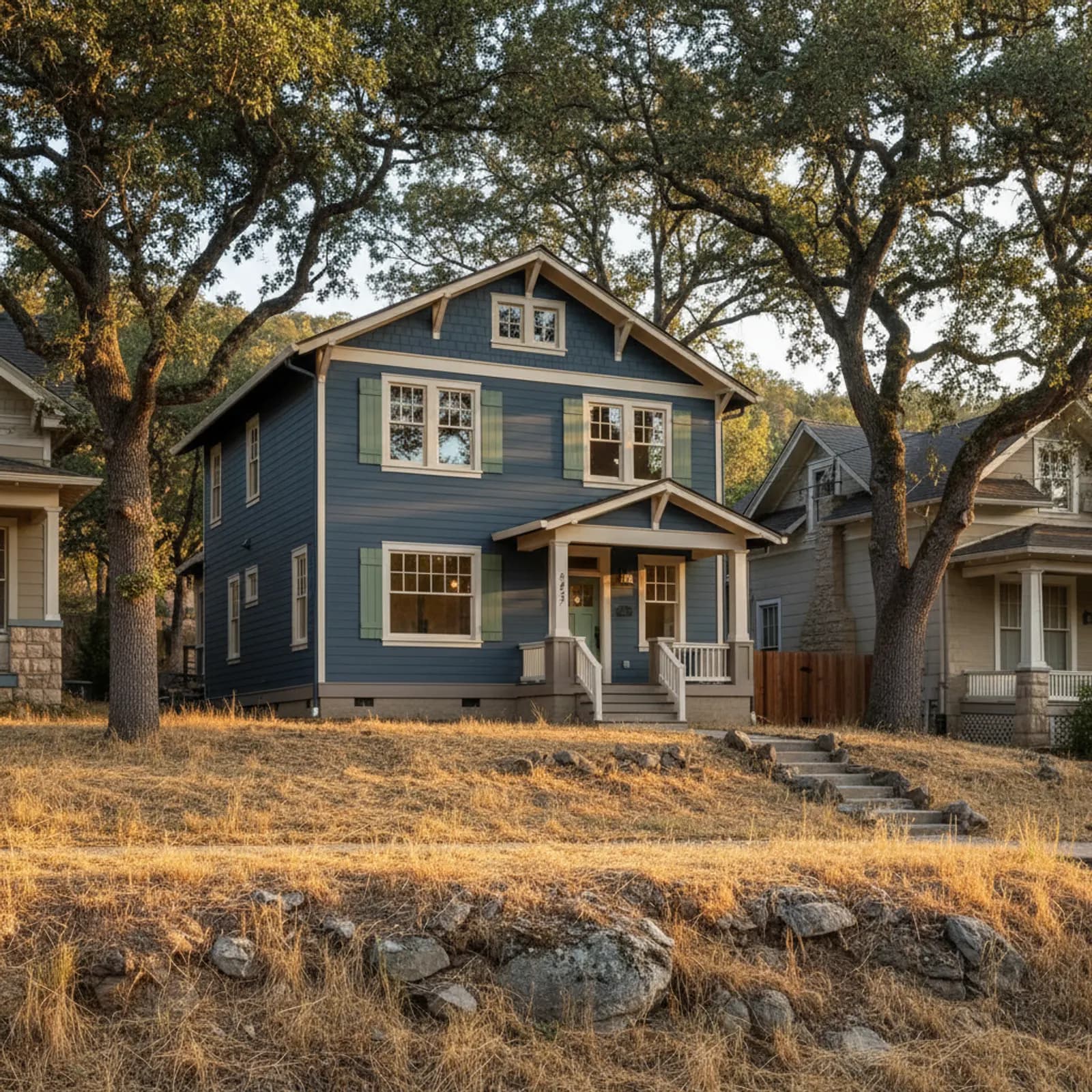
An Auburn re-side is a different conversation entirely from the valley cities thirty minutes west. Auburn is the gateway to the Sierra and sits in genuine wildland-urban-interface fire country — historic Old Town homes, 1970s–1990s hillside subdivisions on oak-and-pine slopes, and rural acreage. For most Auburn homeowners, replacing siding is also the single most effective opportunity to harden the home against ember intrusion.
So we scope Auburn re-sides fire-first: the cladding choice, eave and vent detailing, and ground-to-wall transition are treated as one defensive assembly, not a cosmetic refresh.
Re-siding as home hardening in Auburn
Most homes lost in California wildfires are ignited by wind-driven embers, not a flame front — which is why the exterior matters so much in Auburn. We strip combustible wood, T1-11, or hardboard, correct the weather barrier, and re-clad in non-combustible material with hardened eave and vent detailing. The boards are the visible part; the ignition resistance is the point.
Old Town character vs. hillside exposure
Auburn's historic Old Town homes need period-sensitive profiles done in non-combustible material; the hillside subdivisions and rural parcels need the most rigorous hardening. We tailor the approach to where the home sits on Auburn's fire-exposure gradient.
Class A cladding and the WUI spec sheet for Placer foothills
Auburn sits inside Cal Fire's designated wildland-urban interface, and that classification changes what siding can legally and sensibly go on a wall here. On the oak-and-pine slopes where the 1970s through 1990s subdivisions were built, we steer most homeowners toward noncombustible or ignition-resistant cladding: fiber cement boards, fiber cement panel-and-batten, or mineral-based systems that carry a Class A flame rating and will not feed a fire that an ember has already started. The product is only half of it. We pair the cladding with the WUI assembly details that actually decide whether a house survives the night, including ember-resistant vents, closed or fire-blocked eaves, and noncombustible trim at penetrations. The lower three feet of wall, where embers pile against the foundation and landscaping, gets the most scrutiny. For a hillside Auburn lot, treating the siding job as a coordinated noncombustible envelope, rather than swapping in look-alike boards, is the difference between a cosmetic upgrade and a hardened one.
Working steep lots, narrow lanes, and acreage staging in Auburn
A re-side in Auburn is as much a logistics problem as a building one. Old Town's tight historic streets and the steep cut-and-fill driveways of the foothill subdivisions rarely give a crew flat ground to stage scaffold, stack material, and park a dumpster, so we plan access before we plan the wall. On rural acreage parcels off the ridgelines, the wall may be a quarter mile from where a delivery truck can safely turn around, which affects how we sequence tear-off and haul-away. Slope also dictates fall protection and scaffold engineering that a flat valley lot never needs. Defensible-space rules add another layer: clearing brush and combustibles back from the structure is often required before and after the work, and we coordinate so the re-side does not undo that zero-to-five-foot buffer. We walk every Auburn site for grade, turnaround room, and overhead lines first, then build a phasing plan around it, because a clean install on a hillside starts with honest access planning, not optimistic scheduling.
Why this matters in Auburn
- Specified for Sierra Foothills conditions
- Class A non-combustible fiber cement as the recommended system
- Correctly detailed weather-resistive barrier and flashing
- Installed by a crew with 20 years combined experience
Recommended systems for Auburn
- Class A non-combustible fiber cement
- fire-hardened eave and vent detailing
- James Hardie fiber cement
- robust flashing for seasonal swings
Fiber Cement Siding for Auburn homes
The full fiber cement siding approach — materials, weather-resistive detailing, and the manufacturer standards we install to — is covered on the main service page, then specified for Auburn's conditions on this one.
Our Auburn process
- Step 1
Consultation
We listen to your goals and assess your home on site — exposure, substrate, and architecture.
- Step 2
Design & Proposal
A clear written proposal with the right system specified for your climate and a transparent scope.
- Step 3
Expert Installation
Trained crews install to manufacturer best practices with careful weather-management detailing.
- Step 4
Walkthrough & Support
A final walkthrough, full cleanup, and a clear written record of the scope completed — work we stand behind.
FAQ
Siding in Auburn — FAQ
Yes — in Auburn's WUI terrain, re-cladding combustible siding in non-combustible material with hardened eave and vent detailing is one of the most effective ignition-resistance upgrades available.
In Auburn's wildfire environment, combustible cladding is a meaningful liability. Replacing it with non-combustible material is a high-value hardening action, not just a cosmetic improvement.
Yes — period-sensitive profiles in non-combustible fiber cement preserve the character while delivering Class A fire performance.
Yes — they get the most rigorous hardening (eaves, vents, ground transitions, whole-site awareness); the right spec scales with the parcel's exposure.
Keep Exploring
More for Auburn homeowners
More in Auburn
Other exterior services in Auburn
Nearby Service Areas
Siding near Auburn
Helpful Exterior Guides