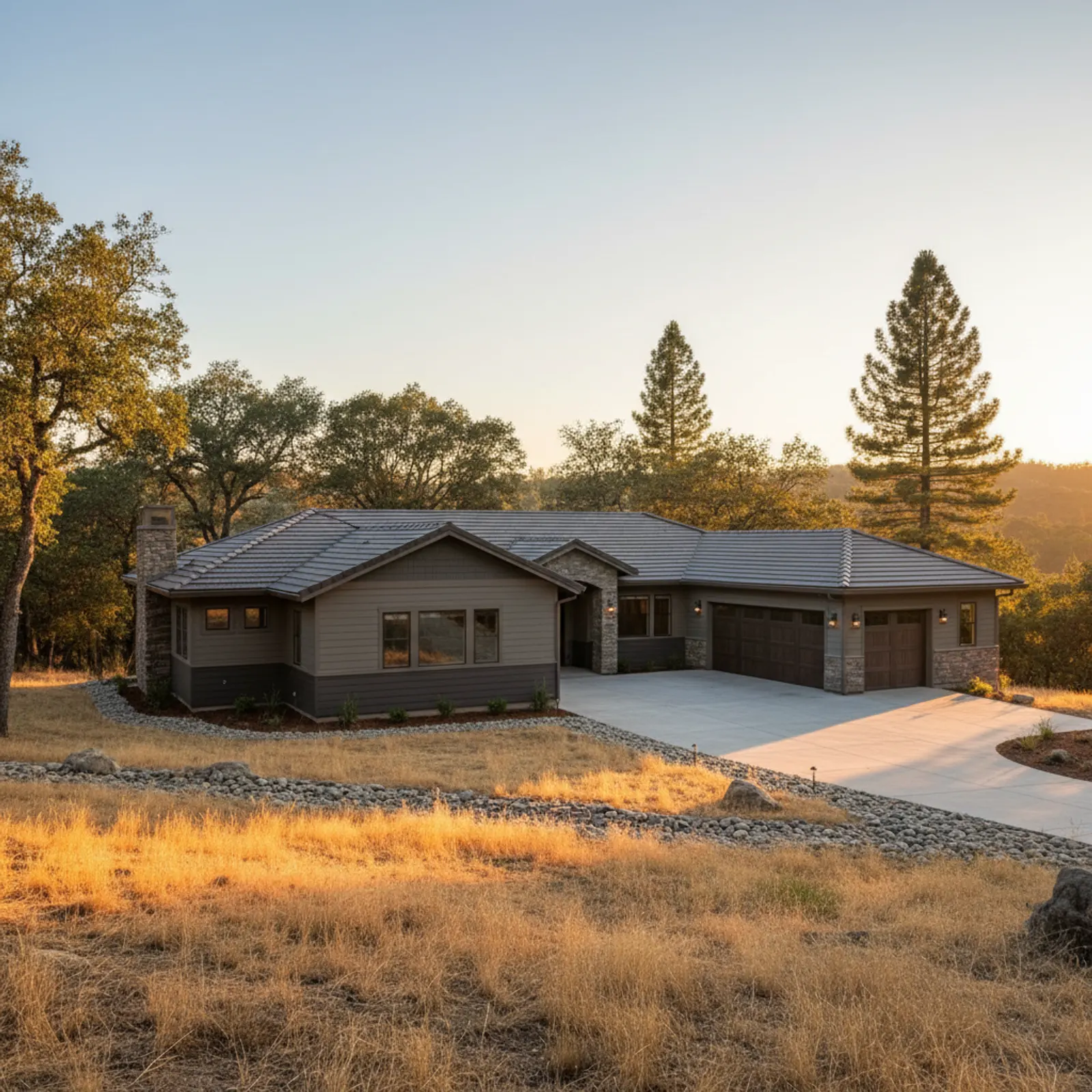
Exterior renovation in Auburn
Auburn is the gateway to the Sierra and the historic seat of Placer County, and its exterior-renovation conversation is fundamentally different from the valley cities thirty minutes west. Here the controlling factor is wildfire. Auburn's mix of historic Old Town homes, 1970s–1990s hillside subdivisions, and rural acreage properties sits in or near the wildland-urban interface, and for most Auburn homeowners a re-side is also an opportunity to materially harden the home against ember intrusion.
The exterior as a defense system
Most homes lost in California wildfires are not consumed by a wall of flame — they are ignited by wind-driven embers landing on or against the structure. That reframes the exterior entirely. In Auburn we do not treat fire performance as an upsell; it is the design premise. Cladding choice, eave and soffit detail, vent strategy, and the ground-to-wall transition are all part of one assembly whose job is to deny embers a place to start.
Considering an exterior project in Auburn?
Auburn housing and architecture
Auburn's housing is varied: character-rich older homes in and around historic Old Town and the Downtown/East Auburn area, extensive hillside subdivisions built from the 1970s through the 1990s on oak-and-pine slopes, and rural parcels with significant defensible-space considerations. Many of these homes still wear original wood, T1-11, or hardboard siding — combustible materials that are exactly what we want to replace in this environment. Re-cladding in non-combustible material is one of the single most effective hardening steps an Auburn homeowner can take.
Auburn's foothill climate
Auburn summers are hot and very dry, with elevated UV relative to the valley due to elevation and clear foothill air, and meaningfully cooler winters than the valley floor with occasional light snow. The dryness and heat that make Auburn pleasant also create the long, severe fire season that dominates exterior strategy. We specify finishes and detailing for that heat and for large seasonal temperature swings, while making fire performance the non-negotiable backbone of the assembly.
Fire-hardening an Auburn exterior
For Auburn homes we specify Class A non-combustible fiber cement as the cladding, then address the points that actually decide ignition: closed or carefully detailed eaves, ember-resistant venting, and a non-combustible zone at the base of walls where surface fire and embers collect. We coordinate cladding decisions with soffit and fascia work so the whole exterior assembly behaves as one hardened system rather than a non-combustible wall undermined by a vulnerable eave. Where homeowners are pursuing broader home-hardening or defensible-space programs, we document the materials and assemblies used so the work supports insurability conversations.
Recommended materials for Auburn
Non-combustible fiber cement — James Hardie or equivalent Class A board — is the clear recommendation for Auburn. We deliberately steer away from combustible engineered wood and any wood-based cladding in this environment regardless of its other merits, because the fire calculus dominates. Fiber cement also delivers the durability needed for Auburn's heat and seasonal swings, so there is no performance trade-off in choosing the safer material here.
What an exterior project costs in Auburn
Auburn projects carry the standard cost drivers — size, stories, trim, substrate condition, window integration — plus the fire-hardening scope at eaves, vents, and ground transitions, and frequently more challenging site access on hillside and rural parcels. Demolition and dry-rot discovery on older foothill homes can also add scope. We assess on site and provide a written, itemized estimate; in Auburn the fire-detailing line items are not where we recommend economizing.
Old Town character versus hillside subdivisions
Auburn is not one kind of home. The historic Old Town and Downtown/East Auburn neighborhoods hold character-rich older houses on tighter lots, where the goal is hardening the exterior while keeping profiles and trim sympathetic to a streetscape that predates ember-aware construction by a century. The 1970s-through-1990s hillside subdivisions on the oak-and-pine slopes are a different problem: sloped lots, downhill exposure, and the access constraints that come with grading and rural drives. We read which Auburn a home sits in — period core or hillside tract or open acreage — and detail the fire strategy and the staging plan to match, rather than applying one foothill spec to all of them.
PG&E, PCWA water, Auburn Fire, and Old Town design review
Working exteriors in the City of Auburn coordinates with a few local authorities. Electric and gas both come from PG&E, and Auburn is in high-PSPS territory — Public Safety Power Shutoffs during red-flag events can affect scheduling. Water is supplied by the Placer County Water Agency (PCWA), a customer-owned public agency, and the Nevada Irrigation District (NID) serves some parcels — meter and backflow coordination goes through the applicable water agency. Fire response is the Auburn Fire Department alongside CAL FIRE for the surrounding State Responsibility Area. On the permit side, the City of Auburn Community Development Department handles building permits, and the Old Town Historic District (California Historical Landmark #404) carries design-review expectations on visible exterior work — material, profile, and color can be regulated on contributing structures. We flag utility, permit, and heritage items at the estimate stage.
HZ10 and the 2025 FHSZ remap on Auburn's foothill parcels
Auburn is in James Hardie's HZ10 climate zone; installing HZ5 is a documented warranty misapplication. On the fire side, much of Auburn's oak-woodland and hillside terrain carries Moderate to Very High designations under California's 2025 LRA Fire Hazard Severity Zone map — a first comprehensive revision since 2007 — with much of surrounding unincorporated Placer running into State Responsibility Area outright. On designated parcels the 2025 California Wildland-Urban Interface Code governs the exterior wall. The code frame changed on January 1, 2026, when Chapter 7A moved into the standalone WUI Code. We check the parcel at scoping.
Our process in Auburn
- Step 1
Consultation
We listen to your goals and assess your home on site — exposure, substrate, and architecture.
- Step 2
Design & Proposal
A clear written proposal with the right system specified for your climate and a transparent scope.
- Step 3
Expert Installation
Trained crews install to manufacturer best practices with careful weather-management detailing.
- Step 4
Walkthrough & Support
A final walkthrough, full cleanup, and a clear written record of the scope completed — work we stand behind.
In Auburn, a re-side done right is also a meaningful reduction in your home's ignition risk. We design for both at once.
FAQ
Auburn — Common Questions
Class A non-combustible fiber cement, installed with fire-aware detailing at eaves, vents, and the ground-to-wall transition. Cladding alone is not enough — the detailing completes the protection.
In Auburn's wildfire environment, combustible wood, T1-11, or hardboard cladding is a meaningful liability. Re-cladding in non-combustible material is one of the most effective hardening steps available.
Home hardening can support insurability and resilience in WUI areas. We document the materials and assemblies used so the work can support those conversations, though insurers set their own criteria.
Embers — not direct flame — ignite most homes, and they collect at eaves, vents, and the base of walls. Non-combustible cladding undermined by an open vulnerable eave is not a hardened exterior.
Yes. We routinely work Auburn's hillside subdivisions and rural acreage parcels, accounting for access and defensible-space considerations in the plan.
We generally advise against combustible cladding in Auburn regardless of its other qualities. The wildfire calculus dominates, and non-combustible fiber cement carries no durability penalty here.
Yes — Auburn summers are hot, dry, and high-UV. We specify finishes and detailing for that heat and for large seasonal temperature swings, alongside the fire backbone.
Yes, with care. We can deliver a modern, hardened exterior while respecting the character of older Auburn homes through profile and trim choices.
Explore