Exterior renovation in Colfax
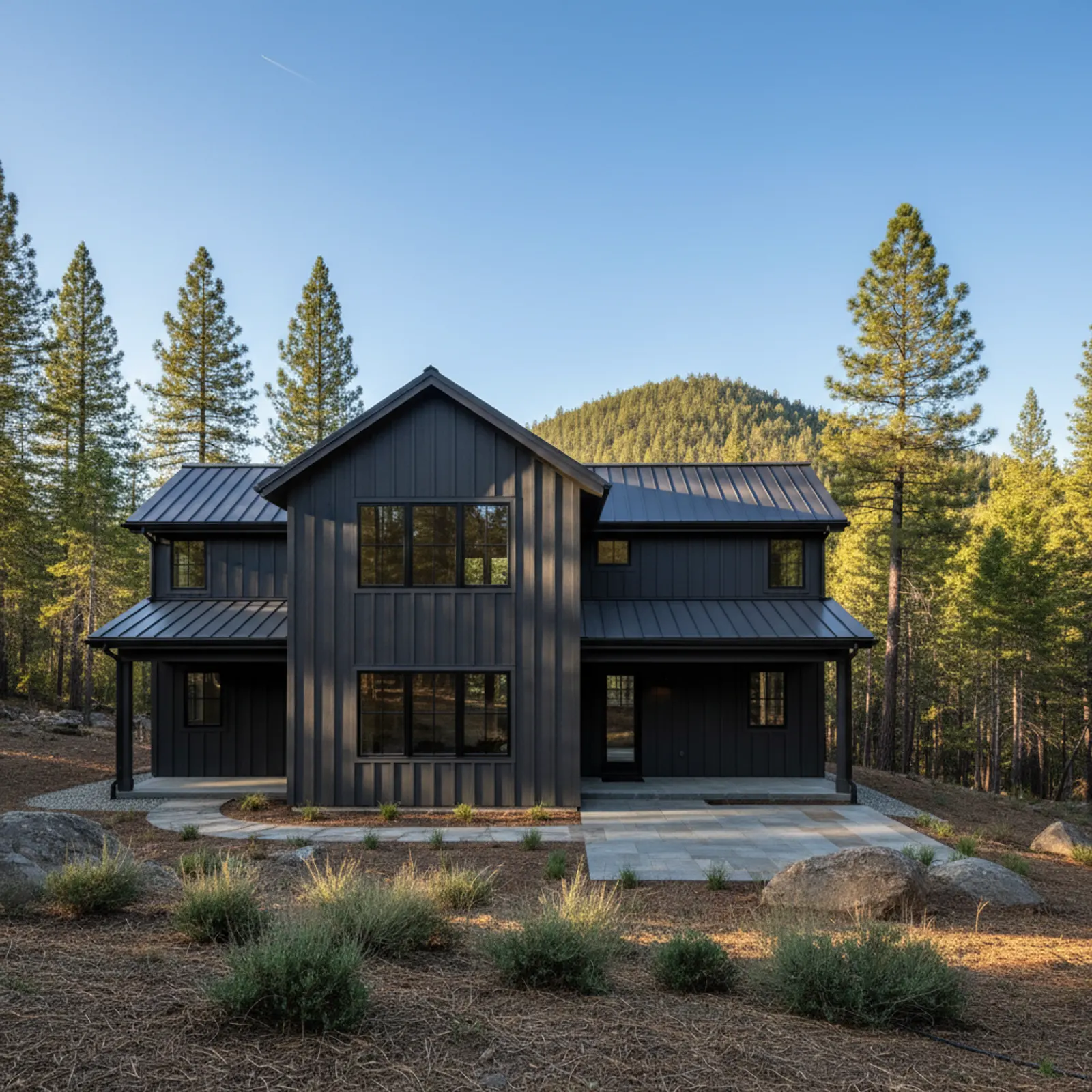
Colfax is a small historic Sierra rail town at higher elevation than the rest of populated Placer, surrounded by forest, ridges, and rural acreage along the I-80 corridor. For Colfax homeowners the exterior conversation is unambiguous: this is high wildfire-exposure country, often deep in the wildland-urban interface, and the exterior of the home is a primary line of defense. A re-side in Colfax that does not take fire seriously is a missed opportunity at best, and at worst it leaves a forest-adjacent home exposed at exactly the points embers exploit.
Fire first, but not fire only
Colfax's elevation means the spec has to be robust on two fronts at once. The fire backbone is non-negotiable — Class A non-combustible cladding with determined detailing at eaves, soffits, vents, and ground transitions where ridge and forest parcels take heavy ember loading. But Colfax also sees real winter precipitation, occasional snow, and freeze-thaw cycling, so the same assembly needs freeze-aware flashing that a lower-foothill town can skip. A minimal valley-grade re-side is the wrong answer here precisely because it answers neither hazard properly.
Considering an exterior project in Colfax?
Colfax housing and architecture
Colfax's stock includes character-rich historic rail-town homes near the old downtown, older small-lot houses, and a substantial number of rural foothill cabins, acreage parcels, and ridge properties scattered through the surrounding forest. Many of these are still clad in combustible wood lap or T1-11 from earlier decades. The eras and forms vary widely, but they share one trait that matters here: most were built well before ember intrusion was understood, so the original detailing at eaves, vents, and ground transitions almost never reflects current hardening practice.
Colfax's elevated foothill climate
Colfax's controlling stressor is foothill fire, sharpened by its elevation. Summers run hot and dry with strong UV, building serious seasonal fuel in the surrounding forest, while winters are cooler than the lower foothills and bring meaningful precipitation including occasional snow and freeze cycles. The exterior therefore has to carry a serious fire backbone and still tolerate some freeze-thaw, which is why a minimal valley-grade assembly is the wrong answer in Colfax — the spec has to be robust on two fronts.
Aggressive fire-hardening in Colfax
Colfax warrants the most aggressive end of our fire-hardening practice. Class A non-combustible cladding is the baseline, and on top of it we apply determined detailing at eaves, soffits, vents, decks, and ground-to-wall transitions, recognizing that ridge and forest-adjacent parcels see heavy ember loading whenever a wind event drives a fire. We coordinate cladding with soffit and fascia work and document the assemblies so the project supports the homeowner's broader home-hardening and defensible-space efforts rather than standing apart from them.
Recommended materials for Colfax
Non-combustible fiber cement is the only cladding we recommend for Colfax's exposure, paired with freeze-aware flashing and durable factory finishes for the elevation's seasonal swings. Combustible cladding is simply not a category we entertain at this exposure level. The convenient part is that fiber cement's durability also serves the freeze-thaw and snow side of Colfax's climate, so a single material choice answers both the fire hazard and the winter hazard without forcing a compromise between them.
What drives a re-side's cost in Colfax
Cost in Colfax is driven by extensive fire-hardening scope, freeze-aware detailing, and frequently difficult rural and ridge site access — long driveways, steep grades, and limited staging room are routine. Older homes and cabins regularly reveal substrate and dry-rot issues once demolition begins. We assess these qualitatively on site rather than guessing, because in Colfax the hardening scope is the core of the value, not an optional line item, and pretending otherwise would understate what the property actually needs.
Ridge and forest-adjacent parcels
A large share of Colfax homes sit on ridges or back directly onto forest, and those are precisely the parcels that take the heaviest ember loading in a wind-driven fire. For these properties we pay extra attention to the vulnerable ignition points — vents, eaves, deck-to-wall junctions, and the base of the walls — because that is where embers actually start home fires, not through the cladding field. The siting drives the detailing as much as the architecture does.
The historic downtown core
Near the old rail-town center, Colfax has smaller, older homes on tighter lots with genuine period character. Re-cladding these in non-combustible material lets owners keep the small-town look while removing the combustible wood that is often the original siding. We work to keep profiles and trim sympathetic to the older streetscape so a hardened exterior doesn't read as out of place against its neighbors.
Cabins, off-grid, and dry-rot discovery
Colfax's rural fringe includes off-grid and seldom-updated cabins where decades of weather have worked into the framing behind aging wood siding. Opening these walls commonly turns up dry rot and substrate damage that the old cladding concealed. We scope for that discovery honestly and repair substrate before the new non-combustible system goes on, since hardening a wall over compromised framing only defers the real problem.
City of Colfax, PG&E + PSPS, PCWA water, and CAL FIRE
Working exteriors in Colfax coordinates with a few local authorities. Colfax is a small incorporated city — building permits go through the City of Colfax Building Department. Electric and gas are PG&E, and Colfax is squarely in high-PSPS territory. Water is supplied by the Placer County Water Agency (PCWA), a customer-owned public agency. Fire response is Colfax Fire Protection District alongside CAL FIRE's Nevada-Yuba-Placer Unit for the surrounding State Responsibility Area. The historic Colfax downtown carries some design-review considerations. Our /dry-rot-repair service page names Colfax in its Placer foothill belt precisely because the freeze-thaw, cabin-construction, and post-fire-season dry-rot patterns cluster here.
HZ10 and Very-High FHSZ across Colfax
Colfax is in James Hardie's HZ10 climate zone; installing HZ5 is a documented warranty misapplication. On the fire side, essentially all of Colfax and the surrounding unincorporated Placer sit in Moderate to Very High FHSZ under California's 2025 LRA Fire Hazard Severity Zone map, with most of the surrounding forest in State Responsibility Area. The 2025 California Wildland-Urban Interface Code governs the exterior wall on essentially every re-side here. The code frame changed on January 1, 2026, when Chapter 7A moved into the standalone WUI Code.
Our process in Colfax
- Step 1
Consultation
We listen to your goals and assess your home on site — exposure, substrate, and architecture.
- Step 2
Design & Proposal
A clear written proposal with the right system specified for your climate and a transparent scope.
- Step 3
Expert Installation
Trained crews install to manufacturer best practices with careful weather-management detailing.
- Step 4
Walkthrough & Support
A final walkthrough, full cleanup, and a clear written record of the scope completed — work we stand behind.
In Colfax the exterior is genuinely defensive infrastructure for a forest-surrounded town. We scope every Colfax project on site, build it to that standard with a written, itemized estimate, and won't pretend a minimal valley-grade re-side is adequate where the fire exposure is this real.
FAQ
Colfax — Common Questions
High. Colfax sits in genuine WUI fire country at elevation, surrounded by forest and ridges, which is why we apply the most aggressive end of our fire-hardening practice here.
Class A non-combustible fiber cement with determined detailing at eaves, soffits, vents, and ground transitions, plus freeze-aware flashing for the elevation's winter cycles.
Re-cladding combustible wood or T1-11 in non-combustible fiber cement is one of the highest-value hardening steps available for a forest-adjacent Colfax property.
Yes — at its higher elevation Colfax sees meaningful winter precipitation including occasional snow and freeze cycles, so we include freeze-aware flashing and detailing.
Ridge and forest-adjacent Colfax parcels see heavy ember loading in wind events, and embers ignite homes at exactly those vulnerable points — not through the wall field.
No — given Colfax's high exposure we do not entertain combustible cladding. Fiber cement also handles the freeze-thaw side, so it is the sound choice on both counts.
Yes. Rural and ridge site access is a routine part of our Colfax project planning and estimating.
Yes. We document the assemblies used so the exterior work complements broader home-hardening and defensible-space programs.
Explore
Exterior Services
Helpful Exterior Guides