
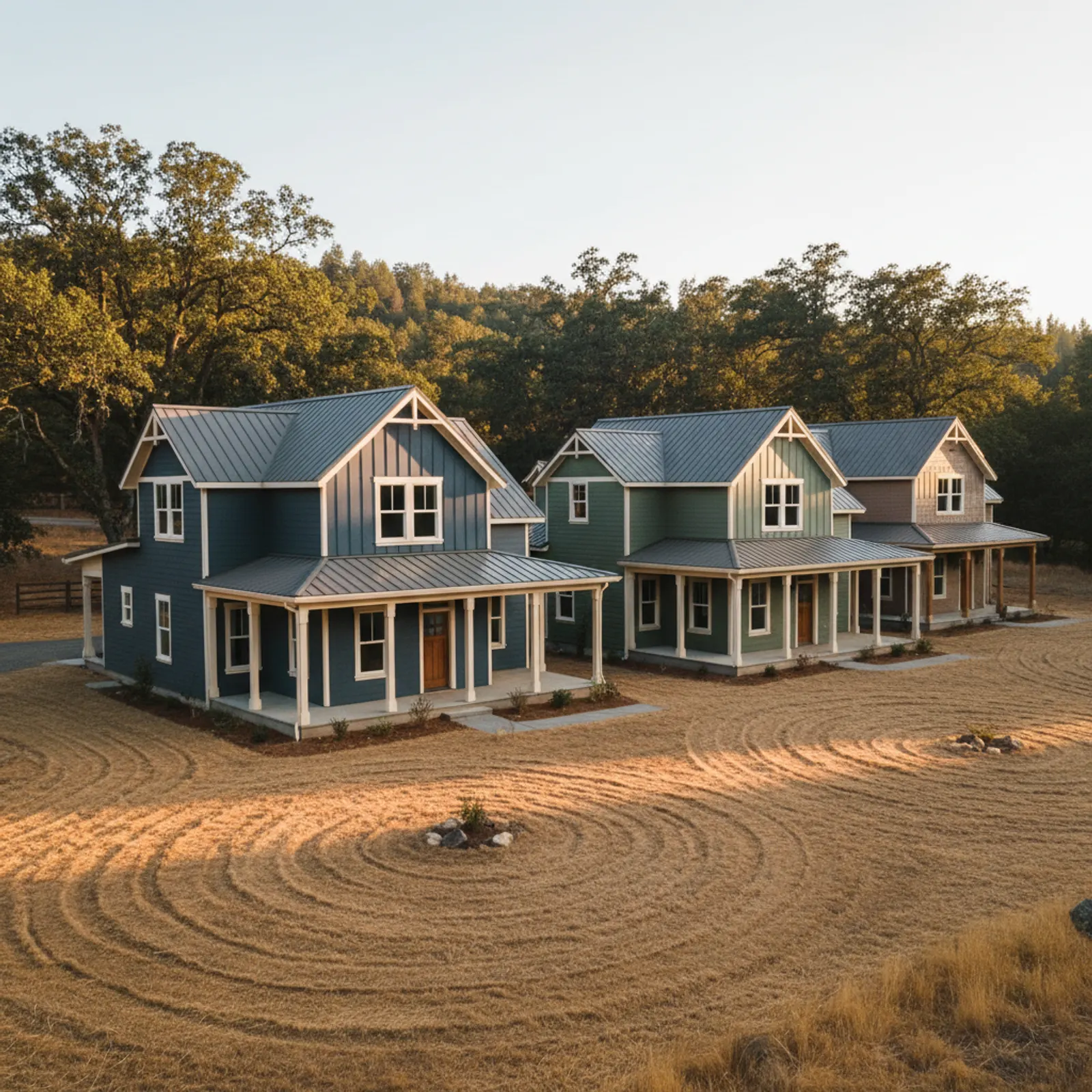
James Hardie Siding in Colfax
James Hardie suits Colfax because it brings Class A non-combustibility for the high forested fire together with HZ10 heat stability for the elevated summers and freeze-tolerant detailing for the moderate winter — installed to hardened, warranty-grade standards, with period-faithful profiles for the rail-town core.
Hardie hardened for the foothill
Colfax forested parcels often back directly to ladder-fuel chaparral, so the install discipline runs tighter than standard Hardie spec — 12" minimum ground-to-cladding clearance, all-stainless penetration fasteners, and the trim returns boxed off the deck rather than tucked behind it. The carrier file gets a full materials and clearance schedule for the underwriter to review.
Heritage profiles and ColorPlus
Period-faithful Hardie profiles serve the rail-town core; HZ10 and baked ColorPlus suit the elevated summers and cut the repaint cycle on remote, hard-to-access homes.
Remote-ridge logistics are part of the scope
On Colfax's off-grid and access-constrained ridge parcels, delivery, staging, and the documentation insurers want are real parts of a Hardie project — not afterthoughts. We plan them honestly up front given how far suppression and services are.
Where the wall meets the rest of the ignition zone
On a Colfax parcel, James Hardie cladding is only one layer of the home's fire story, and we spec it as part of the whole assembly rather than a standalone product. The fiber-cement field stops flame spread, but embers find the gaps: the soffit-to-wall junction, the rake and fascia terminations, and the band where siding meets a wood deck or rock skirt. So on ridge and forest-backed lots near the rail-town core, we tie the Hardie field into ember-resistant soffit detailing, close the gaps behind trim returns with non-combustible backing, and flash transitions so a blowing ember has nowhere to lodge. Many older Colfax homes carry a patchwork of past additions, which means uneven substrate planes and odd transition heights that have to be reframed flat before cladding goes on. We document those transition points in the carrier file alongside the field material, because in this wildland-urban interface the weakest detail, not the strongest panel, sets the real exposure rating for the structure.
Elevation freeze-thaw and the older Colfax substrate
Colfax sits higher than the populated Placer valley floor, so its winters bring real freeze-thaw cycling and periodic snow load against the wall, even though ambient moisture here is generally low. That combination drives how we detail James Hardie on the town's older small-lot homes and rail-era cottages. Water that gets behind cladding and then freezes will pry trim and fasteners loose over a few seasons, so we run a drained, back-ventilated rainscreen behind the fiber-cement rather than face-sealing it, and we hold the bottom course well above grade so snow piling against the wall cannot wick up into the joint. Older Colfax framing is frequently out of plumb and balloon-framed, with original board sheathing that has dried and cupped, so we sheath over and shim to a true plane before any Hardie goes up; otherwise the rigid panels telegraph every wave. Penetrations get stainless fasteners and freeze-tolerant sealant rated to keep its flexibility through the foothill cold snaps, which protects the cut edges that matter most at this elevation.
Why this matters in Colfax
- Specified for Sierra Foothills conditions
- Class A non-combustible fiber cement as the recommended system
- Correctly detailed weather-resistive barrier and flashing
- Installed by a crew with 20 years combined experience
Recommended systems for Colfax
- Class A non-combustible fiber cement
- aggressive fire-hardening detailing
- freeze-aware flashing
- durable factory finishes
James Hardie Siding for Colfax homes
The full james hardie siding approach — materials, weather-resistive detailing, and the manufacturer standards we install to — is covered on the main service page, then specified for Colfax's conditions on this one.
Our Colfax process
- Step 1
Consultation
We listen to your goals and assess your home on site — exposure, substrate, and architecture.
- Step 2
Design & Proposal
A clear written proposal with the right system specified for your climate and a transparent scope.
- Step 3
Expert Installation
Trained crews install to manufacturer best practices with careful weather-management detailing.
- Step 4
Walkthrough & Support
A final walkthrough, full cleanup, and a clear written record of the scope completed — work we stand behind.
FAQ
James Hardie Siding in Colfax — FAQ
Yes — Class A non-combustible for the high forested fire, HZ10 for the elevated summers and freeze-tolerant for the moderate winter, with period-faithful profiles for the rail-town core.
Yes — to Hardie's gap, fastening, and clearance best practices coordinated with hardened detailing, documented for insurability.
Non-combustible hardening can support insurability in forested foothill terrain; we document materials and assemblies, though insurers set their own criteria.
Heritage tones for the rail-town core and forested charcoals/cedar accents for ridge homes — all in ColorPlus, holding up to foothill UV.
Keep Exploring
More for Colfax homeowners
More in Colfax
Other exterior services in Colfax
Nearby Service Areas
James Hardie Siding near Colfax
Helpful Exterior Guides