James Hardie Siding in Boulder Creek
Boulder Creek is the end of the road — the deepest, most remote stretch of the San Lorenzo Valley, well up Highway 9 past Felton, with off-grid and limited-utility properties common and a catastrophic CZU history. Out here the James Hardie decision is governed less by climate than by isolation: the home, and even the project itself, has to be planned for being far from everything.
Maximum self-reliance, by necessity
Suppression resources are furthest away here, so a Boulder Creek home must assume it defends itself for an extended window. That justifies the most thorough hardening we do — Class A board with fully hardened eaves, vents, decks, and ground transitions — over a drying-capable plane for the heavy canopy damp, because trapped moisture is the failure mode if hardening is done without it.
The project has its own logistics problem
Re-cladding a remote Boulder Creek home isn't just a spec question — material delivery up a narrow forest corridor, staging on a constrained parcel, and limited services all shape how the work is sequenced. We plan that honestly up front rather than discover it on site, because access defines feasibility here as much as the assembly does.
Hardening a wall that lives under a wet canopy
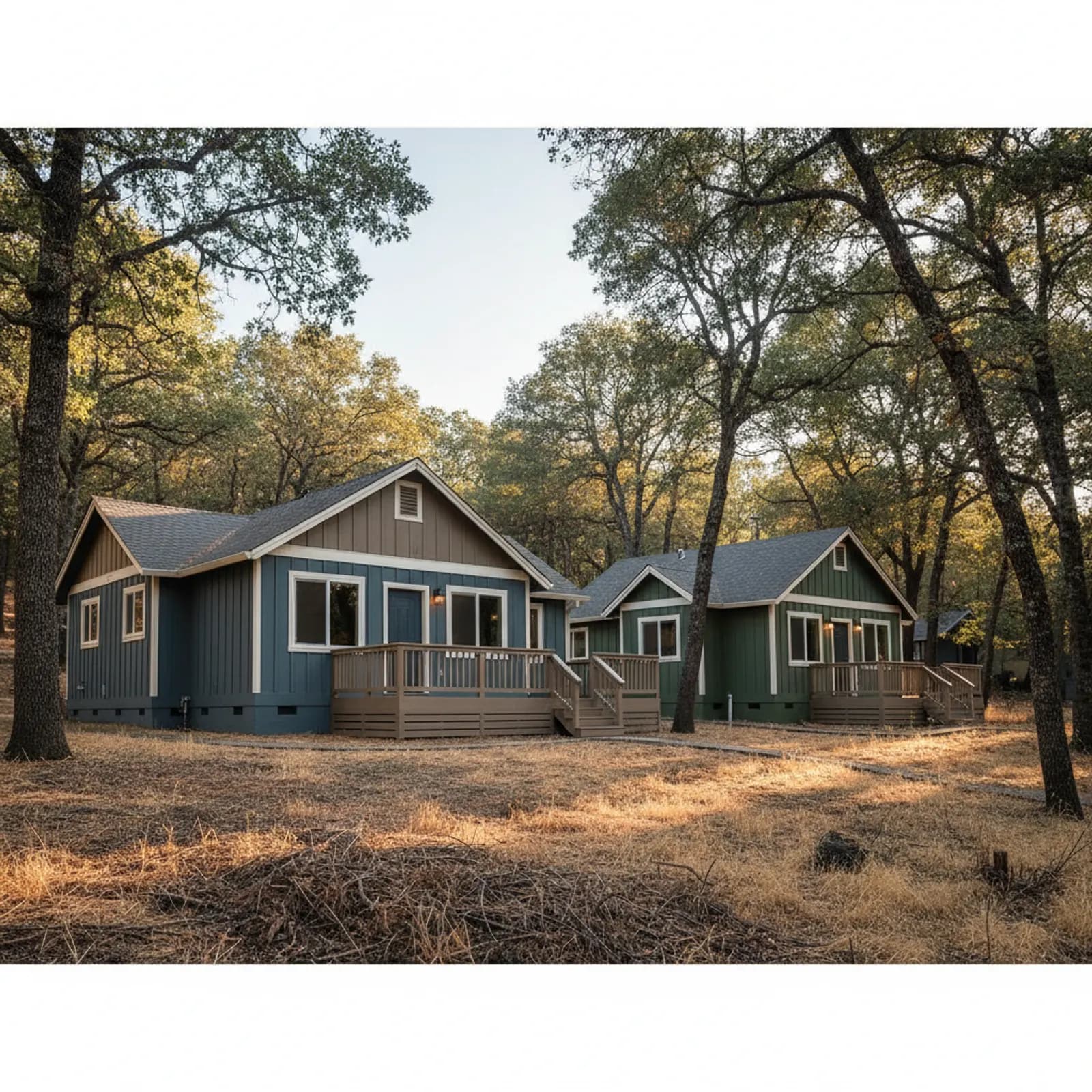
What makes James Hardie tricky in Boulder Creek is the contradiction the site forces on it. The fire risk here is extreme, which argues for sealing the home up tight against embers. But this is also the dampest pocket of the San Lorenzo Valley, where a dense redwood canopy keeps walls in shade and holds humidity long after the rest of the county has dried out. Fiber cement handles that climate well only if water has a way back out. So on these forested parcels we do not hang the boards flat against the sheathing. We build a drainage gap behind the cladding so any moisture that gets past the joints can drain and the back face can dry, then back-prime cut ends and keep the bottom course up off grade where bark litter and ground moisture sit. Done that way, the same hardened, noncombustible wall that defends against ember attack will not quietly rot from the inside under a perpetually shaded, drip-prone canopy. Skip the drying detail and the moisture, not the fire, becomes the thing that fails first.
Rebuilding to a tougher standard than the cabin it replaced
The CZU Lightning Complex reshaped what siding means in Boulder Creek. Many homes still going up along Highway 9 and the roads branching off it are replacements for structures that burned, and the owners have no interest in cladding that performs the way the old place did. That is where James Hardie earns its place: a noncombustible exterior is one of the most consequential upgrades available when you rebuild from the studs out. The advantage of a rebuild is that the whole wall is open, so the hardened siding can be paired with details a retrofit struggles to reach. We coordinate the Hardie plane with ignition-resistant eaves and soffits, ember-rated venting, and a clean noncombustible band at the base of the wall where leaf litter and bark debris pile up under the redwoods. For a parcel this far up the valley, the goal is not to recreate the rustic cabin look that came before but to build an envelope that can hold its own while suppression crews are still working their way toward the end of the road.
Why this matters in Boulder Creek
- Specified for Santa Cruz Mountains conditions
- Class A non-combustible fiber cement as the recommended system
- Correctly detailed weather-resistive barrier and flashing
- Installed by a crew with 20 years combined experience
Recommended systems for Boulder Creek
- Class A non-combustible fiber cement
- aggressive fire-hardening detailing
- robust flashing
James Hardie Siding for Boulder Creek homes
The full james hardie siding approach — materials, weather-resistive detailing, and the manufacturer standards we install to — is covered on the main service page, then specified for Boulder Creek's conditions on this one.
Our Boulder Creek process
- Step 1
Consultation
We listen to your goals and assess your home on site — exposure, substrate, and architecture.
- Step 2
Design & Proposal
A clear written proposal with the right system specified for your climate and a transparent scope.
- Step 3
Expert Installation
Trained crews install to manufacturer best practices with careful weather-management detailing.
- Step 4
Walkthrough & Support
A final walkthrough, full cleanup, and a clear written record of the scope completed — work we stand behind.
FAQ
James Hardie Siding in Boulder Creek — FAQ
Mostly degree and isolation — Boulder Creek is deeper up the valley, more remote, more often off-grid, and further from suppression. The hardening is even more thorough and the project logistics (delivery, staging, access) become a real part of the plan.
In this terrain, yes — with help potentially far off, the structure carries more of its own defense for longer. We still pair every hardened detail with a drying-capable plane so the canopy damp doesn't rot what the hardening protects.
Yes, but it's planned differently — material staging, the narrow corridor, and limited on-site services are worked out before we start. Access feasibility is part of the honest scope for a remote Boulder Creek home, not an afterthought.
Keep Exploring
More for Boulder Creek homeowners
More in Boulder Creek
Other exterior services in Boulder Creek
Back to
Santa Cruz County & Boulder Creek
Helpful Exterior Guides